
109. The Nine Circles

In 1787, the French astronomer and historian Jean-Sylvain Bailly published his Traité de l'astronomie indienne et orientale, an extensive investigation into the astronomical knowledge of ancient India and its possible origins. On pages 204–206, Bailly describes an Indian representation of the cosmos, accompanied by a table of planetary distances expressed in joojuns, or yojanas, an ancient Indian unit of length. The figures are remarkable, not least because the table extends beyond the seven traditional planets to include two further circles, named Natchatter and Akash - nine in all.
At first glance, however, something seems rather wrong with these distances. The yojana is a unit usually considered to be exactly nine miles, but ancient units do sometimes come in different versions. Even allowing for this uncertainty, the distances, and indeed their proportions, seem implausible. The celestial bodies are arranged in order of increasing distance from the Earth, with the Sun placed between Venus and Mars, as though it were farther away than Mercury and Venus, but closer than Mars, Jupiter and Saturn. Could the ancient Indian astronomers who produced such sophisticated calculations of planetary motion really have believed that this was the physical arrangement of the solar system?
The numbers themselves are equally puzzling. They are surprisingly precise, with Venus, for example, assigned a distance of 2 664 636 yojanas. Why such an exact figure? And what are we to make of the two additional elements, which do not correspond to any particular planet, the Natchatter and Akash? The larger of these, Akash, is assigned an incredible 18 712 080 864 000 000 yojanas. What could such a number possibly represent, and why would anyone have calculated it?
The number nine is itself intriguing. Indian astronomy and astrology are commonly associated with the navagraha, or nine celestial influences, although only seven of these correspond to the classical planets recognised elsewhere in the ancient world: the Sun, Moon, Mercury, Venus, Mars, Jupiter and Saturn. The remaining two, Rāhu and Ketu, are not planets at all, but the ascending and descending nodes of the Moon's orbit, the points where it crosses the ecliptic and where eclipses become possible. Bailly's nine circles, however, represent a different arrangement. The seven familiar planets are followed not by Rāhu and Ketu, but by Natchatter, the circle of the fixed stars associated with the lunar mansions, and Akash, the outermost circle of cosmic space. We thus encounter two distinct systems of seven plus two. Whether the recurrence of nine reflects the particular significance of that number in Indian tradition, or simply the structure of the astronomical model, is an interesting question. In Bailly's diagram, at least, the two additional circles appear to serve a mathematical and cosmological purpose, extending the system beyond the planetary revolutions to the fixed stars and the greater cycles of time.
The puzzle is all the more striking because, throughout much of his book, Bailly examines the methods by which Indian astronomers determined the positions and movements of the celestial bodies, including their variations in speed and the inequalities of their orbits. He finds a tradition of remarkable mathematical sophistication, employing methods which, in certain respects, resemble those used by European astronomers of his own day. How, then, are we to reconcile this apparent precision with a system of planetary distances that seems so far removed from physical reality?
Nor are these figures simply an isolated curiosity in Bailly's account. Some of the same numbers and concepts appear in the Sūrya Siddhānta, one of the principal surviving works of classical Indian astronomy. In a nineteenth-century English translation, the planetary circumferences are interpreted as the basis for calculating actual distances from the Earth, with results that fall considerably short of modern astronomical measurements. Yet this raises another possibility. Might the apparent inadequacy of these distances arise not from a failure of astronomical knowledge, but from a misunderstanding of what the numbers were originally intended to represent? Could they belong to a different kind of mathematical system, one whose original purpose has become obscured through centuries of transmission, commentary and reinterpretation?
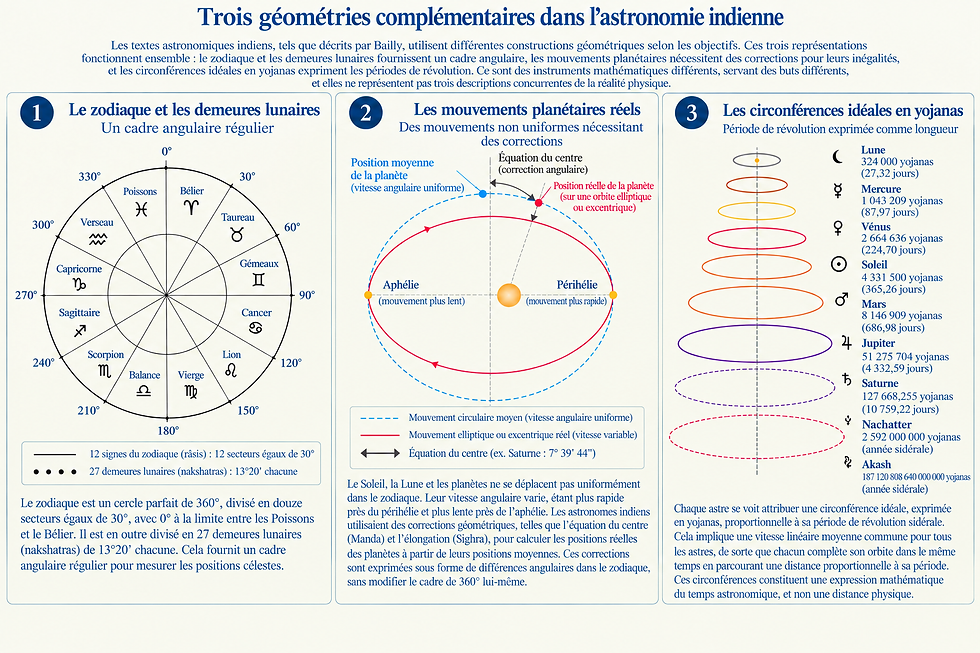
To explore this possibility, it is worth considering a fundamental distinction within astronomy, between the mathematical framework used to describe the heavens and the movements of the celestial bodies themselves. The zodiac, for example, is a perfect circle of 360°, divided into twelve equal sectors of 30°, or into 27 lunar mansions, known as nakṣatras (sometimes 28). Like the geographical grid of latitude and longitude, these divisions provide a regular and consistent system of reference, allowing positions and movements to be measured, compared and calculated. They are not themselves features of the natural world, but mathematical constructions through which the natural world becomes intelligible.
Within this framework, however, the movements of the Sun, Moon and planets are neither perfectly regular nor uniform. Their apparent speeds vary, their paths differ, and their positions must be calculated with reference to these variations. Indian astronomical tables preserve sophisticated methods for accounting for such irregularities, including variations in solar motion and the planetary equations of the centre. The astronomers responsible for these calculations clearly understood the distinction between an ideal geometrical framework and the complex movements of the celestial bodies observed within it.
Where, then, do the extraordinary values recorded by Bailly fit into this picture? Are they part of an ideal mathematical framework, derived from astronomical observations, or perhaps a combination of the two? What appears at first to be a collection of physically implausible planetary distances may instead belong to a system in which the dimensions of space are used to express the passage of time. If so, the question is no longer simply whether these astronomers correctly measured the distances to the planets, but what they intended their numbers to represent in the first place.

Nine Strange Circles
Bailly introduces the material in the context of four Indian astronomical tables he had examined. He remarks that Indian astronomers had employed methods comparable in their simplicity and precision to those developed in European astronomy, without having known Copernicus or Kepler. He mentions that four tables themselves say nothing about the distances of the planets from either the Sun or the Earth. However, some planetary distances appear instead in a separate diagram of an Indian cosmological system, which Bailly had recently received.
He explains that the diagram had been communicated to him by M. d'Hancarville, who had obtained it from M. Broughton-Rous, who had brought it from India, where he had lived for a considerable time. Broughton-Rous had received the table from a Brahmin of Kishen-Nugger named Knourkum-Brishut.
La terre est représentée au centre, enveloppée des orbites des sept planètes et de deux cercles qui portent les noms de Natchatter et d’Akash. Cela ne suffit pas pour conclure que les Indiens placent la terre au centre du monde : l’auteur de la figure le suppose ; mais il paraît que les Brames sont divisés à cet égard, comme nous l’avons été longtemps nous-mêmes.
The Earth is represented at the centre, surrounded by the orbits of the seven planets and by two circles bearing the names Natchatter and Akash. This is not sufficient to conclude that the Indians place the Earth at the centre of the universe: the author of the diagram assumes it; but it appears that the Brahmins are divided on this question, just as we ourselves were for a long time.
According to his description, the Earth occupies the centre of the diagram, surrounded by the orbits of the seven planets and two additional circles, which are named Natchatter and Akash. He is careful to state that the diagram should not be taken as proof that Indian astronomers universally placed the Earth at the centre of the universe. Bailly also finds proof of heliocentrism in his study of Indian astronomy.

He makes two observations about the order of the celestial bodies. First, the Moon is represented as the nearest planet to the Earth, a position he contrasts with certain other Indian accounts. Second, Mercury and Venus are placed below the Sun, recalling the arrangements associated with Pythagoras, the Chaldeans and Ptolemy. Bailly uses these comparisons to speculate about the antiquity and possible transmission of astronomical knowledge, although they do not establish a common historical origin.
Presumably, these circles are perfectly circular. There is no mention of ellipses, which would suggest the actual motion of the sun, moon, or planets.
At first sight, the distances appear to be separating the Earth from the planets, followed by the dimensions of two immense outer regions of the cosmos, because they are given as distances in a well known unit of measure, the joojun (or yojana). Yet, as Bailly explains, the values are instead all linked to time, as they are linked to the sidereal orbital periods of the planets.
If you divide the moon distance by the sun distance, as per these values, the result is 0.0748. This is the ratio between a sidereal month and year. 27.321661 / 365.25636 = 0.0748. Or, the other way round, if you divide, the sun distance by the moon distance, you get the number of sidereal months in a sidereal year: 13.3663. In fact each distance given in joojuns divided by the sun distance gives the ratio between the sidereal year and that planet's sidereal orbit.
Each orbital period is arrived at by dividing it by the sun distance, which is 4 331 500, and multipling by a civil year in days, 365¼ days. It's unclear why Bailly uses a civil year instead of a sidereal year, but the difference is small. He gives the following periods:
Celestial body | Period in days, as printed by Bailly |
Moon | 27.32 |
Mercury | 87.98 |
Venus | 224.66 |
Mars | 686.89 |
Jupiter | 4 323.32 |
Saturn | 10 739.30 |
These values are close to today's. If Bailly had used the sidereal year instead, the values would have been closer to modern values. Just to show how precise these values are, there is a second table below.
Comparison of Bailly's Indian planetary periods with modern astronomical values
Celestial body | Bailly (1787), days | Modern sidereal period, days | Difference, days |
Moon | 27.32 | 27.321662 | −0.001662 |
Mercury | 87.98 | 87.969256 | +0.010744 |
Venus | 224.66 | 224.7008 | −0.0408 |
Sun / Earth | 365.25 | 365.25636 | −0.00636 |
Mars | 686.89 | 686.97982 | −0.08982 |
Jupiter | 4 323.32 | 4 332.589 | −9.269 |
Saturn | 10 739.30 | 10 759.23 | −19.93 |
Historical figures: Bailly, Traité de l'astronomie indienne et orientale (1787), p. 205, with his stated solar year of 365¼ days. The differences are calculated as Bailly minus modern value.
Elsewhere in his Traité, he records an Indian sidereal year of 365 days, 6 hours, 12 minutes and 30 seconds, equivalent to 365.258680555 days, a value also found in Aryabhata's astronomical system. Another Indian astronomical tradition, represented by the Sūrya Siddhānta, gives a sidereal year of 365.25875 days.
Although both Indian values are slightly longer than the modern sidereal year of 365.25636 days, substituting either into Bailly's calculations brings five of his six planetary periods closer to their modern equivalents. Only Mercury becomes less accurate. The comparison demonstrates the considerable precision of the planetary periodicities preserved in Indian astronomy, while also illustrating the effect of the solar-year convention chosen by Bailly.
Celestial body | Bailly's original (days) | Aryabhata / Bailly's Indian year (days) | Sūrya Siddhānta year (days) | Modern sidereal period (days) |
Moon | 27.32 | 27.320649 | 27.320654 | 27.321662 |
Mercury | 87.98 | 87.982091 | 87.982108 | 87.969256 |
Venus | 224.66 | 224.665339 | 224.665382 | 224.700800 |
Mars | 686.89 | 686.906325 | 686.906455 | 686.979820 |
Jupiter | 4 323.32 | 4 323.422748 | 4 323.423570 | 4 332.589000 |
Saturn | 10 739.30 | 10 739.555231 | 10 739.557273 | 10 759.230000 |
The original periods are those printed by Bailly in his Traité de l'astronomie indienne et orientale (1787), p. 205. The recalculated periods are obtained by multiplying Bailly's published values by the respective Indian sidereal-year value divided by 365.25. The modern periods are comparison values, not the basis of the calculations.
Substituting either Indian sidereal-year value improves the agreement for the Moon, Venus, Mars, Jupiter and Saturn; only Mercury becomes slightly less accurate. The differences between the two Indian recalculations are themselves very small. The underlying planetary periods show a precision similar to today's, and their accuracy is not dependent upon modern astronomical corrections. The Indian tables reproduced accurate knowledge of planetary revolutions. These numbers reflect a developed astronomical tradition capable of determining and recording planetary periodicities with considerable precision. The distances given in Bailly's accompanying table are derived from these periods. Their unusual proportions are not evidence of an imaginary astronomy; they are the consequence of a mathematical procedure that translates observed celestial cycles into geometrical circumferences.
Bailly acknowledges that the figures for Jupiter and Saturn differ from values given elsewhere in his discussion (he is working with documents from various travellers to the east), but considers the discrepancies unimportant for his immediate purpose. What interests him is the principle by which the distances were calculated.
On page 206, he states:
« On voit bien que les tems des révolutions ont établi la proportion des distances ; c'est la méthode qu'on a suivie pour les déterminer. »
"It is clear that the times of the revolutions have established the ratio of the distances; this is the method that was followed to determine them."
Bailly notes that the original distance serving as the common module or unit is not specified. He suspects that it must have been either the distance of the Sun or that of the Moon, but admits that the information available to him does not allow him to decide.
As the moon is assigned a harmonic number, it may be that this is in fact the base unit from which the others are derived. Indeed, taking the moon distance of 324 000 joojuns, the sun distance then results from the ratio of moon to sun, and with modern values for the sidereal periods: 324 000 x 365.25636 / 27.321661 = 4 331 473.
So it is possible the lunar distance comes first in the system, as it is 25 × 34 × 53. The other planetary distances would then all follow from that, depending on the value of their orbital period. But the question remains: why are these values expressed as distances in a linear unit, the joojun, when they are clearly about time, and suppose a model in which planets have a common mean linear speed?
Beyond the ideal circle: the sophistication of Indian planetary astronomy
If the system of planetary distances Bailly is describing is linked to the orbits of the planets, why does it seem to imply perfect circles, or uniform speeds? Elsewhere in his Traité, Bailly examines the Indian methods for calculating the actual positions of the planets, and these reveal a considerably more sophisticated understanding of celestial motion than the simple table of distances might suggest. Just to rule out the idea definitely that the distances given in joojuns are somehow indicative of a primitive astronomy, it's worth briefly looking at the context, and how the motion of planets was in fact calculated.
In Chapter XXII, beginning on page 192, Bailly works through an Indian calculation of Jupiter's longitude for 29 July 1730, at noon in Chrisnabouram, corresponding to 28 July at 18 hours 58 minutes in Paris. The example had been communicated by Father du Champ, and Bailly reproduces the Indian procedure in sufficient detail to compare it with European methods. The calculation does not begin with the planet's observed position, but its mean longitude, derived from its regular periodic motion, and then applies corrections to obtain its true position. Bailly explains that the Indian astronomers employed two tables of planetary inequalities. The first concerned what they called Sicigram, corresponding to the Sanskrit śīghra, and was associated with the elongation of the planet and the relative positions of the planet and the Sun. The second concerned the equation of the centre, which the Indians called Manda. This accounted for the departure of the planet's true position from the position predicted by uniform mean motion. The equation of the centre describes a fundamental feature of planetary motion: a planet does not progress uniformly through equal angles in equal intervals of time when its motion is considered in relation to the Sun. In modern celestial mechanics, this behaviour is explained by the elliptical form of the orbit and Kepler's second law. The planet moves more rapidly near perihelion and more slowly near aphelion.
While the Indian geometrical methods were not identical to Kepler's theory of elliptical orbits, the corrections represent observed inequalities in planetary longitude, rather than treating mean circular motion as a complete description of the heavens. Bailly's worked example makes the distinction particularly clear. For Jupiter, he begins with a mean longitude of 4 signs, 14°12′13″. After applying the corrections, he obtains a true heliocentric longitude of 4 signs, 19°39′11″ and a geocentric longitude of 4 signs, 17°26′51″. The calculation distinguishes not only mean from true position, but also heliocentric from geocentric longitude.
The successive operations involve the equation of the centre, elongation, and the correction associated with the annual orbit. Bailly explicitly compares this procedure with European calculations and observes that the Indian method employs principles analogous to those of his own astronomy. The distinction between heliocentric and geocentric positions is especially interesting, as it demonstrates that the Indian tables could calculate the apparent position of a planet as seen from Earth while taking account of the geometrical relationship between the planet and the Sun. Such calculations are not reducible to the simple arrangement of concentric circles shown in the cosmological diagram transmitted to Bailly.
In his preliminary discussion and subsequent examination of the planetary equations, he considers whether the Indian astronomers had recognised that the corrections themselves change over long periods. On page 187, he observes that Indian astronomy indicates changes in the eccentricities of Saturn and Jupiter comparable to those calculated by Lagrange. He notes that the equations of the centre are subject to alternating increases and decreases, rather than remaining constant indefinitely.
For Saturn, Bailly gives an Indian equation of the centre of 7°39′44″ at an earlier epoch. He compares this with later values and with calculations based on European planetary theory.
The significance lies not simply in the numerical agreement or disagreement between the values. The Indian tables preserve a variable correction, rather than treating the planet's departure from mean motion as an immutable quantity.


Bailly considers the possibility that these values preserve information about earlier astronomical epochs. He compares the Indian calculations with the work of Lagrange and discusses the extent to which their agreement might reflect ancient observations, mathematical theory, or later corrections to inherited tables. His discussion of Saturn is particularly revealing. On pages 175–176, he compares the annual mean motion assigned to Saturn by the Indians, Ptolemy and other astronomers. The Indian value is 0 signs, 12°13′13″ per year; Ptolemy's is 0 signs, 12°13′24″; and the modern value Bailly adopts is 0 signs, 12°13′36″.
These are small differences in annual angular motion, yet Bailly treats them seriously because their cumulative effects become important over long periods.
He also recognises that Saturn's motion is especially difficult to model. He discusses apparent accelerations and retardations, the perturbations produced by interactions between planets, and contemporary attempts by Laplace ("M. de la Place") to explain the changing motions of Jupiter and Saturn.
That's not to say Indian astronomers possessed the same gravitational explanation as Laplace. But the evidence presented by Bailly shows that they were addressing the same observational problem: how to calculate planetary positions when the actual motion departs from a simple uniform cycle.

Not even the path of the earth around the sun is considered to be a perfect circle, in the ancient Indian system. The zodiac provides a regular geometrical framework against which to track the apparent motion of the sun as seen from earth: a circle of 360°, divided into twelve equal sectors of 30° each. However, the sun does not cross these sectors in equal intervals of time. The Indian solar months recorded by 18th century French astronomer Le Gentil vary systematically in length, from 31 days, 36 Indian hours and 38 minutes for Gemini to 29 days, 20 hours and 53 minutes for Sagittarius. If we interpret this apparent solar motion from a heliocentric perspective, with the Earth revolving around the Sun, the variations are consistent with the Earth's motion along an elliptical orbit, travelling more rapidly near perihelion and more slowly near aphelion. This doesn't prove that the Indian astronomers explicitly conceived of a Keplerian ellipse; the same apparent inequality could be represented through an eccentric circular construction. But, it demonstrates that their mathematical representation of the heavens accommodated precisely the kind of nonuniform motion that an elliptical orbit produces.
There is also a distinction to be made between the geometrical representation of the heavens and the physical arrangement of the celestial bodies. Bailly himself cautions against assuming that an Earth-centred Indian diagram necessarily implies a geocentric conception of the universe. On page 204 of his Traité, he observes that the author of the diagram places the Earth at the centre, but that Indian astronomers appear to have differed in their opinions on this question.
Cela ne suffit pas pour conclure que les Indiens placent la terre au centre du monde : l'auteur de la figure le suppose ; mais il paroît que les Brames sont divisés à cet égard, comme nous l'avons été long-temps nous-mêmes.
This is not sufficient to conclude that the Indians place the Earth at the center of the world: the author of the diagram assumes this to be the case; however, it appears that the Brahmins are divided on this matter, just as we ourselves were for a long time.
An Earth-centred representation may serve an essentially observational or methodological purpose, describing the heavens as they appear from our position on Earth, without necessarily making a claim about the ultimate centre of planetary motion. This distinction is particularly relevant to the planetary circumferences expressed in yojanas: the ideal circle may provide the mathematical framework for measuring astronomical cycles, while the observed inequalities of motion are accounted for separately.
Eighteenth century French astronomer Le Gentil also discusses the unequal months of the Indian system, which implies both precision, and possibly, the orbit of the earth being elliptical, not circular.

Two different representations of planetary motion
We can now return to Bailly's table of distances with a better understanding of its significance. The planetary circles expressed in joojuns are proportional to the periods of revolution. They belong to an idealised mathematical model in which all celestial bodies move at the same speed. The calculations of planetary longitude, by contrast, incorporate corrections for the actual inequalities of celestial motion. They distinguish mean and true positions, account for the relative geometry of the Sun, Earth and planets, and preserve information about changing orbital parameters. If the planetary circles Bailly discusses were intended as literal measurements of physical trajectories, their strict proportionality to orbital periods would imply a common mean linear speed for all the planets, something that does not correspond to their actual motions. But if the circumferences are understood as mathematical expressions of periodic time, their proportions become more intelligible.
Akash and Natchatter: The Eight and Ninth Circles
Bailly attempts to interpret the two outer circles: Natchatter, and Akash. He admits that he does not know what the circle named Natchatter signifies. By applying the same method used for the planets, he obtains a revolution of 5 984 years. He considers the possibility of it being intended to be 6 000 years, which could then in turn represent one quarter of a revolution of the fixed stars lasting 24 000 years, or alternatively half of a mahāyuga of 12 000 years in the reckoning he is discussing.
For Akash, Bailly provides a different kind of explanation. He identifies it with the ether and cites M. Dow's account of Brahmin religion, in which ether is described as a celestial, pure and impalpable element through which the planets move. According to the account Bailly reproduces, this element offers no resistance to planetary motion. The planets continue moving as a consequence of the original impulse imparted by Brahma and will not cease until they are annihilated. Bailly finds this strikingly reminiscent of Newtonian discussions of motion in a medium without resistance.
He also associates the immense Akash circumference with the great cosmological period of 4 320 000 000 years, described as a thousand mahāyugas of 4 320 000 years each. Akash is presented as a cosmic region, an ether through which celestial bodies move, yet its numerical value belongs to a mathematical system in which distances are derived from periods of revolution.
What, then, do these two outer circles actually measure? To answer that question, starting with Akash, we can turn from Bailly's eighteenth-century account to the Indian astronomical texts themselves. The Sūrya Siddhānta preserves an explicit rule for calculating Akash, and that rule reveals that its immense circumference is generated from the revolutions of the Moon. It is here that the apparent measurement of cosmic space begins to reveal itself as a measurement of time. The system is about representing time through space.
The word ākāśa (आकाश) means sky, space or ether. In the Sūrya Siddhānta, the full expression is ākāśakakṣā (आकाशकक्षा), the orbit or circuit of space. Another expression, khakakṣā, similarly refers to the circuit of the sky. In Chapter XII of the Sūrya Siddhānta, this immense circumference is generated by a simple instruction: multiply the circumference of the Moon's orbit by the number of lunar revolutions in a kalpa, which is a cosmological period of 4 320 000 000 years. The lunar orbital circumference is 324 000 yojanas. The number of sidereal lunar revolutions in a kalpa is 57 753 336 000.
324 000 x 57 753 336 000 = 18 712 080 864 000 000
This is Bailly's Akash, expressed in joojuns, or yojanas. This circle is generated from a lunar orbital circumference and a count of revolutions.The Sūrya Siddhānta then reverses the operation. By dividing the Akash circumference by the number of revolutions made by each planet during the same period, it obtains the circumference assigned to that planet's orbit.
Each celestial body is assigned a different circumference, but all are constructed to traverse the same total distance during the kalpa. The smaller the orbit, the greater the number of revolutions; the larger the orbit, the fewer. The Akash is therefore a common computational quantity, a numerical invariant connecting all the planetary motions.
The text also gives it a cosmological interpretation. It is associated with the extent of the Sun's rays and with the brahmāṇḍa, the cosmic egg or enclosing sphere of the universe.
What are we to make of this? If the circumference of the cosmic egg is calculated from the number of lunar revolutions, is it really a measurement of the outermost boundary of space? Or is the cosmic boundary itself being defined through time? The cosmic egg becomes a mathematical representation of the totality of their periodic movements. Space and time are bound together.
The eighth circle in Bailly’s diagram, Natchatter, appears to take its name from the Sanskrit nakṣatra, a word referring to stars or asterisms, and more particularly to the lunar mansions through which the Moon makes its monthly passage against the background of the fixed stars. The association is deeply rooted in Indian astronomical tradition. The Taittirīya Saṃhitā (IV.4.10) enumerates 27 nakṣatras, while other texts sometimes recognise 28, including Abhijit. The lunar significance of these divisions is also preserved in the story of Soma, the Moon, who marries the daughters of Dakṣa, identified with the lunar mansions, but favours Rohiṇī above the others. In mathematical astronomy, the 27 mansions divide the celestial circle into equal sectors of 13°20′, providing a stellar reference against which the Moon's movement can be measured.
The Sūrya Siddhānta (XII.25) explicitly describes the creation of the 27-fold asterisms alongside the twelve zodiacal signs, while XII.30 places the revolution of the asterisms within the outer circle of the cosmic sphere. Natchatter may therefore be understood as the circle of the fixed stars, closely associated with the lunar mansions, rather than a further planetary orbit. Its position beyond Saturn in Bailly's diagram is consistent with this interpretation: it provides the stellar framework against which the revolutions of the seven traditional planets are measured.
The astronomical system preserved in the Sūrya Siddhānta raises an intriguing question about the relationship between measurement, geometry and time in ancient astronomy. Its planetary orbits are expressed as circumferences in yojanas, an Indian unit of length, yet the numerical values of these circumferences are determined by the periods of revolution of the celestial bodies. The system thus establishes a direct mathematical correspondence between lengths and astronomical periods.
Trying to Interpret these Circles
The Akash, corresponding to 18 712 080 864 000 000 yojanas, is linked to the astronomical constants of the Sūrya Siddhānta. The text assigns 57 753 336 sidereal revolutions of the Moon to a mahāyuga, a period of 4 320 000 years. A kalpa, one of the great cycles of Hindu cosmology, consists of 1 000 mahāyugas, or 4.32 billion years, and is traditionally understood as a day in the life of Brahmā. Multiplying the number of lunar revolutions in a kalpa by the Moon’s assigned orbital circumference of 324 000 yojanas gives precisely Bailly’s figure: 57 753 336 x 1 000 x 324 000 =18 712 080 864 000 000
The number 57 753 336 is a fundamental astronomical constant, also found in the Āryabhaṭīya of Āryabhaṭa. Interestingly, divided by 10 000, it is also the height of the Great Pyramid expressed in inches. The exact reconstruction of Akash suggests that at least some of these apparently immense spatial dimensions were calculated from periods of time. Rather than representing a physically measured distance to the outermost boundary of the universe, the circumference of Akash may express the total distance traversed at the Moon’s assigned orbital rate over an entire cosmological cycle. Time, in other words, has been translated into an ideal geometrical circumference.
There is, however, an important distinction between Bailly’s table and the surviving Sūrya Siddhānta. His circumference for Natchatter, the circle associated with the fixed stars, is 25 920 000 000 yojanas, whereas the Sūrya Siddhānta gives a different value, 259 890 012 yojanas, for the corresponding stellar circumference. The Akash figure, by contrast, agrees exactly. This suggests that Bailly’s figures should not necessarily be treated as a single, unchanged system reproduced from the surviving Sūrya Siddhānta. They may reflect different astronomical traditions, versions of the texts, or methods of calculation. Nevertheless, the exact agreement in the case of Akash provides particularly strong evidence that the immense circumferences in these Indian astronomical schemes could be generated from cycles of revolution rather than direct measurements of physical space.
The Moon is the basis of the system
This correspondence becomes particularly interesting when we examine the dimensions assigned to the Moon. The Sūrya Siddhānta gives the Moon a diameter of 480 yojanas and its orbit a circumference of 324 000 yojanas. These figures are precisely related through an apparent lunar diameter of 32 arcminutes. The Moon may therefore provide a key to understanding the mathematical foundations of the entire system.
What if these values belong to an astronomical metrology in which linear dimensions, angular measurements and periods of time were conceived as interconnected quantities? The lunar diameter may have provided an initial standard from which the lunar orbital circumference was established, and the Moon's sidereal period may subsequently have furnished the means of expressing the periods of the Sun and planets as corresponding lengths.
This interpretation also invites comparison with the 24 000-year precessional cycle reported by Le Gentil, in which a period of time is defined by an angular displacement of 54 arcseconds annually. Both systems employ the division of the circle to establish relationships between celestial motion and numerical measures.
In Chapter XII of the Sūrya Siddhānta, the circumferences of the planetary orbits are expressed in yojanas, presumably the same as the joojuns Bailly deals with. Among the values given are 324 000 yojanas for the Moon and 4 331 500 for the Sun. These correspond exactly to the figures recorded by Bailly, so it seems the underlying system is the same one. Rather than assigning each planet an independently measured orbital distance, the system assumes a common mean linear motion. The circumference of each orbit is then determined by multiplying this motion by the body's sidereal period. The Moon provides the reference: 324 000 / 27.32167416 = 11 858.717
Applying this common motion to the sidereal year gives:
11 858.717 x 365.25875648 = 4 331 500
In this way, the circumference assigned to the Sun is generated from the ratio between the solar and lunar sidereal periods. The ratio of the assigned circumferences is essentially the ratio of the periods of revolution.
Taking these distances as such, expressions of orbital periods, would help to resolve some of the problems in a nineteenth-century translation and commentary, by Ebenezer Burgess and William Dwight Whitney, who examine these quantities as the dimensions of physical planetary orbits. Following the geometrical procedures of the text, they derive planetary distances from the assigned circumferences. For the Sun, the resulting distance is approximately 862 Earth radii, far smaller than its actual distance of approximately 23 500 Earth radii. The commentators recognise this discrepancy. The problem, however, is not necessarily that the original astronomical observations were grossly inaccurate. It arises because the circumference assigned to the Sun was not independently established from its distance. It was calculated from its period of revolution through the assumed common linear motion. If a temporal ratio is expressed as a spatial ratio, it cannot automatically be expected to reproduce the actual physical distances of the bodies concerned. The Sūrya Siddhānta itself contains procedures for deriving distances from orbital circumferences, so the spatial interpretation cannot simply be attributed to the European translators. The surviving text employs the values geometrically as well as computationally. Nevertheless, this does not settle the question of how the numbers originated. It is possible that quantities originally established through astronomical periods subsequently acquired a more literal spatial interpretation. Equally, the computational and geometrical interpretations may have developed together. The text establishes their mathematical relationship, but not necessarily their historical order. This raises the possibility that more than one explanatory framework is preserved within the same astronomical tradition.
The relationship between the Moon's assigned diameter and orbital circumference is a good place to start to interpret the system. Chapter IV of the Sūrya Siddhānta gives the diameter of the Moon as 480 yojanas and that of the Sun as 6 500 yojanas. It then provides procedures for calculating their apparent angular diameters, including corrections based on their true and mean motions.


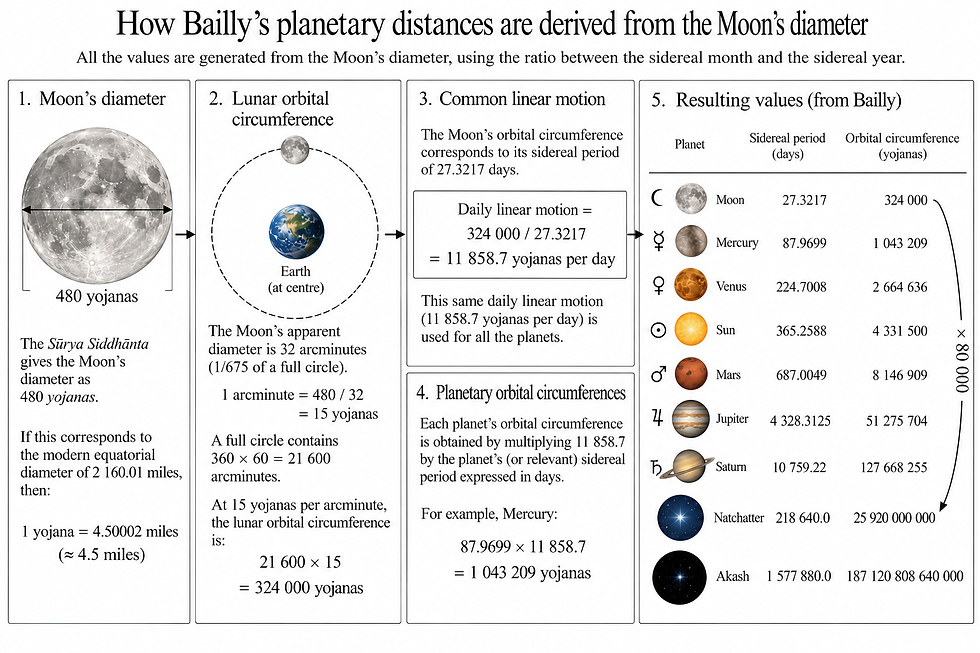
The Moon's assigned orbital circumference is 324 000 yojanas. As a complete circle contains 360 degrees, or 21 600 arcminutes, one arcminute on the lunar orbital circle corresponds to exactly 15 yojanas. If we think of the Moon's size in terms of an angle, as a portion of a full circle, then the Moon's diameter of 480 yojanas therefore corresponds to 480 / 15 = 32 arcminutes. The apparent lunar diameter, as seen from here on earth, is exactly 32 arcminutes, or 0.53333 degrees. As the Moon is sometimes closer and sometimes farther from earth, its apparent size changes a little. The apparent diameter varies between approximately 29.4 and 33.5 arcminutes, as its distance from Earth changes. In modern values, its mean apparent diameter is in fact approximately 31.1 arcminutes. The use of 32 arcminutes as the Moon’s apparent diameter does not imply that Indian astronomers were unaware that its apparent size varies as its distance from the Earth changes. It's more likely to be a convenient standard within an ideal geometrical model, in which the Moon’s diameter, expressed in yojanas, is translated into angular measure according to a simple rule of thumb, allowing its dimensions to be related to the circumference of its orbit.
The three quantities, 480 yojanas, 32 arcminutes and 324 000 yojanas, form an exact mathematical relationship. If we begin with the Moon's diameter and its apparent angular size, we can then obtain precisely the orbital distance preserved in the diagram Bailly recieved.
From lunar measurement to planetary periods
If the lunar circumference was established from the Moon's diameter and apparent angular size, the next stage would be to connect that circumference with the Moon's sidereal period.
The period given in the nineteenth-century commentary is 27.32167416 days. Dividing the circumference of 324 000 yojanas by this period establishes a common daily linear motion of approximately 11 858.717 yojanas.
That rate can then be applied to the sidereal periods of the Sun and planets.
The result is a system in which each astronomical period acquires an equivalent circumference. The Moon's motion supplies the conversion between time and length.
The Sūrya Siddhānta explicitly relates the orbital circumferences to planetary revolution counts and uses them to calculate angular motions. Its procedures also employ the lunar orbital circumference as a reference for expressing apparent diameters in arcminutes.
The Moon's diameter may have provided the original metrological foundation for this structure. The Moon's apparent angular size would determine its assigned orbital circumference, and its sidereal period would then establish the scale by which other astronomical periods were expressed as lengths. This would explain why the planetary circumferences are so closely coordinated with their periods of revolution, without requiring them to represent independently measured physical distances.
The possibility of a lunar standard becomes particularly interesting when we consider the traditional numerical values associated with the physical dimensions of the Sun and Moon.
A lunar diameter of 2 160 miles corresponds to 480 yojanas of 4.5 miles each, or 240 yojanas of 9 miles each. These conversions depend on the particular yojana standard adopted; they are not established by the Sūrya Siddhānta itself. The value 2 160 is also connected to the number 216, which appeared in the geometrical reconstruction of the lunar orbit. The solar diameter is geenrally given as 865 000 miles, but if we reduce it by a thousand miles, we get a nice harmonic number, 864 000, which may well have been the original assigned value. Thsi is exactly 400 times bigger than the moon. This relationship is interesting because the Sun and Moon have similar apparent angular diameters, while the Sun is approximately 400 times larger and approximately 400 times farther away.
The Sūrya Siddhānta, however, assigns the Sun a diameter of 6 500 yojanas, not 864 000 miles. Its own solar and lunar diameters form a different numerical relationship, designed to work with its assigned orbital circumferences. This is odd, because it is not the 480 yojanas assigned to the moon multiplied by 4. It is possibly linked to a time value instead, and perhaps that could be the 480 yojanas of the moon multiplied by 400, but then divided by a synodic lunar month: 480 x 400 / 29.53059 = 6501.7326.
If we take the difference between a tropical year of 365.242199 days and twelve synodic lunar months of 29.53059 days of 10.875119 days, we can arrive at a solar circumference of 29.53059 x 1 000 000 / 10.875119 = 2 715 426.84 miles, which, divided by pi gives a diameter of 684 347.2 miles, which is close to the circumference calculated from the solar diameter.
It is also worth noting, in passing, that the traditional 24 000-year cycle fits naturally into the same family of numbers. The 4 320 000 years of a mahāyuga contain exactly 180 such cycles, while 24 000 itself belongs to the familiar harmonic pattern of multiples and divisions involving 12, 24, 36, 72, 324 and 432 that recur in astronomical and cosmological reckoning. This does not establish that the 24,000-year cycle was used to construct any of Bailly’s nine circles, but it raises the possibility that these periods belong to a broader numerical framework in which astronomical time was organised through related proportions.
There is another numerical relationship worth considering. The Akash, expressed as a pure number, is remarkably close to the number of inches in a statute mile multiplied by the mean synodic month and 10¹⁰:
18 712 080 864 000 000 / (63 360 x 29.53059 x 10¹⁰) = 1.000080117
The discrepancy is approximately 0.008%, or 80 parts per million.
This is not an exact identity, but it introduces a second lunar relationship into the investigation. Akash is constructed from sidereal lunar revolutions, yet its numerical value also closely approximates a simple expression involving the synodic month and the statute mile.
What, then, are we to make of these nine circles? They begin to make sense when we consider the diagram not as an attempt to represent the physical distances of the planets from the Earth, but as a mathematical model in which their periods of revolution are translated into spatial dimensions. The Moon’s diameter and sidereal month provide the foundations of a common system of measurement, while the other planetary distances can be understood in relation to their periods of revolution against the fixed stars. Seen alongside other Indian astronomical texts, and the immense cycles of time expressed through yugas and kalpas, even the apparently fantastic dimensions of Akash acquire a mathematical logic. The traditional 24 000-year cycle, discussed by Le Gentil and Bailly, with its harmonic relationship to the 4 320 000 years of a mahāyuga, may also belong to this wider numerical conception of cosmic time.
But why express time through these great circles at all? There is something quite impressive about the merging of space and time in this diagram. The Earth occupies the centre, not necessarily as a declaration about the physical structure of the universe, but as the position of the observer, from whose perspective the movements of the seven traditional planets, the Moon, Mercury, Venus, Sun, Mars, Jupiter and Saturn, are measured against the background of the fixed stars. Their differing periods are brought into a single geometrical system, expressed not simply as numbers of days but as proportions of the sidereal year. In this sense, the ordinary day almost disappears as a unit of reckoning. The Sun, so fundamental to our familiar measurement of time, assumes a less privileged position, while the Moon comes to the fore. Its diameter establishes the initial scale, its sidereal revolution provides the common measure of movement, and its relationship to the sidereal year connects the lunar and solar systems of reckoning. That relationship is especially important in the construction of the Sun’s circle and, on a vastly greater scale, that of Akash, whose circumference encompasses the lunar revolutions of an entire kalpa.
Perhaps the most interesting possibility is that the diagram was intended as a computational and conceptual instrument rather than a picture of the heavens. The yojana, which is a unit of distance, becomes a means of expressing astronomical time, while the circle provides the geometrical form through which different movements can be compared. The irregular and apparently unrelated revolutions of the planets are rationalised into a common framework governed by the Moon, with the fixed stars providing the reference against which those revolutions are defined. The resulting system extends from the Moon’s familiar passage through the lunar mansions to the almost inconceivable duration of a kalpa, all contained within the ordered geometry of the cosmic egg. We cannot yet know precisely how such a diagram was used, or whether it served calculation, instruction, cosmological speculation, or some combination of these purposes. But what initially appeared to be a collection of implausible distances begins to suggest something considerably more coherent: an attempt to bring the movements of the heavens, and perhaps the great cycles of cosmic time themselves, within a single intelligible system of measure.
The Yojana: From the Atom to the Cosmic Egg
At the heart of these calculations lies the yojana, an ancient Indian unit of length. Ancient metrology allows for quantities of vastly different magnitudes to be expressed within a common framework. The old English system is linked to the Indian in a couple of ways, but the most interesting here is the yojana and mile. The Brahmāṇḍa Purāṇa describes a progression from the smallest conceivable particle to the great distances of the cosmos. In verses 117–118, the paramāṇu, or atom, is described as something that can be conceived by the mind but cannot be seen by the eyes, and which cannot be further divided. The text then establishes a sequence of measures, each eight times greater than the preceding one. Eight paramāṇus make a trasareṇu, likened to a particle of lotus pollen; eight trasareṇus make a rathareṇu; and successive multiples lead through the tip of a hair, the egg of a louse, the louse itself, and finally the grain of barley. Eight barleycorns make an aṅgula, or finger-breadth. From there the system proceeds through spans, cubits and larger measures until, in verse 126, we are told that 8 000 dhanus make one yojana. The text then announces its intention to describe the distances of the worlds using this unit, beginning with the Sun and Moon. Measurement, in this conception, is a means of organising the world into a continuous and intelligible system, extending from the atom to the cosmic egg.
In 1930-31, at Mohenjo-daro, Ernest Mackay discovered a broken piece of shell bearing 8 divisions of 6.7056 mm each, which is equivalent to 0.264 inches. Two and a half of these units of 0.264 make an Aṅgula of 0.66 inches. This unit is called a shusi in the Sumerian tradition, as found on the statue of Gudea. 96 Angulas make an ordinary Dhanusha, and this is exactly a thousandth part of an English mile. According to the Brahmanda Purana, a yojana of 8000 Dhanusha (of 108 Angulas each) is 9 miles and 1000 Dhanushas of 96 Angulas each are 1 mile. The unit exactly equal to a mile in the Indian system is called a Sakrakosa.
124-125. Learned men call ninety-six Aṅgulas, a Dhanus. It is remembered that the unit Dhanus is taken up in calculating Atoms, etc.anus consists of two Daṇḍas with the fingers placed like a tubular vessel (?) Persons who know calculation call three hundred Dhanus units a Nalva.
126. Two thousand Dhanus units make one Gavyūti. Eight thousand Dhanus units make one Yojana.
127-128. The measurement of the distance of a Yojana is based on this unit of Dhanus. It should be known that a thousand, of these Dhanus make the distance called Śakrakośa. It has been reckoned so by the experts in the knowledge of calculation. Listen to the distances of worlds in the creation of Brahmā with this Yojana as the unit.
129. The sun is more than a hundred thousand Yojanas from the surface of the Earth. The moon is two hundred thousand Yojanas above the Sun. (1)
Obviously, this last verse is a bit odd. The moon is not twice as far from earth as the sun.
The yojana as given in the Sūrya Siddhānta, however, might be exactly half of what it is in the Brahmanda Purana, where the Moon's diameter is given as 480 yojanas. Since the equatorial diamater of the moon is almost exactly 2 160 miles, you would expect to find 240 yojanas there of the Brahmanda Purana type. It seems that the moon yojanas in the Sūrya Siddhānta are actually 4.5 miles long. It's not impossible however that somehwere along the line there was a mix-up between diamater and radius. The yojana in Āryabhaṭa is different again, with 1 050 yojanas for the Earth, 315 for the Moon, and 216 000 for the lunar orbital circumference, which suggests that the yojana was not a single, universally fixed unit, and that different astronomical traditions may have employed different standards or conventions.
The yojana in the Ṛgveda seems to be 9 miles. Another intriguing example of the relationship between distance and time occurs in a commentary on the Ṛgveda attributed to the fourteenth-century scholar Sāyaṇa. Commenting on a hymn to the Sun, he gives a traditional statement concerning the Sun's rays travelling 2 202 yojanas in half a nimiṣa, or nimiṣārdha. The researcher M. R. Goyal has examined this figure using a nine-mile yojana and a division of the sidereal day into 810 000 nimiṣārdhas. With these assumptions, the resulting velocity is approximately 299 820 kilometres per second, remarkably close to the modern speed of light. The calculation might not prove beyond doubt that the speed of light was known in ancient India, but it is very intriguing.
This example also recalls the treatment of the Sun's rays and the outermost reaches of the cosmos in Indian astronomical literature. The Sūrya Siddhānta describes an immense celestial sphere, while the circumference assigned to Akash can be reconstructed from the number of lunar revolutions in a kalpa. Such passages invite us to consider whether the yojana was being employed in more than one sense: sometimes as a measure of physical length, sometimes as a conventional unit within an ideal geometrical construction, and sometimes as a means of translating periodic motion into spatial magnitude. The distinction matters, because the apparent precision of a number does not necessarily tell us what kind of quantity its authors intended to describe.
We return, then, to the nine circles preserved by Bailly. The yojana is a measure of length, yet within this astronomical system length is used to express time. The Moon's diameter establishes a geometrical scale; its sidereal revolution provides a common measure of movement; and the orbital periods of the other planets are translated into circumferences through their relationships with the lunar month and sidereal year. The immense circle of Akash extends the same principle into cosmological time, encompassing the lunar revolutions of an entire kalpa. What initially appeared to be an incoherent collection of distances can therefore be approached as a system of proportional relationships, linking the familiar movements of the seven traditional planets with the great cycles of the cosmos. Whether these measures originated in observation, mathematical convention, inherited metrological standards, or some combination of all three remains to be established. But the underlying idea is a powerful one: that the dimensions of space and the passage of time might be expressed through a single system of number, measure and geometry.
The Greek and Indian systems of measure both use the same fundamental division of the circle into 360 degrees, 60 minutes per degree and 60 seconds per minute (as do many other systems). 100 Greek feet correspond to an arcsecond of the Earth; in the Indian lunar reconstruction, one yojana corresponds to four arcseconds of the Moon's ideal orbit. The nautical mile as it was (before it was tragically rounded from 6 075 to 6 076.11549 feet) is also relevant, as equivalent to 6000 Greek feet of 12.16 inches. Historically, the nautical mile was conceived as one minute of latitude, although the length of a minute of latitude varies because the Earth is not a perfect sphere.
Lunar measures expressed in yojanas, miles, Greek feet and nautical miles
Using 1 Bailly yojana = 4.5 statute miles, 1 Greek foot = 12.16 inches, and 1 historical nautical mile = 6 000 Greek feet = 6 080 English feet.
Unit or division | Bailly yojanas (4.5 miles) | Statute miles | Greek feet (12.16 inches) | Nautical miles (6 080 ft) | Angular equivalent |
1 arcsecond | 0.25 | 1.125 | 586.1842 | 0.0976974 | 1″ |
1 statute mile | 2/9 | 1 | 521.0526 | 0.0868421 | 8/9″ |
1 Bailly yojana | 1 | 4.5 | 2 344.7368 | 0.3907895 | 4″ |
1 arcminute | 15 | 67.5 | 35 171.0526 | 5.8618421 | 1′ |
1 degree | 900 | 4 050 | 2 110 263.1579 | 351.7105263 | 1° |
1 lunar mansion (nakṣatra) | 12 000 | 54 000 | 28 136 842.1053 | 4 689.4736842 | 13°20′ |
Moon's diameter | 480 | 2 160 | 1 125 473.6842 | 187.5789474 | 32′ apparent diameter |
Full distance in Bailly's lunar circle | 324 000 | 1 458 000 | 760 657 894.7368 | 126 647.3684211 | 360° |
The angular equivalents refer to the ideal lunar circle of 324 000 yojanas, except for the Moon's diameter, where 32′ represents its assumed apparent angular diameter. The final row describes the full linear distance assigned to Bailly's lunar circle, rather than an independently measured physical orbital circumference. Greek-foot and nautical-mile conversions are rounded to four or seven decimal places as displayed.
Conclusion
The nine circles recorded by Bailly present us with a series of puzzles. Why are the seven traditional planets arranged in this particular order, with the Sun between Venus and Mars? Why are their distances expressed in such precise numbers when they bear so little resemblance to the actual distances of the planets? What are we to make of the two outer circles, Natchatter and Akash, whose dimensions are so immense? And why does the Moon, rather than the Sun or Earth, appear to provide the key to the whole construction?
The answer may lie in recognising that these figures are not primarily measurements of physical distance, just as Bailly suggested. The Sūrya Siddhānta preserves an astronomical system in which orbital circumferences, sidereal periods and apparent angular dimensions are mathematically interconnected. The Moon occupies a particularly important position within this structure. Its assigned diameter of 480 yojanas and an apparent angular diameter of 32 arcminutes generate a distance of 324 000 yojanas. This provides the scale, while the Moon's sidereal month establishes a common rate of motion through which the orbital periods of the other celestial bodies can be expressed as corresponding lengths. What first appeared to be an incoherent collection of planetary distances begins to reveal a remarkably consistent mathematical pattern.
The arrangement of the seven planets is no longer so puzzling either. Their sequence follows their sidereal orbital periods, provided we recognise that the Sun's apparent annual revolution corresponds to the Earth's revolution around the Sun. In effect, the Earth and Sun exchange places when we move from the observer's geocentric perspective to the orbital periods underlying the calculations. Mercury and Venus have periods shorter than the Earth's year, while Mars, Jupiter and Saturn have progressively longer ones. The Earth remains at the centre of the diagram because it is from Earth that the heavens are observed, but the ordering of the circles makes sense in terms of the periods of revolution rather than the physical arrangement of the solar system.
The two outer circles extend this principle beyond the seven planets. Natchatter, associated with the Sanskrit nakṣatra and the lunar mansions, represents the fixed stars against which the planetary revolutions are measured. Bailly's circumference of 25 920 000 000 yojanas is exactly 80 000 times the lunar circumference, equivalent to approximately 5 984 sidereal years. Its relationship to the traditional 24 000-year cycle remains an intriguing possibility, particularly since four such periods approach 24 000 years. Akash takes us further still, into the immense cycles of Indian cosmology. Its circumference of 18 712 080 864 000 000 yojanas corresponds exactly to the Moon's assigned orbital distance multiplied by the number of lunar revolutions in a kalpa, a period of 4.32 billion years.
The yojana itself is central to this interpretation. If the Moon's diameter of 480 yojanas is understood as approximately 2 160 miles, one yojana corresponds to 4.5 miles. Within the proposed geometrical model, it also corresponds to four arcseconds of the lunar orbital circle, while each of the 27 lunar mansions occupies exactly 12 000 yojanas. The familiar divisions of the circle, the dimensions of the Moon and the periods of celestial revolution are thus brought into a single system of measurement. The yojana is not simply a unit of distance applied to the heavens: it becomes the means by which the passage of time can be represented as length.
The hypothesis that emerges is that this astronomical system may have originated with a lunar standard of measure, from which a wider geometrical and temporal framework was developed. The seven planetary circles express their orbital periods through a common lunar scale, the circle of the fixed stars establishes the background against which those periods are understood, and Akash extends the same method to the great cycles of cosmic time. The Sun remains essential through the relationship between the sidereal month and year, but it is the Moon, with its diameter, its monthly revolution and its passage through the lunar mansions, that provides the foundation of the construction.
Perhaps the most interesting question is what such a system tells us about the way its creators understood the heavens. The circle unites space and time: a revolution is both a movement through space and a measure of duration, and the two can be expressed through the same numerical relationships. Rather than measuring each planetary orbit independently, the system brings them all into proportion with one another, using the Moon as a common standard. It is a way of rationalising the movements of the heavens, from the seven familiar planets to the fixed stars and the immense duration of a kalpa, within a single mathematical framework.
There are differences between Bailly's figures and those preserved in the surviving Sūrya Siddhānta. Natchatter, for example, is assigned a different circumference, and Jupiter's value also varies. These differences suggest that we may be looking at related but not identical versions of an astronomical tradition, whose original principles have not necessarily survived intact. Yet the underlying numerical relationships are too systematic to dismiss as arbitrary. Bailly's nine circles may preserve elements of an older metrological and astronomical framework, one in which the dimensions of the Moon, the revolutions of the planets and the great cycles of time were all understood through a common language of circles, angles, numbers and proportions.


Notes
From the Brahmanda Purana https://www.wisdomlib.org/hinduism/book/the-brahmanda-purana/d/doc362935.html



Comments