
102. Plato's Creation Story and Giza

Updated: Apr 16
In the cosmology presented in Plato’s Timaeus, time is not treated as a primary feature of the universe. Instead, time emerges from the ordered motions of the heavens. Plato writes that the visible celestial bodies were created in order to “distinguish and preserve the numbers of time” (Timaeus 38c). The Sun, Moon, and five planets were placed in their respective orbits so that their motions could provide measurable cycles through which time might be understood. The passage is striking because it reverses the modern intuition that time exists independently of celestial motion. In Plato’s account, the heavens themselves generate time. The cycles of the wandering stars become the numerical framework through which temporal order appears.
Plato describes eight celestial revolutions in total: the seven wandering stars: the Moon, Sun, Mercury, Venus, Mars, Jupiter, and Saturn, together with the outer sphere of the fixed stars. These eight motions together define what he calls the “complete number of time”, or in other translations the "perfect number of time":
“It is possible to perceive that the complete number of Time fulfils the Complete Year when all the eight circuits, with their relative speeds, finish together and come to a head, when measured by the revolution of the Same and Similarly-moving.”
Timaeus 39d (trans. W. R. M. Lamb)
This complete year is not a simple solar year, but a theoretical moment when the various celestial cycles realign. The cosmos becomes numerically complete when the revolutions of all the wandering stars and the sphere of the fixed stars once again coincide. The planets move at different speeds and follow different cycles, but when those motions are gathered into a single numerical expression they reveal an underlying order. The perfect year is therefore a numerical harmony emerging from the whole system of celestial motions. Plato’s “perfect number of time” can be interpreted as the numerical synthesis of the celestial cycles. The cycles can be gathered into a single number that contains them all.
The important point is that the cosmos becomes “complete” when all its motions are considered together as a numerical system. One way to represent a moment when all cycles complete whole revolutions is to construct a number that contains all of the periods as factors. The simplest such construction, if not the shortest, is the product of the cycles themselves. The resulting quantity is a number that contains each period within it, so that dividing by any individual period produces the remaining composite structure. In that sense the product provides a single numerical container for the entire system of cycles.

In Timaeus, Plato also introduces the idea that the universe was created by a creator, called the Demiurge. This being does not create out of nothing, but rather organises pre-existing chaotic matter into an ordered cosmos, according to a pre-existing order. The Demiurge, driven by goodness and intelligence, aims to create the most perfect and harmonious universe possible. The Demiurge uses reason and mathematics to impose order on the chaotic material, and the cosmos is constructed as a living being, endowed with soul and intelligence. Plato emphasises that the cosmos is governed by order, proportion, and harmony, reflecting the rational structure imposed by the Demiurge. The cosmic order is deeply rooted in mathematical ratios and geometric forms. In Timaeus, Plato describes how the Demiurge crafts the universe using ideal mathematical forms like the Platonic solids, which are associated with the elements (earth, air, fire, water, and ether).
Before the Sun Was Lit: The Numerical Structure of Time
What Plato says
Plato describes two great circles: the outer one, called the circle of the Same, which represents the fixed stars, and the inner one, the circle of the Different, which is broken into seven parts, corresponding to the movements of the seven known planets. This duality is a key aspect of much ancient thought. This is reminiscent also of the duality represented by two constellations: Ophiuchus and Scorpio, or the Archangel Michael and the dragon, the dragon then being associated often with the number seven, through the number of its heads. The circle of the Different is the slow movement of the stars across the heavens. As seen from Earth, the stars appear to revolve in circles around the celestial poles, completing a full circuit each day. Over longer timescales this circular framework itself slowly shifts, so that the positions of the celestial poles and equinoxes move gradually through the background of the stars. This slow cycle, known as the precession of the equinoxes, unfolds over approximately 26 000 years.
Together, in Plato's system, these eight circles represent the celestial order. The outermost circle is the motion of the fixed stars (the Same). The inner circles represent the motions of the seven planets, including the Sun and Moon (the Different). In total, there are eight circles of motion: the fixed stars plus the seven planets known to antiquity. Plato's description in the Timaeus gives a detailed account of the ordered cosmos, with the stars and planets following their harmonious revolutions, reflecting the structure and motion of the universe.
Plato describes how time, heaven, and the seven planets came into being:
“Time, then, and the heaven came into being at the same instant in order that, having been created together, if ever there was to be a dissolution of them, they might be dissolved together. It was framed after the pattern of the eternal nature, that it might resemble this as far as was possible; for the pattern exists from eternity, and the created heaven has been, and is, and will be, in all time. Such was the mind and thought of God in the creation of time. The sun and moon and five other stars, which are called the planets, were created by him in order to distinguish and preserve the numbers of time; and when he had made-their several bodies, he placed them in the orbits in which the circle of the other was revolving-in seven orbits seven stars. First, there was the moon in the orbit nearest the earth, and next the sun, in the second orbit above the earth; then came the morning star and the star sacred to Hermes, moving in orbits which have an equal swiftness with the sun, but in an opposite direction; and this is the reason why the sun and Hermes and Lucifer overtake and are overtaken by each other.”(1)
The seven “stars” are the moon, the sun, Venus (referred to as the “morning star”, and Lucifer), Mercury (referred to as “the star sacred to Hermes”, or simply as Hermes, the Greek counterpart of Hermes being Mercury in the Roman tradition), and, not mentioned by name, Mars, Jupiter and Saturn. These “stars” are described in terms of their motion, within time.
“Now, when all the stars which were necessary to the creation of time had attained a motion suitable to them,-and had become living creatures having bodies fastened by vital chains, and learnt their appointed task, moving in the motion of the diverse, which is diagonal, and passes through and is governed by the motion of the same, they revolved, some in a larger and some in a lesser orbit-those which had the lesser orbit revolving faster, and those which had the larger more slowly. Now by reason of the motion of the same, those which revolved fastest appeared to be overtaken by those which moved slower although they really overtook them; for the motion of the same made them all turn in a spiral, and, because some went one way and some another, that which receded most slowly from the sphere of the same, which was the swiftest, appeared to follow it most nearly.”(2)
The structure implied by this cosmology is deeply numerical. The seven wandering planets (as the Moon and sun were also called in this system), together with the eighth motion of the fixed stars form a framework in which the number seven plays a central organising role. In many cosmological traditions, the number eight represents the completion of this structure: seven moving bodies set within the encompassing sphere of the heavens.
Translations differ. What Benjamin Jowett translates as “perfect number of time” can also be interpreted as “complete" year or number of time, for example, as below, in the translation by W.R.M. Lamb:
"Nevertheless, it is still quite possible to perceive that the complete number of Time fulfils the Complete Year when all the eight circuits, with their relative speeds, finish together and come to a head, when measured by the revolution of the Same and Similarly-moving."(3)
At the end of this "perfect number of Time", all the planets realign, bringing renewal. In this translation, the emphasis is on completion, as opposed to perfection, in the earlier quotation.
Plato doesn’t say what this number is. Perhaps the perfect or complete number of time is 28. Indeed, four cycles of seven might provide a natural framework for organising the interaction of the seven celestial bodies. Also, the divisors of twenty-eight, which are 1, 2, 4, 7, and 14, form a sequence that appears repeatedly in ancient cosmological symbolism. The number fourteen in particular carries mythological significance in Egypt, where the dismembered body of Osiris was said to have been divided into fourteen parts before being reassembled through ritual and cosmic renewal. And the number 28 is also a perfect number, in a mathematical sense, because it is the sum of its divisors (1, 2, 4, 7, 14). The number 28 is a key number, being linked to the Pascal computation (19 x 532) and to the Mayan calendar. 28 x 13 weeks make the 364-day year.
Perhaps the most convincing argument in favour of 28 being this perfect or complete number of time is however the following: when the cycles of the seven classical planets and precession are multiplied by each other, the product is remarkably close to 100 000 000 / 28. So in fact we would be dealing with 28 as a divisor.
If we express the planetary periods in Earth sidereal years, which would make sense in that at this stage of Plato’s creation story, the sun has not yet been lit, and so day and night do no yet exist, and if we multiply together the cycles to make a super-cycle, the result is interesting. In such a system the Earth has a value of one, and the Sun, rather than being another moving object, becomes the reference against which the others are compared. The Sun therefore enters the calculations not as a period to be multiplied, but through ratios that link lunar and solar time. In this way the solar element is present throughout, even when it is not written explicitly. If we multiply the sidereal orbital periods of Mercury (0.24084 years), Venus (0.61519 years), Earth (1 year), Mars (1.88082 years), Jupiter (11.86178 years), Saturn (29.44781 years), and the Moon (0.07480 years), all expressed in earth sidereal years, and then include the Metonic cycle (19 years) and axial precession, 25 772 years being the modern estimate, the result is 3 565 260.8. This is using all modern estimates. This is close to 10 000 000 / 28 = 3 571 428.57. This is a remarkable natural coincidence, which, while not exact, creates an intriguing possibility.
The Metonic cycle is included on the basis that it reconciles the movements of the sun and moon, because 19 years are almost exactly 235 synodic months and 254 sidereal months. If the Metonic cycle is not included in this supercycle, the movements of the sun and moon can’t adequately be reconciled. So whilePlato doesn’t mention this cycle, it would make sense to include it. On the subject of the values used here, the most accurate figures have been used, because it’s impossible to know what values were used by astronomers in Plato’s day. If we adjust one or more of these values by a very small amount, it is possible to obtain almost exactly 100 000 000 / 28. For example, we can add 44 years to the precessional value (equivalent to 0.17% of the precessional cycle) and obtain almost exactly 10^8 / 28. In the work that follows, I pursue the implications of 100 000 000/28 being the complete, or perfect, number of time, and adjust the precessional cycle slightly to fit. This does not mean that this value is what was used by ancient Greeks, or Egyptians before them. It simply means that by adjusting this value slightly we can arrive at a super cycle which in theory would reconcile the motion of the sun, as seen from earth, the moon, Mercury, Venus, Mars, Jupiter, Saturn, and axial precession, and which would be close to 100 000 000 / 28 sidereal years.
Such numerical structures reflect a broader principle often found in ancient cosmology: the belief that the universe is organised through harmonious ratios linking celestial motions, numerical systems, and symbolic narratives. The cosmos is not merely a collection of physical objects but a structured order in which number, motion, and meaning are intertwined. Within this framework, the “complete number of time” described by Plato can be understood as the mathematical harmony produced by the combined cycles of the heavens. A supercycle which is based on the number 28 would have many numerical and symbolic advantages, and would match a subdivision of a lunar month into 28 days.
At this stage of Plato’s cosmology, the distinction between day and night has not yet emerged. The Sun has not yet been described as a source of light governing daily alternation. What exists instead are large-scale celestial cycles, motions measured in years rather than days. Time is therefore defined first in terms of planetary revolutions, not solar days. The lighting of the Sun introduces the alternation of day and night, bringing the large planetary cycles into relation with the daily motion of the Earth. From that moment onward, celestial time can be measured not only in years but also in days. However, before that time, it makes sense to measure in sidereal years.
It is within this transition, from the great celestial cycles of the planets to the measured rhythms of solar time, that numerical cosmologies often take architectural form. Structures built according to harmonic numbers could serve as material reflections of the cosmic order described in texts such as the Timaeus. In such a system, geometry becomes a bridge between the motions of the heavens and the built environment of human society.
It is within this transition, from the great celestial cycles of the planets to the measured rhythms of solar time, that numerical cosmologies often take architectural form. Structures built according to harmonic numbers could serve as material reflections of the cosmic order described in texts such as the Timaeus. In such a system, geometry becomes a bridge between the motions of the heavens and the built environment of human society.
Body / Cycle | Sidereal period (days) | Sidereal period (Earth years) | Synodic period (days) |
Mercury | 87.969 | 0.24084 | 115.88 |
Venus | 224.701 | 0.61519 | 583.92 |
Mars | 686.980 | 1.88082 | 779.94 |
Jupiter | 4332.59 | 11.86178 | 398.88 |
Saturn | 10759.22 | 29.44781 | 378.09 |
Moon | 27.32166 | 0.07480 | 29.53059 |
Axial precession (traditional) | — | 25 772 years But using 25 816 years in this study* | — |
Table 1

Mapping to Giza
So to summarise so far: there are 8 celestial motions, a universe of numbers which these eight motions are created to "distinguish and preserve the numbers of time". So first comes these numbers of time and the demiurge, then comes time itself, and the 7 planets and precession which distinguish and preserve these key numbers. There is a period before the sun is lit, and day, night have not yet been created. and there is a perfect number which unites these cycles, by describing how all the eight revolutions, though they vay in speed, complete a cycle and "are accomplished together and attain their completion at the same time", in a way which allows "the created heaven" to "imitate the eternal nature, and be as like as possible to the perfect and intelligible animal.” We might pause here briefly to reflect on the strange nature of this animal which is both alive and numeric.
We need to remember that the sun has not yet been lit, and so there are no days and nights. So let's take the orbital periods of these planets, with respect to the stars, and assign to them a value in relation to the stars, and also the earth, ie the sidereal year. As described before, for Mercury, the sidereal period is 0.24084 sidereal years, for Venus, it is 0.61519 sidereal years, for Mars it's 1.88082, for Jupiter it's 11.86178 and for Saturn it's 29.44781 sidereal years. So that's five of the seven planets. The earth counts as 1 sidereal earth year, so 1. The moon's sidereal period is 27.321661 days, so 0.07480 sidereal years. Because we are measuring in earth sidereal years, the earth counts for 1, so it needs an adiditional number to reconcile its movement to the moon's, and then from there to the other planets. So the Metonic cycle can be brought in, of 19 years, equivalent to 254 sidereal months. If we multiply all these cycles together, so earth as 1, Moon as both 0.0748 and as 19 in relation to earth, and the other five planets, we get: 0.24084 × 0.61519 × 1.88082 × 11.86178 × 29.44781 × 0.0748 x 25 772 × 19 = 3 565 260.9. Let's adjust that so that the product of these cycles is 10 000 000 / 28 = 3 571 428.57 (using the precessional cycle to carry the adjustment, so changing it to 25 816 years). This number divided by 100 is very close to the length of the Giza rectangle which is formed by the outer corners of the Great Pyramid and the third pyramid. This length, running perfectly north-south, is given by Petrie as 35 713.2 inches. So if this length can be linked to the cosmology described by Plato, then according to this system, an inch represents a year. The year-inch.
This inch is the very same as the one commonly used in the UK and the US today, equivalent to 2.54 cm. The origins of the inch are unclear. It is used in the USA and the UK, and before the adoption of the metre, it was used in Ireland, in the British empire, and in Russia also.
The inch was present as a base unit in ancient Egypt and can be found expressed in multiples of 6, 7, 8, 9 and 10 in various ancient units. One example of this is the tomb of Hesy, a high Egyptian official of the third dynasty king Neterket (Sa-nekht), from about 2650 BC. Petrie's measurements of a set of units of measure in a mural in this tombshow this.
As Jon Bosak remarks:
(...) the vessels are shown in an exact side view, which makes outside measurements easy, and since all the tomb paintings were drawn life size (as confirmed by depictions of weights elsewhere in the mural, calculations of the weight of which based on size and density of the materials used correspond well to actual weight data), the outside dimensions can be gauged with fair accuracy. (...) The copper measures turn out to form two interleaved series of units, each series exhibiting a binary set of relationships. According to Petrie, one series is based on a unit of 28.8 in³ and the other on a unit of 21.6 in³. (7)
The mural shows a system which was designed in inches, using multiples of 6 and 8, very like the modern imperial system, which is based on 6s and 8s (as well as 2, 10, 12 etc). The inch is present as a background unit in the systems of other ancient cultures. For example the Persian royal cubit is 25.92 inches (6 x 6 x 8 x 9 / 100), the Beit-Lehm cubit is 24.3 inches (3 x 9 x 9 / 10), workers cubits from Mayence, Riga, Sardinia, Amman, Pernau, Florence are all around the 21.6 inch mark (6 x 6 x 6 / 10) , the Persian zer is 18.9 inches (3 x 7 x 9 / 10), the Dera Kesra cubit is 25.2 inches (4 x 7 x 9 / 10), the Attic stadium is 7290 inches (9 x 9 x 9 x 10). The Roman and Egyptian digits are generally thought of as 0.729 inches, the shusi of Babylon and the angula of India are 0.66 inches. Many ancient units depend on a system of multiples of 2, 3, 4, 6, 7, 8, 9, and 10 inches.
Furthermore, Richard Heath and Robin Heath, through their studies of prehistoric monuments such as the megalithic remains at Carnac in France, discovered that these ancient sites were constructed using measurements that aligned with the natural rhythms of the cosmos. They have proposed that the dimensions encoded in these ancient sites were intentionally designed to reflect time cycles, in particular those related to the Sun, Moon, and Earth. The key to this is the inch, which represents a day. In their work in Brittany, they found that Richard Heath and Robin Heath found that:
The day-inch measure was always the original measure based upon regularized day counting. (8)
The relations shown here suggest that units of measure such as the inch, the mile, and the metre may be understood not as arbitrary conventions, but as part of a broader system linking terrestrial dimensions to astronomical cycles. When the Earth’s equatorial and polar circumferences are expressed in inches, they can be brought into close relation with combinations of the tropical year, the synodic month, and longer cycles such as the yuga. In this framework, the inch functions as a mediating unit, allowing durations to be translated into lengths, and vice versa. The mile and the metre then appear not as independent systems, but as scaled expressions within the same structure, recoverable through simple numerical transformations. This interpretation gains further resonance when considered alongside traditional values for the sizes of the Sun and Moon: the Moon’s diameter of 2 160 miles (radius 1 080), and the Sun’s diameter of 864 000 miles. These numbers, long noted for their harmonic relationships, suggest a continuity between celestial magnitudes and terrestrial measures. Whether or not these correspondences are intentional, they point toward a way of thinking in which astronomy, geometry, and metrology are not separate domains, but aspects of a single, integrated system.

However, here we are dealing with inches which represent sidereal years, and this may well be because, at this stage of the creation story, the sun has not yet been lit and there are no days and nights yet.
If 28, or 10⁸ / 28, is the perfect number Plato refers to, then we can think of the basis of the whole site, running north south, as 10⁸ / 28 inches, with one inch representing one sidereal year. This axis reflects the polar axis, around which our earth spins. This distance represents a scaled expression of the “complete number of time” described in the Timaeus. The length of the Giza rectangle thus becomes the architectural starting point of the entire system, translating a composite planetary cycle into measurable space. If this interpretation is correct, the layout of the Giza plateau begins not with the pyramids themselves but with a numerical framework derived from the motions of the heavens, a framework that echoes Plato’s description of a cosmos whose temporal structure emerges from the revolutions of the planets.

The North–South Axis

The line that runs almost perfectly north–south, aligning with the axis of the Earth and therefore with the rotation of the heavens around the celestial pole. It's also the axis around which the fixed stars seem to turn, as seen from our planet. This is a key line, which is hugely symbolic. Night after night, the entire sky turns around a single point near the north celestial pole, as seen from earth. The stars themselves appear to circle this point. The pole therefore is a symbol of cosmic stability, the fixed centre around which the heavens revolve. Because of this motion, certain constellations close to the pole acquire particular significance. The group of stars now known as the Big Dipper, for example, has been recognised across many ancient cultures as a celestial marker of the northern sky. Similar importance was attached to other circumpolar constellations and stars that successively occupied the position of the pole star over the long cycle of precession. In many traditions the region of the pole became associated with permanence, immortality, or the axis connecting heaven and earth.

In Plato’s cosmology this axis plays a fundamental role. The outer sphere of the fixed stars, referred to as the “revolution of the Same", defines the primary motion of the heavens. All other celestial motions are measured against this great rotation. It is this motion that ultimately gives rise to the daily cycle once the Sun is introduced as a visible marker of time.
In the stage of creation described earlier in the Timaeus, the Sun has not yet been “lit” and the alternation of day and night has not yet appeared. Time exists only through the large celestial revolutions of the planets and the sphere of the fixed stars. Yet the axis about which the heavens rotate already exists in principle. When the Sun later becomes the source of light governing day and night, the rotation of the Earth around this axis transforms that cosmic motion into the daily rhythm experienced on Earth.

The human body itself has often been understood through a similar symbolism. Traditions that describe the flow of energy through the spinal column, such as the concept of kundalini rising through the chakras, mirror the same axial structure found in cosmological myths. In this sense the axis becomes not only a cosmic feature but a model of life itself, the central channel through which motion, energy, or consciousness flows.
Within the celestial sphere, this axial symbolism is sometimes expressed through pairs of constellations positioned along the path of the Milky Way. Two particularly striking examples are Orion and Ophiuchus, both located near the intersection of the ecliptic and the galactic plane. In later astronomical traditions these regions were sometimes described as the “gates” through which souls or celestial influences pass, the so-called “Golden Gate” near Orion and the “Silver Gate” near Ophiuchus. Positioned on opposite sides of the sky, these constellations form a symbolic pair, often interpreted as twin pillars of the heavens.

The constellation Orion, in particular, is associated with ideas of cosmic transition and renewal. Its prominent belt stars form one of the most recognisable patterns in the night sky, and their position near the celestial equator makes Orion a natural marker of the division between northern and southern skies. It is within this symbolic framework that the orientation of the Giza plateau acquires additional resonance. The pyramids themselves have frequently been associated with the stars of Orion’s Belt, most notably in Robert Bauval’s Orion correlation hypothesis. The idea that the pyramids relate symbolically to Orion reflects a broader cosmological theme: the alignment of earthly structures with the great patterns of the heavens. In the length of the Great Giza Rectangle, the cosmology of Plato, the symbolism of the cosmic or world tree, and many other sysmbols of the north celestial pole, are linked up with the constellation Orion, Robert Baval's theory, and the role Orion plays in the journey of souls beyond death.
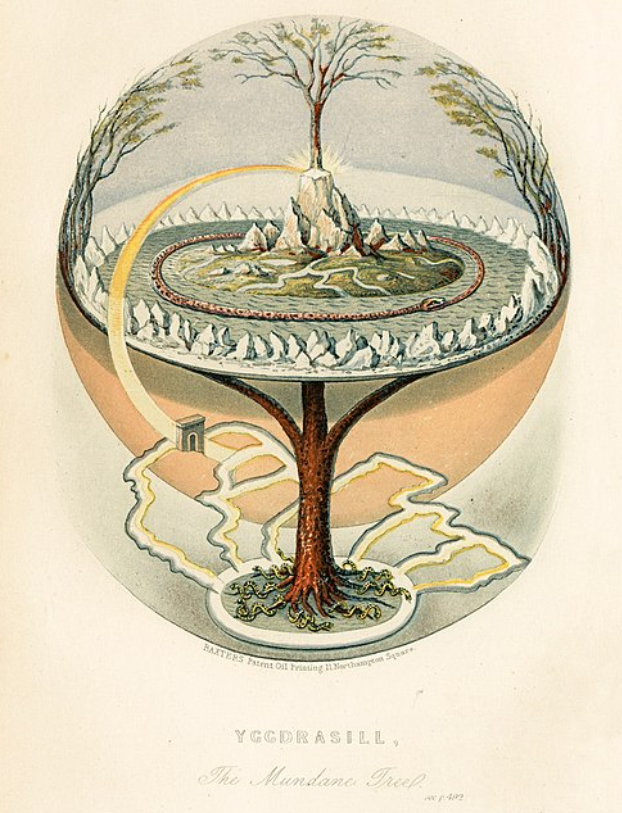
Seen in this context, the north–south axis of the Giza rectangle does more than align the site with the rotation of the Earth. It situates the monument complex within a larger symbolic geography of the sky, in which the axis of the world, the revolving stars, and the great constellations of the Milky Way participate in a shared cosmological order.
If Plato’s Timaeus describes a universe in which time emerges from the revolutions of the heavens, the architecture of Giza may be understood as situating itself within that same cosmic framework: an earthly structure aligned with the axis around which the celestial order unfolds.
If the Giza rectangle encodes the composite planetary cycle described above, the remaining dimensions of the plateau can be understood as successive transformations of this initial numerical framework.
The north–south axis at Giza may also be understood symbolically as a vertical ordering of the cosmos, a line along which multiplicity is gathered and aligned. The recurrence of the number seven along such an axis, whether in the seven visible planets, the seven chakras of later Indian tradition, or the seven colours of the spectrum, suggests a structuring of reality into differentiated but ordered levels, each distinct yet part of a continuous ascent. To this seven is often added an eighth: a principle beyond or behind the system, whether conceived as the fixed stars, the celestial pole, or a unifying light. In this sense, a 7+1 structure emerges, where the seven mark the articulated world of change, and the eighth denotes the axis itself, stable and orienting. While the classical Indian system speaks of seven chakras aligned along the central axis of the body, many traditions implicitly or explicitly add a further principle beyond them: a point above the crown, associated with unity or transcendence. In this sense, the structure becomes 7+1, not as eight equivalent levels, but as seven differentiated centres oriented toward an eighth that lies beyond articulation. The vertical axis is thus not merely a sequence, but a path: a movement from multiplicity toward unity. At Giza, the northward alignment toward the celestial pole reinforces this idea of a cosmic spine, a line of orientation linking Earth to the heavens. While such correspondences must remain speculative, they point toward a recurring intuition across cultures: that the cosmos is not only extended horizontally in cycles, but also ordered vertically, along an axis that unites the many into a single, directed whole.
A comparable structure may be found in the Egyptian concept of the Ogdoad, the primordial group of eight deities associated with the state before creation, particularly at Hermopolis. These eight, which are arranged as four male–female pairs, represent the fundamental conditions out of which the ordered cosmos emerges: darkness, hiddenness, infinity, and primordial waters. While not directly equivalent to a vertical sequence like the chakras or the planetary spheres, the Ogdoad nevertheless expresses a similar intuition: that the manifest world arises from an underlying set of principles organised around the number eight. In this light, the recurring pattern of 7 + 1, seven differentiated levels oriented toward an eighth principle beyond them, may be seen as a transformation of this deeper structure, where the eighth is no longer simply one element among others, but the unifying or originating source. At Giza, the strong axial orientation toward the north celestial pole invites the possibility that such an “eighth” principle is not merely symbolic, but spatially encoded, as the fixed point around which the visible heavens turn
The axis is thus not merely a direction in space, but a principle of organisation, an invisible line along which the cosmos is both divided and made one.
Switching on the Lights
What Plato Says

In the Timaeus, Plato makes a striking statement about the origin of time. Time, he explains, did not exist before the creation of the heavens. It began only when the Demiurge set the celestial bodies into motion:
“Time, then, and the heaven came into being at the same instant… The sun and moon and five other stars… were created in order to distinguish and preserve the numbers of time.”
Before the Sun was lit, there were no days, only the motions of the heavens measured in relation to the earth as 1 year, or to the Moon-Earth cycle, as 19 years. Suddenly the day is born, and timekeepers can use this unit. The cycles of the heavens, day and night, the lunar month, the solar year, and the periods of the wandering planets, provide the fundamental units from which the arithmetic of astronomy emerges. It is from these cycles that the relations explored in the preceding sections are constructed.
At this point the Platonic idea can be tested more directly. If the astronomical constants and cycles discussed earlier form a coherent numerical structure, one may ask whether that structure finds expression not only in celestial motion but also in architecture. The sun is described as giving light to “the whole of heaven”, which enables animals on earth to see all the heavenly activity, learn arithmetic, and “participate in number”. Several cosmic cycles are briefly described: the rotation of earth on its own axis (day and night), the orbit of the moon around the earth (month), and the earth around the sun (year), though it is described as the sun around the earth, just as it is seen from the viewpoint of earth. Rather than describe the other planetary orbits, Plato simply comments that most people don’t know much about them.
The seven planetary motions, together with the encompassing motion of the fixed stars, generate a numerical architecture of time that precedes the emergence of daily solar rhythms. Only after this celestial structure is established does the role of the Sun become fully defined.
That there might be some visible measure of their relative swiftness and slowness as they proceeded in their eight courses, God lighted a fire, which we now call the sun, in the second from the earth of these orbits, that it might give light to the whole of heaven, and that the animals, as many as nature intended, might participate in number, learning arithmetic from the revolution of the same and the like. Thus then, and for this reason the night and the day were created, being the period of the one most intelligent revolution. And the month is accomplished when the moon has completed her orbit and overtaken the sun, and the year when the sun has completed his own orbit. (4)
(Timaeus, Plato, 360 B.C.E, 39d, Translated by Benjamin Jowett, https://classics.mit.edu/Plato/timaeus.html)
The system of the seven planets: Saturn, Jupiter, Mars, the Sun, Venus, Mercury, and the Moon, occupies a singular place in the history of astronomy. It reflects a deliberate and enduring structuring of cosmic order. These seven were not simply the brightest or most distant bodies, nor do they follow an obvious physical hierarchy; rather, they form a symbolic and mathematical system that proved stable across cultures. Bailly writes:
This Astronomy possessed knowledge of the seven planets, since it assigned their names to the days of the week. This is perhaps the most singular proof of both the antiquity of Astronomy and the existence of this people, which preceded all others. These planets, which predestined the days of the week, were arranged according to an order that still exists among us. It is: first the fovea, then the moon, Mars, Mercury, Jupiter, Venus, and Faturus (*). The same is found among the ancient Egyptians, the Indians, and the Chinese (a). This order is not that of the distance, size, or brightness of the planets. It is an order that appears arbitrary, or at least one that is based on reasons that we do not know. It can be said that it is impossible that the hafard led these three nations, first to the same idea of giving the days of the week the names of the planets, then to giving these names according to a certain arrangement, unique among an infinity of others. (5)
As Bailly observed, the attribution of these seven to the days of the week, in a very particular order, is preserved from antiquity through to the present in languages across Europe and beyond, and constitutes one of the most striking testimonies to the antiquity The familiar order of the days of the week does not follow directly from the Chaldean order of the planets (Saturn, Jupiter, Mars, Sun, Venus, Mercury, Moon), which is itself arranged according to their apparent speeds. Rather, it arises from a second, more complex operation imposed upon this order: the assignment of each planet to successive hours. Each day consists of 24 planetary hours, cycling repeatedly through the sequence of seven planets. After three complete cycles (21 hours), three further hours are counted, so that the planet governing the first hour of the following day lies three places ahead in the original sequence. It is this constant “step of three” that generates the order of the weekdays: Saturn (Saturday), Sun (Sunday), Moon (Monday), Mars (Tuesday), Mercury (Wednesday), Jupiter (Thursday), and Venus (Friday). The sequence is therefore neither arbitrary nor purely observational, but the result of a constructed numerical system, combining the heptadic order of the planets with the division of the day into 24 hours. That this same structure appears across distant cultures underscores not only its antiquity, but the presence of a shared cosmological logic in which number, time, and the heavens are intimately bound together. The planets form the basis of the way we structure days, and are based in number.
This conceptual system in which seven “wandering stars” mediate between the fixed heavens and the Earth, structures both time and meaning. That this same sevenfold order appears in India, China, and the Mediterranean world strongly suggests not coincidence but the transmission and preservation of a very ancient framework. Importantly, other celestial bodies, even though perceived (as in the figures of Uranus or Neptune), were not incorporated into this system; the heptad was closed, complete, and sufficient. In Egypt, while the evidence is more implicit than explicit, the importance of the sevenfold celestial order can be discerned in texts such as the Book of the Dead and in decanal star systems, as well as in later Hellenistic Egyptian astrology (notably in the temple inscriptions at Dendera), where the seven planetary deities play a clear role. Thus, the seven-planet system is not merely observational but foundational: a cosmological grammar that shaped calendars, mythologies, and measures of time across the ancient world. In this sense, the week is not merely a cultural convention but a numerical unfolding of the planetary order, generated through a simple but profound algorithm.
The monuments at Giza provide a remarkable dataset for an investigation of this ancient system. Plato describes the creation of the Sun as the moment when time itself became measurable. Once the celestial clock began to run, the cycles of the heavens could be counted and compared. At Giza, the numbers associated with the pyramids appear to participate in that same arithmetic of time. Whether these relations were intentionally encoded or simply reflect deeper mathematical structures remains uncertain. Yet the possibility that architecture could embody the numerical order of the cosmos was entirely consistent with ancient philosophical thought. If the pyramids do indeed contain such relations, they would represent not merely monuments of stone but something more unusual: a geometric instrument through which the cycles of the heavens could be contemplated.

After the Sun Was Lit: The Algorithm of Days
In Plato’s account of creation in the Timaeus, time begins when the heavenly bodies are set in motion. Before this moment there is structure but no measurement. Once the Sun is lit and the Moon too is illuminated, time becomes countable in days, as opposed to years. Also, the first natural unit of celestial time the lunar month appears, as a cycle expressed in days. The synodic month, the cycle of lunar phases, therefore provides the first step of the algorithm. The mean synodic month is 29.53059 days. This number appears repeatedly in the geometry that unfolds at Giza.
The Numerical Framework of the Giza Pyramids
Now that day and night exist, at this stage of Plato's creation story, the inches can represent days, instead of years. When the principal dimensions of the three pyramids are expressed in inches, following Petrie’s measurements, a compact set of numbers emerges that can be treated as a numerical framework for the site.
Among the most important values are:
the base side and height of the Great Pyramid
the dimensions of the King’s Chamber
the base sides and heights of the Second and Third Pyramids
the distances between the pyramid centres
the dimensions of the Great Giza Rectangle
Taken together, these measurements form a surprisingly small dataset from which many of the relations explored in this study can be derived.
For example:
Great Pyramid height: 5776 inches
Great Pyramid base side: 9068.8 inches
King’s Chamber length: 412 inches
King’s Chamber width: 206 inches
These values generate a network of ratios that correspond closely to astronomical cycles when expressed in days, months, or years.
Once time is measured in days, the numerical structure begins to reveal itself. Ratios between the pyramid dimensions produce numbers that approximate:
the tropical year
the synodic month
the sidereal month
the Metonic cycle
the Saros cycle
When these cycles are combined, the relations explored earlier appear naturally: approximations of π, φ, √2, √3 and √5 emerge from the interaction of solar, lunar, and planetary periods. In this sense the Giza dataset behaves like a numerical seed. From a relatively small set of architectural measurements, a much larger network of astronomical and geometric relations can be generated.
If the numbers embedded within the pyramid dimensions do indeed correspond to astronomical cycles, the architecture may be understood not merely as symbolic but as algorithmic. The measurements form the input values.The ratios between them generate the astronomical cycles.Those cycles in turn produce the geometric constants that govern classical geometry. In this way, circular motion (π), triangular geometry (√3), and proportional harmony (φ) arise from the same underlying numerical framework. Such a system resembles a kind of cosmic calculation, in which the geometry of the monument encodes relationships between celestial cycles and mathematical form. Seen in this light, the pyramids could be interpreted as a physical expression of the Platonic idea that number governs the structure of the cosmos. The architecture does not simply represent the heavens symbolically; it performs the arithmetic of the heavens through its proportions.
The First Geometry: The Solar–Lunar Rectangle
To the north–south line, an east–west line is added, forming a right angle, and from this, the rectangle. This right angle is not incidental; it is the foundational gesture of the entire system. It establishes a relation between two orders of motion, two domains of meaning.
The north–south axis may be understood as the axis of the heavens. It reflects the apparent rotation of the celestial sphere around the north celestial pole, and with it the ordered movements of the seven classical planets and the slow cycle of precession. This is the vertical dimension: the axis of becoming, of ascent and return, of life and death. It is along this line that one may situate the symbolic pathways of the soul, the great polar alignments, and the dual figures of Orion and Ophiuchus, figures which, in different traditions, mark thresholds between worlds. This axis points beyond the human, toward the eternal and the unchanging.
The east–west axis, by contrast, belongs to the Earth. It is defined by the daily rising and setting of the Sun, by the rotation of the planet around its own axis, and by the most immediate and fundamental unit of time: the day. This is the horizontal dimension: the domain of human life, finitude, and experience. Here time is not vast and cosmic, but lived and measured, marked by light and darkness, by the cycle of waking and rest. If the north-south axis was about sidereal years, the west-east axis is about day and night.
The right angle formed by these two axes is therefore not merely geometric, but symbolic. It brings into relation the eternal and the temporal, the celestial and the terrestrial, the infinite cycle and the finite day. The rectangle that emerges from this crossing can be understood as the first act of mediation between these domains: a space in which cosmic order is translated into measurable form.
It is within this framework that the role of the inch becomes clearer. If the vertical axis encodes long cycles, planetary periods, precession, and the great measures of time, then the horizontal axis introduces a different scale. Once the solar cycle is established, the inch can be understood not only as a unit of length, but as a unit of time: a day-inch. The turning of the Earth, expressed spatially, becomes measurable along the equator, where a point traces a complete circle in one day.
The Earth’s equatorial circumference thus becomes a key quantity. When expressed in inches, it corresponds closely to large cycles of time. In particular, it aligns with the number of days in a yuga of 4,320,000 years:
4,320,000 × 365.242199 ≈ 1,577,845,440 inches
4,320,000 × 365.256363 ≈ 1,577,907,488 inches
These values fall within a narrow range of the Earth’s equatorial circumference expressed in inches, suggesting a deliberate equivalence between spatial measure and temporal duration. The circumference of the Earth, the path traced in a single day, becomes a register of vast cycles of time.
From this perspective, measurement is not confined to space alone. It becomes a bridge between space and time, between the rotation of the Earth and the longer rhythms of the cosmos. The rectangle, grounded in the right angle of north–south and east–west, provides the structure within which this translation can occur.
It is possible to extend this relation further. If the equatorial circumference is taken as the total number of days in a yuga, and this value is then divided by the length of the sidereal month (27.321661 days), and further scaled by a factor of 10,000, the result approaches 5,775 inches, which is the height of the Great Pyramid. Whether taken as coincidence or design, this convergence suggests that the same system of relationships may operate across multiple scales, linking the rotation of the Earth, the cycles of the Moon, and the proportions of the monument itself.
The starting line of the system is what may be called the Great Giza Rectangle, the rectangle enclosing the bases of the three pyramids. Using Petrie’s measurements:
Width (east–west): 29 227.2 inches
Length (north–south): 35 713.2 inches.
The width corresponds closely to eighty years counted in days:
80 × 365.2422 = 29 219.4 days.
Thus the width is only about eight inches greater than eighty solar years expressed in days.
The octaeteris, or eight-year cycle, is one of the earliest and most elegant attempts to reconcile the motions of the Sun, Moon, and planets within a single numerical framework. Eight solar years amount to roughly 2922 days, a period that sits very close both to 99 synodic months (99 × 29.53059 ≈ 2923.53 days) and to a 107 sidereal lunar revolutions, so that the phases of the Moon return to nearly the same place in the sky after this interval. This near-commensurability made the octaeteris a practical calendar tool in the ancient world, especially in early Greek astronomy, where it was used to intercalate months and keep lunar and solar time in alignment before the refinement of the Metonic cycle. It also resonates with the rhythm of Venus: five synodic cycles of Venus (5 x 116.75 days) and thirteen sidereal cycles of Venus (13 x 243.0226 days) correspond almost exactly to eight solar years, producing the well-known pentagonal pattern of Venus in the sky. The numbers 8 and 13, consecutive terms in the Fibonacci sequence, appear in this context, reflecting the deeper numerical structure of these approximations. Even in our modern calendar, a faint echo of this logic remains: the leap year system adds a day every four years, so that over eight years two extra days are inserted, roughly maintaining alignment with the solar year. The octaeteris thus stands as a foundational cycle in the history of astronomy, revealing how ancient observers recognised and worked with the near-harmonies between celestial motions long before the development of more precise models. It is also worth noting that the octaeteris resonates with the deeper numerical structure underlying the division of time itself. The system of 24 hours in the day, when combined with the seven planetary sequence, generates the well-known progression of the weekdays through a step of three, so that each day advances by three places in the planetary order. In this sense, the eight-year cycle 8 × 3 echoes the same underlying arithmetic, linking the reconciliation of solar and lunar time to the combinatorial structure of the planetary week. This relationship appears again, in more extended form, in later calendrical systems such as the 24-year cycles associated with Roman and Numan reforms, where longer periods were used to stabilise the interplay between solar, lunar, and planetary rhythms. Though these systems differ in scale, they seem to reflect a shared numerical intuition: that time is structured through recurring ratios built from a small set of integers, 3, 8, and 24, through which the heavens are brought into provisional harmony.
Thus the width of the rectangle encodes the long-term incommensurability of the solar year and the lunar month. At Giza, the prominence of the 8-year cycle (scaled up to 80) appears to be foundational, emerging at the very outset of the geometrical scheme in the width of the Great Giza Rectangle itself. This dimension corresponds closely to 80 tropical years, a period that brings into near-alignment 99 lunations, 107 sidereal months, and 13 Venus cycles, placing Venus at the heart of the system. Though less precise than other cycles that reconcile sun and moon, such as the Metonic or Callippic cycles, the octaeteric rhythm seems to provide the initial scaffolding of the design, and a first reconciliation of solar, lunar, and planetary time from which the rest of the structure unfolds. In this light, Venus governs the opening movement of the Giza algorithm, just as Mars, through the proportions of the King’s Chamber, appears to shape its inner articulation. Venus has a synodic cycle that fits almost perfectly into eight solar years, corresponding to five synodic periods (5 × 583.92 ≈ 2919.6 days, compared to 8 × 365.2422 ≈ 2921.94 days). If these eight years are instead measured against the sidereal period of Venus (224.701 days), the result is approximately thirteen sidereal revolutions: 8 × 365.2422 / 224.701 ≈ 13.0037. The Venus cycle may therefore be expressed as a triplet: 8 years, 5 synodic cycles, and 13 sidereal revolutions. Remarkably, these numbers, 5, 8, and 13, are consecutive terms in the Fibonacci sequence, suggesting that the observational cycle of Venus naturally gives rise to one of the most fundamental numerical patterns in mathematics.
This numerical pattern is not without symbolic resonance. The fivefold cycle of Venus traces a pentagonal form in the sky over eight years, a geometry long associated with the golden ratio, φ, and with organic growth and proportion. The sequence 5–8–13, emerging directly from the motions of Venus, mirrors the generative structure found in living forms, where successive terms arise through addition. It is therefore tempting, though necessarily speculative, to see in Venus not merely an astronomical cycle, but a symbol of life, generation, and continuity. In many traditions Venus is associated with the feminine principle, and one might cautiously extend this to figures such as Ma’at, who embodies balance and cosmic order. Whether or not such identifications were explicit, the recurrence of these numbers suggests that the rhythms of Venus occupy a privileged place at the intersection of astronomy, geometry, and the symbolic language of life.

The area of the Great Giza Rectangle offers a particularly striking illustration of the combinatory, almost playful character of the numerical system at work. Using Petrie’s measurements, the product of width and length yields 1 043 796 839 square inches, a value that can be closely approached through a simple construction involving key astronomical numbers: 235, the number of synodic months in the Metonic cycle; 27, the sidereal month in days (rounded); and 7, the number of classical planets. Expressed as 700 × 27 × 235², the resulting figure reproduces the measured area with remarkable proximity. What is notable here is not merely the numerical agreement, but the manner in which these values combine: the Metonic cycle, already central to the reconciliation of lunar and solar time, is here extended into a two-dimensional expression, generating surface rather than length. This suggests that the same small set of cyclical constants can be recomposed across different geometric registers, reappearing at multiple scales and in multiple forms throughout the Giza layout. The effect is generative, as though the system invites variation within constraint, producing a family of related expressions from a shared numerical core.

The Rectangling of the Circle
The first major geometric operation occurs when the perimeter of this rectangle is considered. Perimeter: 2 × (29 227.2 + 35 713.2)= 129 880.8 inches. Now imagine a circle whose circumference equals this perimeter. The diameter of that circle becomes approximately 41 358 inches. This value corresponds closely to 1400 × 29.53059 inches.
Thus the synodic month appears again, now multiplied by 1400. The number fourteen is particularly significant, being half of twenty-eight, the number previously discussed as a candidate for Plato’s “perfect number of time”. Here the circle and rectangle meet: the rectangling of the circle.
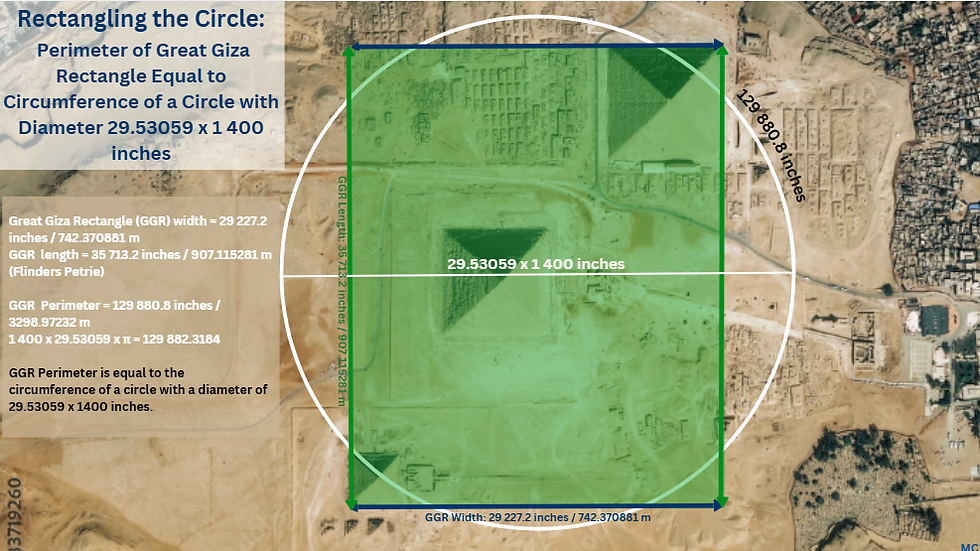
The Diagonal and the Third Pyramid
The diagonal of the Great Giza Rectangle is 46 148 inches. Multiplying this diagonal by 9 / 100 produces 4153 inches, which is essentially the base side of the Third Pyramid: 4153.6 inches (Petrie). The Third Pyramid thus emerges naturally from the geometry of the enclosing rectangle. Astronomically this value corresponds closely to the orbital period of Mercury. Mercury’s sidereal orbital period:
87.9691 days = 0.24084 Earth years.


The Height of the Third Pyramid
The height of the Third Pyramid is approximately 2564 inches. If the base is divided by the golden ratio: 4153.6 / φ≈ 2566 inches.
Thus the golden ratio appears immediately once the pyramid geometry is established.
This height can also be generated astronomically:
19 × 365.2422 × 254 / 686.98≈ 2564 inches.
Here the Metonic cycle (19 years) interacts with the number 254, the number of sidereal months in a Saros cycle, and the sidereal period of Mars.


Generating the Three Pyramid Bases
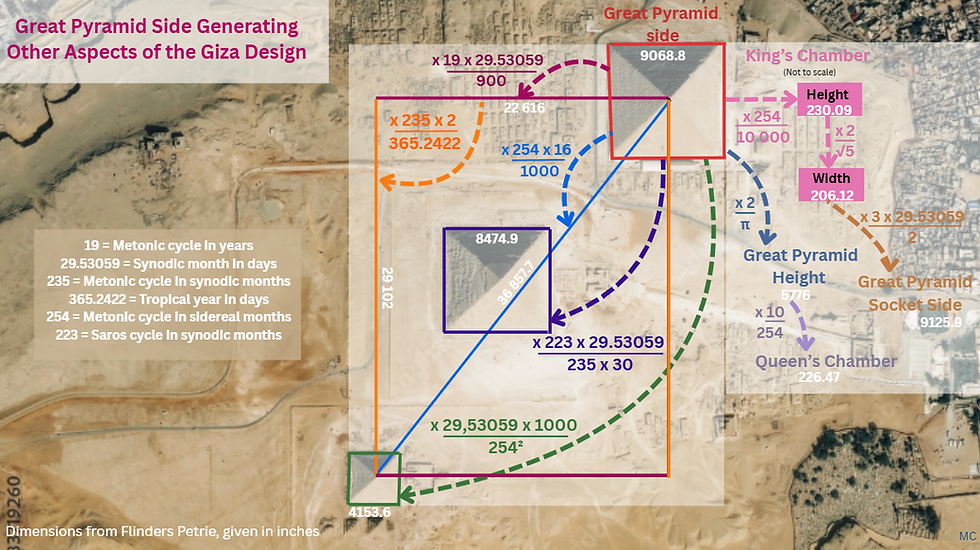
Returning to the length of the Great Giza Rectangle (GGR), several key pyramid dimensions can be derived directly from it. Using 35 713.2 inches, the following relations emerge.
Great Pyramid side: GGR length × 254 / 1000≈ 9069 inches.
Measured value: 9068.8 inches.
Second Pyramid perimeter: GGR length × 223 / 235≈ 33 900 inches.
This relates the Saros cycle (223 months) to the Metonic cycle (235 months).
Third Pyramid side: GGR length × 29.53059 / 254 ≈ 4153 inches.
Thus all three pyramids emerge from transformations of the rectangle using lunar and eclipse cycles.

The Great Pyramid
The Great Pyramid then produces one of the most famous geometric relations in architecture. Base side: 9068.8 inches, Height: 5776 inches.
The ratio between the perimeter and twice the height approximates π.
Perimeter: 4 × 9068.8 = 36 275.2 inches.
This gives Perimeter / (2 × height) ≈ π.
Thus circular geometry appears in the proportions of the monument.
The Height and √3
The pyramid height is also linked to the square root of three.
The number of sidereal lunar revolutions in a yuga of 4 320 000 years, given by Āryabhaṭa, is
57 753 336.
This number is extremely close to 10⁸ / √3. Dividing by 10 000 yields approximately
5775 inches, very close to the pyramid height. Thus the pyramid height connects lunar cycles, cosmological time, and triangular geometry.
The King’s Chamber
The side of the Great Pyramid can also generate the King’s Chamber height.
Multiplying the pyramid side by 254 / 10 000 gives 230.35 metres, the pyramid side expressed in metres. At the same time, this operation yields approximately
230 inches, which corresponds to the height scale of the chamber. The chamber itself forms a double square, introducing √5 through its internal proportions. Its width is close to the sidereal period of Mars, while its diagonal is approximately 460.7 inches. Multiplying this diagonal by eighty gives 36 857 inches, which matches the distance between the centres of the Great Pyramid and the Third Pyramid measured by Petrie.


The Metonic Rectangle
This centre-to-centre distance forms the diagonal of another rectangle associated with the Metonic cycle.
Length: 29 102 inches.
Width: 22 616 inches.
Diagonal:36 857 inches.
These dimensions can be generated from relations involving the synodic month, the Metonic cycle, π / √3, the Saros cycle, the number 254. Thus the geometry linking the pyramids reproduces the arithmetic of lunar and eclipse cycles.


Why?
What remains to be asked is why such a system would be constructed at all. Why gather celestial cycles, reconcile them through number, and inscribe them in stone? One possible answer is that these numbers were not conceived as arbitrary, nor even as human inventions, but as discoveries. The regularities of the heavens, the cycles of the Sun, Moon, and planets, revealed patterns: ratios, recurrences, and relationships that could be expressed numerically. In working with these patterns, certain forms emerged repeatedly: circular relations expressed through π, proportional growth reflected in φ, and geometric harmonies grounded in √2, √3, and √5. These were not imposed structures, but encountered ones. Number, in this sense, was not a tool, but a window onto order.
If such order was understood as fundamental, then to measure was not merely to quantify, but to participate. The act of translating celestial cycles into lengths, into architecture, into the proportions of a temple, into the organisation of space, becomes a way of aligning the human world with the structure of the cosmos. Measurement itself takes on a sacred character: it is the means by which what is observed above is established below. In this light, the system identified at Giza is not simply descriptive, but generative. It provides a framework through which the world can be recreated in accordance with the patterns perceived in the heavens.
Among the relations that emerge from these combinations, certain constants appear with particular insistence. Ratios approximating π/√3 arise from the interplay of solar and lunar cycles, linking circular and triangular forms, while expressions approaching φ³ emerge from the combined planetary periods, echoing patterns of growth and proportion associated with the golden ratio. These are not imposed geometries, but results: they arise from the interaction of the cycles themselves. In Platonic terms, one might say that the wandering stars, through their motions, generate the very geometries by which the cosmos is understood. Number gives rise to form.
In the Timaeus, Plato describes the construction of the cosmos through a series of numerical ratios, most notably 2:1, 3:2, and 4:3. These correspond to what later musical theory would recognise as the octave, the perfect fifth, and the perfect fourth. Crucially, these ratios are not presented as abstract inventions, but as the structural principles through which the world itself is ordered. The movements of the heavens, governed by regular cycles, are understood to give rise to these proportional relationships. What is striking, in light of the relations presented here, is that similar ratios emerge from the interaction of planetary and lunar cycles. When the synodic and sidereal periods of the visible planets are combined, through the Metonic and Saros cycles, and through the reconciliation of solar and lunar time, simple harmonic ratios such as 3:2 and 4:3 appear with remarkable precision. In this sense, the Platonic ratios may be read not merely as philosophical ideals, but as reflections of observed celestial harmonies.
From a small set of quantities, five planetary sidereal periods together with the Metonic cycle and precession, a relation emerges that is unexpectedly close to one of the fundamental ratios of ancient harmonic theory. In compact form:
0.24084 x 0.61519 x 1.88082 x 11.86178 x 29.44781 x 25 815 x 19 x π / 10^8 = 1.499904 ≈ 3/2

The result is the ratio 3:2, known in musical theory as the perfect fifth. This interval stands alongside the octave (2:1) and the fourth (4:3) as one of the primary consonances of the ancient harmonic system. It also appears explicitly in Plato’s construction of cosmic order in the Timaeus, where the Demiurge generates the structure of the world soul through proportional divisions including 3:2 and 4:3.
The ratio 3:2 appears again explicitly, linking the observable motions of Mars and the Moon.

Another way in which the planetary motions resolve toward the perfect fifth is this:

Another simple expression using the Metonic cycle in sidereal months and the synodic month of the Moon yields the ratio 4:3:

A related expression involving the combined planetary cycles produces a similar result, approaching the same harmonic structure, expressed here as the inverse of 4:3:

Other geometric relations emerge from various combinations of planetary cycles, such as this one:

This is reflected in the Great Pyramid: the height to base ratio is π / 2. (Height x π / 2 = base side). The height measures 10 000 / √3 inches. The base side can also be interpreted as 2π / (3√3) x 29.53059 x 254.


The circle becomes very important symbolically when pi appears in these planet cosmic combinations, sych as this one:

The golden ratio also appears in these combinations, such as here:

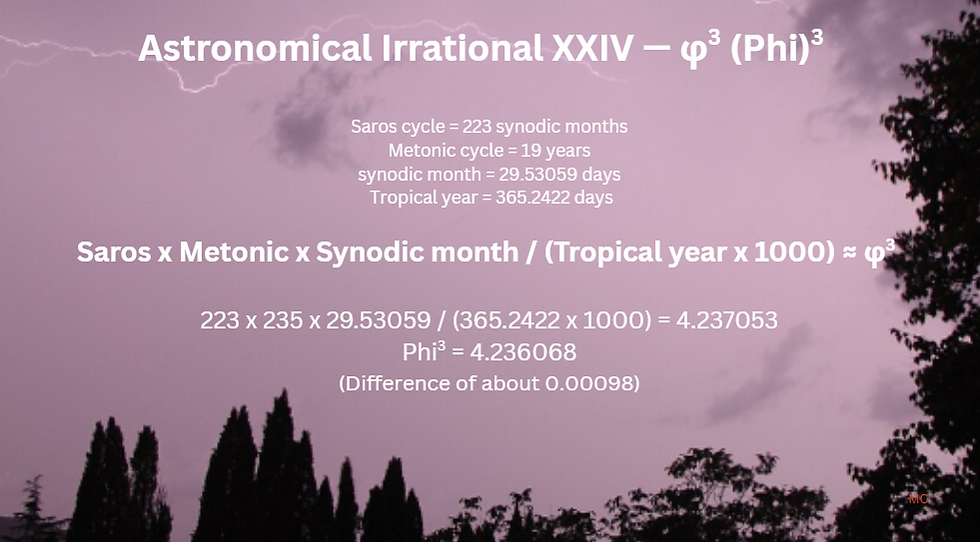
The base side of the second pyramid is literally 2000 x Phi^3 inches. And this may reflect the interest in the crossover between astronomy and geometry. The link between the length of the Great Giza Rectangle and the perimeter of thesecond pyramid is 223 / 235, the relation between the Saros and Metonic cycles, and the result is then a number of inches which connects to Phi, specifically Phi cubed. And then this base perimeter of the second pyramid can also be interpreted as 8 x 223 x 19, that is the number of years in an octaeteris, and in a Metonic period, and the number of months in a Saros cycle. And Phi cubed also gives us a link to the tropical year and synodic month:
The King's Chamber is a double square, which reflects the 1:2 ratio Plato mantins in Timaeus. The diagonal of a double sqaure measures √5 times the width. this reflects various relations between cosmic cycles such as this one:

This √5 ratio is further strengthened by the fact the measurements of the King's Chamber in inches reflect the cycles of Mars in inches.
There are many other such examples. This movement from cosmos to construction does not stop at architecture. The same principles appear to extend into conceptions of the human being. Across traditions, the body is understood as a structured whole, ordered along an axis, with distinct centres or levels, whether articulated in terms of chakras, subtle energies, or symbolic correspondences. Whatever their historical relation, such systems share a common intuition: that the human form reflects a larger order. The idea of a “cosmic man” or “cosmic woman” expresses this directly, the body as a microcosm, structured according to the same principles that govern the macrocosm. If number mediates between heaven and earth, it also mediates between cosmos and self. The vertical axis, whether expressed in the alignment of monuments or in the organisation of the body, becomes a line of correspondence, a way of situating the human within the order of the world.

If the planetary cycles are taken together, Mercury, Venus, Mars, Jupiter, Saturn, the Moon, along with the long cycle of precession and the reconciliation cycles of the Sun and Moon (Metonic and Saros), their product generates a single, comprehensive magnitude. When expressed in years, this value corresponds closely to ten yugas of 4 320 000 years. The image may be read as a circle: the cycles arranged around its circumference, the resulting number forming its diameter. In this way, the many motions of the heavens are gathered into a single measure. The circle does not represent a path, but a the closure of the system upon itself.
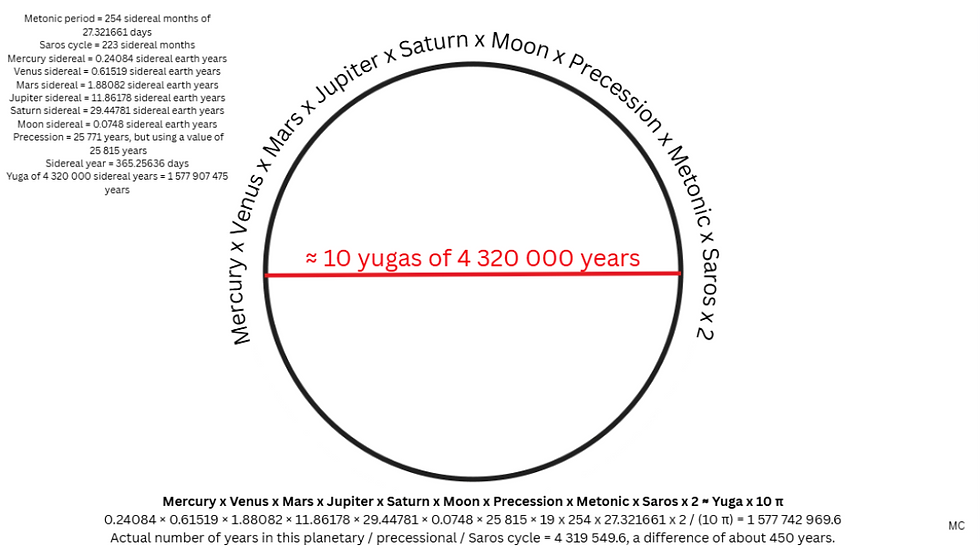
The figures presented here illustrate this double movement. In one direction, planetary cycles and long astronomical periods generate the dimensions of the Giza plateau. In the other, those same dimensions extend outward, producing terrestrial measures and vast temporal cycles. What is discovered in the heavens becomes the basis for measurement on Earth, and from there, a framework for understanding time, space, and the human form itself. The system does not terminate at any single level; it unfolds across them.
Perhaps Plato's number 5040 is also present in the Great Pyramid:

Taken together, these relations suggest that the dimensions of the pyramids can be generated through a sequence of transformations involving astronomical cycles.
The Great Giza Rectangle establishes the solar–lunar framework. Its diagonal generates the Third Pyramid and introduces Mercury. Transformations of the rectangle length generate the bases of the three pyramids. The Great Pyramid introduces circular geometry through π.
Its height introduces √3 through the relation between the lunar month and the yuga.
The King’s Chamber introduces √5 through its double-square proportions.
Distances between pyramid centres reproduce Metonic and Saros relations.
From this network of relations, an algorithm can be inferred that links solar, lunar, and planetary cycles with geometric constants. If such a system was intentionally encoded, the pyramids would represent not merely monumental architecture but a geometric expression of the arithmetic of the heavens, an algorithm translated into stone. In this sense, the aim is not control but alignment. The world is not reshaped arbitrarily, but brought into correspondence with what is already there. If Ma’at names this condition of balance and right relation, then number is its language, and measure its practice.
Measurement, in this context, is a kind reverence for the divine.
Ma’at, Measure, and the Work of Magic

What emerges from these correspondences is not a system designed for practical use, nor even for prediction in the ordinary sense, but something closer to what the Egyptians themselves understood as Ma’at: the principle of order, balance, and right proportion that sustains both cosmos and society. In Egyptian thought, Ma’at is not merely moral truth, but a structuring harmony, a condition in which things are “set in measure.” This is expressed with particular clarity in later formulations such as the well-known line from the Book of Wisdom: “Thou hast ordered all things in measure, and number, and weight.” Whether or not we attribute such a formulation directly to Old Kingdom Egypt, it captures the spirit of what is at stake: number is not a tool, but a condition of reality itself.
The Egyptian concept of Ma’at is more precise than a general notion of “order.” It refers to a condition that must be maintained: a balance between truth, proportion, justice, and cosmic stability. In the Instruction of Ptahhotep, one is advised to “do Ma’at,” suggesting that it is not merely an abstract principle but something enacted in speech and action. In funerary texts, this takes on a more explicit form: in Spell 125 of the Book of the Dead, the deceased declares, “I have done Ma’at, I have not done Isfet,”(6) aligning themselves with order against disorder. Ma’at is also that which the gods themselves uphold; the king is frequently described as “establishing Ma’at” on Earth, maintaining the balance set at creation. In this sense, Ma’at is not simply moral or symbolic, but structural: it governs the regularity of the heavens, the flooding of the Nile, and the right ordering of society. To act in accordance with Ma’at is therefore to participate in the fabric of the cosmos itself, to maintain a world that has been measured, proportioned, and set in place.
Seen in this light, the geometry of Giza need not be understood as functional or utilitarian. It is not a machine, but a statement. The temple, or whatever term we prefer, is constructed as a site in which the order of the heavens is brought into alignment with the order of the Earth. The cycles of the planets, the reconciliation of the Sun and Moon, the appearance of the great irrational ratios: these are not incidental, but constitutive. They form a language through which the cosmos is made present. Whether the pyramids served funerary, initiatory, or priestly purposes, such a correspondence would have been essential. To enter such a space would be to enter an ordered world. At its most reduced, Ma’at is no longer a figure but a measure. It is the feather against which the heart is weighed. In this transformation, the divine becomes quantitative. The same principle appears, in another register, at Giza, where celestial cycles are brought into relation through number and proportion. What is weighed in the afterlife is measured in stone.
Plato, in a different register, gives voice to a remarkably similar intuition. In the Timaeus, the cosmos is constructed according to number and proportion, and time itself is generated as “a moving image of eternity,” structured through the cycles of the heavenly bodies. Elsewhere, in the Laws, his insistence on the number 5040 as the ideal population of the city reflects not administrative convenience, but numerical completeness: a number chosen for its extraordinary divisibility, its capacity to harmonise relations within the whole. In both cases, number is not merely descriptive, it is normative. It orders the world.
It is in this context that we may cautiously return to the notion of magic. In Totem and Taboo, Freud describes what he calls the “omnipotence of thought,” the belief that inner intention and external reality are linked through symbolic operations. He associates this with what he terms sympathetic magic: the idea that resemblance, number, or repetition can effect real change in the world. Stripped of its evolutionary framing, what remains is a recognition that, in many traditional systems, to know the structure of the world is already to participate in it. Number, in this sense, is operative. It does not merely represent order; it helps to establish it.

Freud’s treatment of magic in Totem and Taboo is striking not only for its analysis, but for its tone: it belongs to a moment in which such practices could be dismissed as relics of a primitive mind. His example of the English woman who, after injuring her foot on a nail, had the nail cleaned rather than the wound itself, believing this would bring about healing, illustrates what he calls the “omnipotence of thought” in its most pathological form. Yet it is clear that this is not magic in its entirety, but something diminished: a fragment of a once more coherent system, detached from understanding and reduced to mechanical imitation. What appears here as superstition may be the residue of a much older intuition, that the world is structured, that correspondences exist, and that these correspondences can be engaged. If so, then what Freud observes is not the origin of magic, but its exhaustion. In this light, one might cautiously suggest that what we call magic is, in part, a degraded form of something closer to Ma’at: an earlier attempt to align human action, number, and form with the perceived order of the cosmos. Where that alignment is lost, the practice becomes empty; where it is preserved, it becomes something else entirely, no longer manipulation, but participation.
From this perspective, the geometry of Giza may be understood as a form of cosmic inscription: an attempt to stabilise, embody, or participate in the order perceived in the heavens. The recurrence of certain numbers such as 7 and 8, 19 and 28, 254 and 4320, the interplay of planetary cycles, and the emergence of irrational ratios, all point toward a system in which difference is not eliminated but held in relation. The many are gathered into a single structure without being reduced to unity.
The image that suggests itself is axial. A vertical ordering, whether expressed in the seven planets, the sevenfold division of the body, or the alignment toward the pole, culminates in a principle beyond the sequence: a seventh plus one, an ordered multiplicity oriented toward a point of stillness. It is tempting, though necessarily speculative, to associate such an axis with figures like Ophiuchus, the serpent-bearer, often depicted as mediating between opposing forces, or with Ma’at herself, who holds the balance. Whether or not such identifications were explicit, the underlying intuition remains: that the cosmos is both structured and centred, differentiated and held together.
One may also recognise, in this Egyptian formulation, a striking affinity with Greek philosophical thought. Although Plato does not speak of Ma’at, his cosmology rests on a comparable principle: that the universe is ordered according to intelligible structure. In the Timaeus, the cosmos is fashioned by a divine intelligence (Nous), which imposes proportion and harmony upon pre-existing disorder, producing a world that is “as far as possible” a likeness of an eternal model. This model, the realm of Forms, is perfectly ordered, and the visible universe participates in it through number, ratio, and geometry. What later traditions would call Logos, ie the rational structure of the cosmos is already present here as the binding principle between thought and world. Plato’s insistence on number, whether in the construction of the World Soul, the organisation of time through celestial cycles, or even in the numerical structuring of the ideal city, reflects the same intuition: that order is not accidental, but foundational. In this sense, Ma’at and the Platonic tradition may be understood as parallel expressions of a single idea that reality is governed by proportion, and that both cosmos and human life must be aligned with it. If this is so, then the numerical structures identified at Giza may be read not only as Egyptian, but as belonging to a broader intellectual tradition, one in which number serves as the bridge between the visible and the intelligible, between the world as it appears and the order it reflects.
If this is so, then the pyramids are not merely monuments, but expressions of a worldview in which number, geometry, and cosmology are inseparable. They do not explain the cosmos; they instantiate it. And in doing so, they suggest that what Plato called the “perfect number of time” is not only to be calculated, but, in some sense, to be built. What later becomes symbol, myth, or ritual may once have been, quite simply, a way of knowing.
Conclusion
What emerges from this study is not simply a network of numerical correspondences, but the outline of a principle. In Egyptian thought, that principle is named Ma’at. She is at once a goddess and more than a goddess: not merely a figure among others, but the condition under which the world remains ordered, truth, balance, proportion, and right relation. To “do Ma’at,” as the Egyptian texts insist, is not only to act morally, but to act in accordance with a structure already present in the cosmos. Against her stands Isfet: disorder, imbalance, the breakdown of relation.
If the analysis presented here is taken seriously, then the architecture of Giza may be understood as a material expression of this principle. The relations traced between planetary cycles, lunar and solar reconciliations, precession, and the dimensions of the pyramids suggest a system in which number mediates between heaven and earth, where celestial periods are translated into lengths, areas, and volumes. In such a system, geometry is not decorative but operative: it is the means by which order is fixed, stabilised, and made present. The so-called “algorithm” of Giza would then be nothing other than the inscription of Ma’at in stone.
From this perspective, the appearance of constants such as π, √3, or φ is not incidental. These are not imposed abstractions, but emergent forms that arise when incommensurable cycles are brought into relation. Just as the diagonal of the square resists expression in whole number, so too do the motions of the heavens resist simple reconciliation. Yet it is precisely in this tension that form appears. Plato’s cosmology, particularly in the Timaeus, can be read in a similar light: the cosmos is constructed through number, proportion, and the reconciliation of the Same and the Different. Time itself is generated as “a moving image of eternity,” a measurable expression of celestial motion. What is described philosophically in Plato may here be encountered architecturally.
It is tempting, then, to ask whether figures such as Plato or Pythagoras, traditionally associated with Egypt, encountered not merely doctrines but practices—ways of thinking in which number, observation, and construction were inseparable. Whether or not such encounters can be historically demonstrated, the affinity is striking. A philosophy adequate to such a temple would not treat number as a tool, but as a principle of reality; not as abstraction, but as participation in order. To know number would be, in some sense, to align oneself with the structure of the world.
This brings us back to Ma’at, and to the question of human action. In the Egyptian texts, one does not simply believe in Ma’at; one either acts in accordance with it or fails to do so. The famous declarations of the Book of the Dead “I have not done wrong… I have not caused imbalance…”are not statements of opinion but of alignment. To follow Ma’at is to maintain proportion: in speech, in action, in relation to others and to the world. If the cosmos itself is structured numerically, then morality becomes, in part, a question of measure of keeping within bounds, of avoiding excess or deficiency. Freedom, in this context, is not the absence of structure, but the capacity to align with it or to deviate from it.
Whether Ma’at can be linked to specific constellations such as Ophiuchus remains uncertain, and such identifications must remain speculative. Yet the symbolic field is strikingly coherent. Ma’at is consistently represented as a feminine principle of balance, often associated with the weighing of the heart, and this image finds echoes across traditions: in the figure of Justice, depicted as a woman holding scales; in the Tarot, where Justice, and in a more veiled form, the High Priestess, embody equilibrium, discernment, and hidden order; and in figures such as Saint Michael, who likewise weighs souls and stands at the threshold between worlds. These are not equivalences, but correspondences: recurring expressions of a principle that mediates between opposites, light and darkness, order and chaos, heaven and earth. In this sense, Ma’at may be understood not as a local deity, but as a formulation of balance itself. If one were to look to the sky for a symbolic analogue, figures such as Ophiuchus poised between Scorpio and the ecliptic, often associated with duality and transformation offer a suggestive, if not definitive, parallel. What matters is not the identification, but the structure: a principle that holds opposites in tension without collapse.
In this light, the notion of magic also requires reconsideration. In its degraded form, as observed by Freud, it appears as superstition: a misplaced belief in causal correspondences divorced from understanding. Yet in a more original sense, magic may be understood as participation in order, the attempt to act in accordance with the structures that bind the cosmos together. If Ma’at names that structure, then magic, at its highest level, would not be the manipulation of hidden forces, but alignment with measure, proportion, and relation. The architecture of Giza, if read in this way, is not magical because it produces effects, but because it embodies a knowledge: a way of situating human action within a cosmos understood as ordered, intelligible, and, above all, measurable.
In the end, what is presented here is not a proof, but a proposal: that the monuments of Giza encode a system in which astronomical cycles, mathematical constants, and architectural forms are brought into a single coherent framework. This framework does not merely describe the cosmos; it participates in it. The pyramids, in this reading, are not only tombs or symbols, but instruments of thought, structures through which number becomes visible, and through which the order of the world is both contemplated and enacted.
What remains, however, is a certain strangeness—one that is already present in Plato. In the Timaeus, the cosmos is not described as a mechanism, nor even as a purely mathematical structure, but as a living being: a single visible animal, endowed with soul and intelligence, ordered through number yet not reducible to it. This dual character is difficult for a modern reader. We are inclined to separate what is mathematical from what is alive, to place number on one side and life on the other. Plato does not make this distinction. For him, number is not opposed to life, but constitutive of it; proportion and harmony are not abstractions, but the very conditions under which a living whole can exist.
Seen in this light, the relations explored here take on a different significance. The recurrence of constants such as π, φ, or √3, and the emergence of harmonic ratios from planetary cycles, need not be understood as imposed patterns, nor as retrospective constructions. They may instead reflect a deeper coherence, in which astronomical motion and geometric form are expressions of a single underlying order. If the cycles of the planets can, in principle, generate approximations of these constants, if number arises from motion, and form from number, then the distinction between observation and construction begins to dissolve. What is measured in the heavens becomes what is built on Earth.
Geometry, as Plato insists throughout, is essential to this process. It is not merely a language for describing form, but the means by which invisible relations become visible. The right angle, the circle, the diagonal, these are not arbitrary figures, but necessary structures through which order is stabilised. If the astronomical relations provide the numerical content, geometry provides the form in which that content can be realised. The system suggested here, in which planetary cycles and geometric constants converge, may thus be understood as a kind of astro-creation: a process in which the patterns of the cosmos are not only observed, but brought into being within the human world.
To say that such a system is “alive” is not to abandon precision, but to recognise that order, in this context, is dynamic. The cosmos is not a fixed diagram, but an ongoing process, a continual balancing of relations across scales, from the turning of the Earth to the cycles of the planets, from the proportions of architecture to the rhythms of human life. If Ma’at names this condition of balance, then it is not merely something to be represented, but something to be maintained. The human being is not outside this system, but within it, participating in its continuance or its disruption.
In this sense, the ethical dimension returns with renewed force. To act in accordance with Ma’at is not only to behave justly, but to remain in proportion, to avoid excess, distortion, and imbalance. If the world itself is structured through relation, then to preserve those relations is, in a profound sense, to care for the world. The cosmos, as Plato suggests, is not only intelligible but animate; and if it is animate, then it is also vulnerable. The structures traced here, be it numerical, astronomical, or architectural, may be read not only as knowledge, but as a reminder: that we inhabit an ordered whole, one that can be understood, measured, and perhaps, in some measure, sustained.
It follows that the place of the individual, within such a framework, cannot be understood in purely modern terms. The self is not conceived as autonomous in the contemporary sense, nor as detached from the structures that surround it. Rather, it is situated, within a cosmos already ordered, already proportioned, and already alive with relation. To exist is to take one’s place within this order, not to stand apart from it. The freedom that follows is therefore not absolute, but relational: it consists in the capacity to recognise proportion, to act in accordance with it, or to depart from it. In Plato’s terms, the well-ordered soul mirrors the well-ordered cosmos; in Egyptian terms, one either does Ma’at or one does not. The individual, then, is neither diminished nor erased, but integrated. One becomes, not by assertion, but by alignment, by entering into the measure that sustains both the world and one’s place within it. If such an order exists, the hope is that it cannot be motionless. It does not present itself as a finished form, but as a movement to be inhabited. Ma’at is not a fixed law, but a living tension, calling to be recognised and enacted. The individual is therefore not constrained, but summoned to enter into a becoming. It is here that freedom resides, in the capacity to discern, at each moment, what sustains balance, and what disrupts it.
Notes
Timaeus, Plato, 360 B.C.E, 39d, Translated by Benjamin Jowett, https://classics.mit.edu/Plato/timaeus.html
Ibid.
Plato, Timaeus, 39, from Plato in Twelve Volumes, Vol. 9 translated by W.R.M. Lamb. Cambridge, MA, Harvard University Press; London, William Heinemann Ltd. 1925. This passage comes with a note from the translator: “the Great World-Year, which is completed when all the planets return simultaneously to their original starting points. Its length was variously computed: Plato seems to have put it at 36,000 years (Cf. Rep. 546 B ff.).”
Ibid.
Bailly, Jean-Sylvain, Histoire de l'Astronomie Ancienne, p 67-68
Book of the Dead, Spell 125 (Faulkner, 1972)
Petrie, William Matthew Flinders, 1926, Ancient weights and measures, British school of archaeology in Egypt, https://archive.org/details/ERA39/page/n41/mode/2up?q=Hesy
Heath, Richard & Heath, Robin, 2010, "The Origins of Megalithic Astronomy as found at Le Manio" https://www.academia.edu/5384545/The_Origins_of_Megalithic_Astronomy_as_found_at_Le_Manio)
Bibliography
Bailly, Jean-Sylvain, Histoire de l'Astronomie Ancienne, p 67-68
Petrie, W. M. Flinders. The Pyramids and Temples of Gizeh. London: Field & Tuer, 1883.
Petrie, William Matthew Flinders, 1926, Ancient weights and measures, British school of archaeology in Egypt, https://archive.org/details/ERA39/page/n41/mode/2up?q=Hesy
Plato,Timaeus, 360 B.C.E, 39d, Translated by Benjamin Jowett, https://classics.mit.edu/Plato/timaeus.html
Plato, Timaeus, from Plato in Twelve Volumes, Vol. 9 translated by W.R.M. Lamb. Cambridge, MA, Harvard University Press; London, William Heinemann Ltd. 1925.
Freud, Sigmund, otem and Taboo. (1913) Translated by James Strachey. London: Routledge, 2001
The Book of Enoch, Translated by R. H. Charles. Oxford: Clarendon Press, 1912
Bosak, Jon, 2010, The Old Measure, An Inquiry into the Origins of the U.S. Customary System of Weights and Measures, Wed edition 2021, p 59 - 60 https://www.ibiblio.org/bosak/pub/wam/the-old-measure-2010.pdf
Heath, Richard & Heath, Robin, 2010, "The Origins of Megalithic Astronomy as found at Le Manio" https://www.academia.edu/5384545/The_Origins_of_Megalithic_Astronomy_as_found_at_Le_Manio)
Mauss, C., 1892, “L’Église de Saint-Jérémie à Abou-Gosch Observations sur plusieurs mesures de l’antiquité (Suite).” Revue Archéologique, vol. 20, 1892, pp. 80–130. JSTOR, http://www.jstor.org/stable/41747027.)


Comments