
100. Celestial Harmonics: Platonic Cosmology and the Mathematical Design of Giza

Updated: Apr 8
“Geometry compels the soul to contemplate being.”— Plato
“Number hath a treble state: one in the Creator, another in every creature, and the third in spiritual and angelical minds.”— John Dee
When we visit an ancient monument, we enter it first through the senses. We notice atmosphere: the weight of stone, the direction of light, the way a wall or passage frames a piece of sky. We lift the camera almost instinctively. We look for horizon lines and alignments; we wait for the sun to touch an edge, for the moon to clear a lintel. In doing so we approach something essential about ancient building cultures. Before mechanical clocks, the sky offered the most stable and precise timepiece. Architecture could make those rhythms visible in terms of a framework, more easily computable, so that day and night, month and year, the slow return of seasons, the rarer recurrence of longer cycles could be glimpsed through it. This is true of megalithic monuments, temples and churches, and religious buildings from many traditions, which were built in relation to the position of the sun, for example, at certain times of year.
There is also another way in which a building can engage the heavens. Instead of guiding the eye, it guides the mind. In this mode the monument becomes a numerical interior: a structure within which measures correspond, ratios recur, and relationships unfold. It resembles an algorithm held in stone. The effect is contemplative. The building honours coherence itself: the conviction that the world possesses an underlying order that can be expressed as number and proportion. This is also true of megalithic monuments, temples and religious buildings. But it is not just about keeping track of time, or observing the sun or moon from a particular vantage point. Nor is it simply about light. It is about measure, and the ratio between the monument's dimensions and geometry, and the workings of the cosmos. It is about Ma'at, logos, or dao, that is to say working within the structure of the cosmos, as it was set in motion by divine creation, and positioning ourselves, as creators of architecture, or as participants in a monument's space for a few moments, within a framework that allows us to live in harmony with it.
This distinction between ways in which we experience a monument, through the eyes, and through the mind, has been articulated in many ways historically. Philosophers from the Pythagorean tradition onward treated number not merely as a tool for counting but as a principle of reality. Plato developed this most vividly: he describes a cosmos organised by ratios and circular motions, a world whose intelligibility rests on mathematical form. Medieval and Renaissance writers inherited the same intuition. John Dee, writing in 1570 in his Mathematical Preface to Euclid, gave it striking English terms: “Number Numbryng”, number as ordering principle, and “Number Numbred”, number applied to visible things. This older distinction matters here, because the patterns examined in this article belong to the first kind: number as structure, not as mere tally.
What follows is an attempt to test a Platonic idea with astronomical material, and to link it with a monument. If time is composed of cycles, planetary periods, lunar recurrences, the slow turning of precession, then these cycles can be treated as numbers. When combined in certain ways, they can yield harmonic ratios familiar from ancient musical theory, such as 3:2, and they also generate irrational quantities tied to geometry, such as π and the golden ratio. These are not imposed from outside; they arise from the arithmetic of the sky.
The most surprising element is the point of entry. The relations presented here did not begin as abstract numerology. They emerged from measured analysis of the Giza plateau expressed in inches, with the inch treated as a calendrical unit, capable of representing days, years, and the conversion between them. The question, then, is simple to state and difficult to dismiss: if architectural measures at Giza repeatedly cohere with astronomical cycles through harmonic and geometric constants, what kind of cosmology might this architecture have been built to express?
Plato and the mathematical structure of time
Plato’s strongest statement of a mathematical cosmos appears in the Timaeus. The dialogue offers a mythic account of creation in which a craftsman-intellect, referred to as the Demiurge, brings order to a pre-existing disorder by means of proportion, symmetry, and circular motion. The cosmos is shaped as a living whole, and time is born together with the heavens, so that the visible order may mirror an eternal pattern.
In one of the most quoted passages, Plato ties time directly to celestial motion. The sun, moon, and planets exist “to distinguish and preserve the numbers of time,” and their revolutions generate our measures of day, month, and year. The basic claim is not technical astronomy; it is metaphysics. Time becomes intelligible because it is periodic; it can be known because it returns. Plato then introduces a larger idea: a complete cycle in which the multiple celestial motions come into a common fulfilment. He calls this the “complete” or “perfect” number of time, fulfilled when “all the eight circuits” finish together and “come to a head.” In modern terms, he gestures toward a grand commensuration: the moment when the diverse cycles of the heavens align.
Plato’s language remains deliberately economical here, and that restraint is part of his strategy. The text supplies the frame, eight motions, relative speeds, completion, without naming the specific value. It invites the reader into a certain kind of thought: the search for a number that belongs to the order of the world itself.
A second Platonic passage matters even more for the present investigation: the construction of harmonic order through ratio. In Timaeus 35b–36a, Plato describes the Demiurge dividing a primordial mixture according to a pattern of doubling and tripling, and then filling the gaps with proportional means. From these operations, harmonic intervals emerge, including 3:2 and 4:3, ratios known from musical consonance. Plato’s creation myth thus connects three domains: cosmic motion, numerical proportion, and harmonic relationship. This provides a clear philosophical template. The heavens are not merely a spectacle; they are a structured system whose motions embody proportion. The mind grasps the system through number, and number expresses itself most purely through ratio. What later tradition called the “music of the spheres” grows naturally from this seed.
At this point the inquiry turns from Plato’s template to observational astronomy. If the sky is a field of recurring cycles, and if those cycles can be combined into ratios, then one may ask whether certain harmonic proportions, especially the perfect fifth, 3:2, arise from the cycles themselves. One may also ask whether the same combinations generate the geometric constants that architecture so often embodies: the circle’s π, the diagonal’s √5, the golden ratio’s φ. These are precisely the quantities that allow a building to stand at the meeting point of the countable and the inexhaustible: finite measure and infinite ratio.
The next section therefore treats astronomical cycles as number, and tests whether their combinations yield harmonic ratios and geometric constants in a way that echoes Plato’s cosmology, before returning, finally, to the place where the patterns first announced themselves: the measured geometry of Giza.
Astronomy as number
The raw material for a mathematical cosmology is surprisingly modest. A small set of stable cycles, visible, recurrent, and preservable in tradition, is enough to generate a rich numerical world. A solar year. A lunar month. The periods of the classical planets. A long stellar cycle, expressed in precession. Add one geometric operator, the circle’s constant π, and the system already begins to behave like a language.
This economy matters. If the architecture of early civilisations embodies a mathematical view of the cosmos, it would most naturally draw upon a limited repertoire: those cycles that can be observed over generations, taught, remembered, and woven into ritual and calendar. The planet list itself is short by definition: Mercury, Venus, Mars, Jupiter, Saturn, together with the Sun and Moon as they appear from Earth. Precession, too, presents itself not as an abstract theory but as a slow, unmistakable drift of the stellar background across centuries. The aim is to treat these cycles as numbers, and combine them by multiplication and scaling.
The astronomical quantities used in the following calculations are few and well known. They are listed below for clarity. For clarity, the periods are expressed in Earth years. Using sidereal years gives a consistent unit: Earth’s orbit becomes the yardstick against which the other motions are measured.
Body / Cycle | Sidereal period (days) | Sidereal period (Earth years) | Synodic period (days) |
Mercury | 87.969 | 0.24084 | 115.88 |
Venus | 224.701 | 0.61519 | 583.92 |
Mars | 686.980 | 1.88082 | 779.94 |
Jupiter | 4332.59 | 11.86178 | 398.88 |
Saturn | 10759.22 | 29.44781 | 378.09 |
Moon | 27.32166 | 0.07480 | 29.53059 |
Axial precession (traditional) | — | 25 920 years But using 25 815 years in this study* | — |
Table 1
Table 1 shows the small set of astronomical cycles used in the calculations that follow. The sidereal periods measure the time taken for each body to return to the same position against the background of the stars, while synodic periods describe the interval between successive alignments with the Sun as observed from Earth. From these few quantities a surprisingly rich numerical structure can be generated. In the calculations below, I have not used the conventional reference value (≈25 772 years), but instead a test value of 25 815 years, which emerges when certain Giza measures are interpreted as scaled images of astronomical cycles. The second value is therefore not assumed as an established astronomical constant; it functions as a hypothesis to be evaluated. It is possible to swap it with the modern value. The 25 815-year value is derived by fitting astronomical relations to architectural measures, and so it risks circularity. For that reason I treat it as provisional and examine whether the same value improves multiple independent relations, rather than a single tuned identity. The methodological question is whether the same value simultaneously improves a family of relations, especially relations that draw on different cycles (planetary, lunar, eclipse) and different architectural measures (lengths, perimeters, diagonals). This is the criterion applied here.
The Metonic cycle folds the Sun–Earth year and the Moon’s phases into a single calendrical reconciliation: after nineteen years the lunar phases return to roughly the same points in the solar year. In that sense the solar and lunar elements are present even when only the Metonic factor is written. Precession enters as the longest cycle in the system, you could think of it as the long sweep against which shorter cycles acquire a larger context.
Cycle | Definition | Value (days) | Equivalent |
Synodic lunar month | Time between successive lunar phases | 29.53059 | — |
Sidereal lunar month | Moon’s orbit relative to the stars | 27.32166 | — |
Metonic cycle | 235 synodic months | 6939.60 | 19 tropical years |
Saros cycle | 223 synodic months (eclipse recurrence) | 6585.32 | ≈ 18.03 years |
Octaeteris | 99 synodic months | 2923.53 | 8 solar years |
Venus octaeteris | 5 Venus synodic periods | ≈ 2919.60 | ≈ 8 years |
Table 2
Table 2 lists several derived astronomical cycles that play an important role in traditional astronomy. The synodic month measures the recurrence of lunar phases, while the sidereal month measures the Moon’s orbit relative to the stars. The Metonic cycle reconciles lunar and solar time, bringing the phases of the Moon back to nearly the same points in the solar year after nineteen years. The Saros cycle governs the recurrence of eclipses, while the octaeteris expresses an eight-year reconciliation of lunar and solar calendars that also closely matches the Venus cycle.
The numerical values used here correspond to modern astronomical measurements rather than rounded traditional approximations. This choice is methodological rather than historical: the aim is to examine the numerical structure that emerges when the cycles themselves are treated as accurately as possible. Whether ancient astronomers possessed these exact values is a separate historical question, and one not assumed here. The present analysis proceeds from Plato’s philosophical framework downward, from cosmology to number, rather than from architectural data upward. These values belong to the traditional observational repertoire of ancient astronomy: the visible planets, the lunar month, the Metonic reconciliation of solar and lunar time, and the long stellar cycle of axial precession.
A. Cosmic Egg Unscrambled
Harmonic relations
Harmonic relation I
With these values in place, the numerical experiment becomes straightforward. Each cycle may be treated simply as a number expressing a period of time. Because the unit is the Earth year, the planetary periods can be multiplied directly. Larger cycles such as the Metonic period and axial precession can then be introduced as scaling factors that connect short-term planetary motion with long astronomical rhythms. The circle enters naturally through π, which provides the geometric bridge between cyclical motion and proportion.
From this small set of quantities, five planetary sidereal periods together with the Metonic cycle and precession, a relation emerges that is unexpectedly close to one of the fundamental ratios of ancient harmonic theory. In compact form:
0.24084 x 0.61519 x 1.88082 x 11.86178 x 29.44781 x 25 815 x 19 x π / 10^8 = 1.499904 ≈ 3/2

The result is the ratio 3:2, known in musical theory as the perfect fifth. This interval stands alongside the octave (2:1) and the fourth (4:3) as one of the primary consonances of the ancient harmonic system. It also appears explicitly in Plato’s construction of cosmic order in the Timaeus, where the Demiurge generates the structure of the world soul through proportional divisions including 3:2 and 4:3.
What is striking here is the economy of the ingredients. Only a limited group of astronomical cycles is required, each belonging to the observational repertoire of traditional astronomy: the visible planets, the reconciliation of solar and lunar time, and the long stellar cycle of precession. When these are combined with the geometry of the circle, the result approaches one of the central harmonic ratios of ancient cosmology.
The reader may reasonably ask what such a relation means. The immediate claim is modest: astronomical cycles can be combined into stable ratios that coincide with harmonic intervals. The broader implication is philosophical. If a culture treats the heavens as a field of ordered motion, then numbers are not merely labels; they become relations that link disparate timescales into a coherent whole. In such a view, harmony is not imposed upon nature. It is discovered within it.
This provides a way to read Plato with fresh eyes. When Plato speaks of time being preserved and distinguished by the revolutions of the heavenly bodies, and when he builds cosmic structure out of ratios such as 3:2 and 4:3, he is describing a world in which motion itself carries number. The heavens become a moving arithmetic.
The planetary relation described above produces the ratio 3:2, the musical interval known as the perfect fifth. This ratio occupies a central place in ancient harmonic theory and appears explicitly in Plato’s account of cosmic structure in the Timaeus. When the Demiurge constructs the world soul, the divisions of the cosmic mixture are made according to numerical ratios including 3:2, 4:3, and 9:8, intervals that later became the foundations of Greek musical theory.
The appearance of the perfect fifth from the combined periods of the planets therefore raises an interesting possibility: that astronomical cycles themselves may encode relations belonging to the harmonic system Plato associates with cosmic order.
When the same set of cycles is examined further, additional relations appear which cluster around these same harmonic intervals. The following examples illustrate how a small group of astronomical quantities, planetary periods, lunar cycles, and the Metonic relation between solar and lunar time, can generate ratios closely aligned with those of ancient harmonic theory.
Harmonic relation II
A particularly striking relation emerges when the sidereal and synodic cycles of Mars are considered.
If the sidereal period of Mars is combined with the perfect fifth and two geometric constants, √5 and a simple decimal scaling, the result closely reproduces the synodic cycle of Mars:
Mars sidereal × 3/2 × √5 × 10 / synodic month ≈ Mars synodic
686.980 × 3/2 × √5 × 10 / 29.53059 = 780.276
The observed synodic period of Mars is approximately 779.94 days, leaving a difference of about 0.336 days, or roughly eight hours.
The relation may also be rearranged to express the same structure in harmonic form:
Mars synodic × synodic month / (Mars sidereal × √5 × 10) ≈ 3/2
In this form the ratio 3:2 appears again explicitly, linking the observable motions of Mars and the Moon.

Harmonic relation III
A second relation connects the sidereal periods of Mars and Mercury with the Metonic cycle, expressed in sidereal months.
Mars sidereal × Mercury sidereal × Metonic (in sidereal months)/ synodic month × 3 / 2000 ≈ Mars synodic
686.96 × 87.9691 × 254 / 29.53059 × 3 / 2000 = 779.6765
The difference from the observed synodic period of Mars is approximately six hours.
Rearranging the expression again produces a form close to the same harmonic interval:
Mars synodic / (Mars sidereal × Mercury sidereal × Metonic months)× synodic month × 1000 ≈ 3/2
Once more the planetary motions resolve toward the perfect fifth.

Harmonic relation IV
Another relation links the sidereal cycle of Mars, the synodic month of the Moon, and the tropical year:
Mars sidereal × synodic month × 18 / 1000 ≈ tropical year
686.96 × 29.53059 × 18 / 1000 = 365.154
The tropical year is 365.2422 days, leaving a difference of approximately two hours.
The factor 18 in this relation corresponds to a simple proportional scaling (9:5), showing once again how relatively small integer relationships can bridge astronomical cycles of very different lengths.

Harmonic relation V
The next set of relations produces another of the classical harmonic intervals: 4:3, the perfect fourth. In ancient harmonic theory this ratio stands alongside the octave and the fifth as one of the principal consonances.
A simple expression using the Metonic cycle in sidereal months and the synodic month of the Moon yields:
Metonic (in sidereal months) × synodic month / 10 000 ≈ 4/3
254 × 29.53059 / 10 000 = 0.75008
This value is extremely close to the reciprocal form of the ratio 4:3.

Harmonic relation VI
A related expression involving the combined planetary cycles produces a similar result:
Planets and precession × Metonic × synodic month² × Mercury / 10⁹ ≈ 3/4
0.24084 × 0.61519 × 1.88082 × 11.86178 × 29.44781 × 0.0748 × 25 815× 19 × 0.24084 × 29.53059² / 10⁹ = 0.750046
Again the result approaches the same harmonic structure, expressed here as the inverse of 4:3.

Harmonic Relation VII

A possible Platonic perfect number of time: 28
In Timaeus, Plato states that the “complete” or “perfect” number of time is fulfilled when the eight revolutions complete their courses together: the revolution of the Same, and the seven revolutions of the Different. In Lamb’s translation:
“the complete number of Time fulfils the Complete Year when all the eight circuits, with their relative speeds, finish together and come to a head, when measured by the revolution of the Same and Similarly-moving.”
Timaeus 39d
Plato does not specify this number. He gives many other numbers and ratios in the dialogue — powers of 2 and 3, the intervals 3:2, 4:3, 9:8, and the eight celestial motions — but not the value of the “complete number of Time” itself. One possible candidate is 28.
Using the sidereal cycles of Mercury, Venus, Mars, Jupiter and Saturn, together with the lunar sidereal month, axial precession, and the Metonic cycle, the following relation appears:
100 000 000 / (0.24084 × 0.61519 × 1.88082 × 11.86178 × 29.44781 × 0.0748 × 25 815 × 19) = 28.001718 ≈ 28
This is notable because 28 is a perfect number, equal to the sum of its proper divisors:
1+2+4+7+14=28
Given Plato’s Pythagorean background, this is at least suggestive. Perfect numbers were already associated in antiquity with completeness and harmonic order. The appearance of 28 in an astronomical context is also interesting because the number already had strong lunar associations. A schematic lunar month is often taken as 28 days, and 28 was later used in calendrical astronomy as the length of the solar cycle, the period after which dates recur on the same days of the week in the Julian calendar.
The inclusion of the Metonic cycle requires comment, since Plato does not mention it explicitly. However, the Metonic cycle is simply a reconciliation of solar and lunar time: 235 synodic months ≈ 19 solar years. Since Plato’s “complete year” concerns the coordinated return of celestial motions, and since the sun and moon are among the seven planetary bodies he discusses, inclusion of the 19-year cycle is defensible as a compact expression of their combined recurrence.
If the Metonic cycle is separated out, the same relation yields the product 28 × 19 = 532:
100 000 000 / (0.24084 × 0.61519 × 1.88082 × 11.86178 × 29.44781 × 0.0748 × 25 815) = 532.03265 ≈ 532
This is also striking. In the Julian calendar, 28 years is the solar cycle and 19 years is the Metonic cycle; together they produce the 532-year Paschal cycle, after which lunar phases and weekdays realign. Although this later Christian calendrical use should not be projected back onto Plato, it shows that 28 and 19 form a natural astronomical pair.
A further point of interest is that the same astronomical product is close to the scale implied by 1/28:
1 000 000 / 28 = 35714.2857
and 0.24084 × 0.61519 × 1.88082 × 11.86178 × 29.44781 × 0.0748 × 25 815 x 19 = 3 571 209.396
This places 28 within the same numerical field as other values relevant to the article. Whether this is philosophically or architecturally significant remains open, but it strengthens the case for treating 28 as more than an arbitrary result.
None of this proves that Plato intended 28 as the perfect number of time. But it does show that 28 is a plausible candidate: it is mathematically distinguished, astronomically resonant, and arises naturally from a combination of planetary, lunar and precessional cycles. At the very least, it deserves consideration alongside other candidates for Plato’s teleios arithmos tou chronou.

Astronomical Irrationals
One of the most remarkable discoveries in Greek mathematics was that certain geometric quantities cannot be expressed as ratios of whole numbers. These quantities, now known as irrational numbers, arise naturally from simple geometric constructions. The diagonal of a square relative to its side produces √2; the geometry of equilateral triangles yields √3; pentagonal geometry gives √5 and the golden ratio φ; and circular geometry gives rise to π. In such cases the lengths involved are incommensurable: no common unit can measure both exactly. This discovery seems to have been profoundly unsettling for ancient mathematicians. Two perfectly well-defined lengths, arising from the simplest geometric forms, could not be expressed as a ratio of integers. The result is an apparent discontinuity between arithmetic and geometry: the discrete world of number cannot fully capture the continuous forms of geometry. Yet although irrational numbers cannot be written exactly as ratios of integers, they can be approximated arbitrarily closely by rational relations.
Astronomical cycles provide a natural framework in which such approximations appear. The motions of the heavens are measured by discrete periods, days, months and years, yet these cycles often combine to produce ratios extremely close to the fundamental constants of geometry. When lunar, solar and planetary periods are combined, values emerge that approximate π, φ, √3 and √5 with surprising precision.
In Plato’s cosmology the structure of the universe itself is described in terms of number, proportion and geometry. In the Timaeus, the Demiurge constructs the cosmos using harmonic ratios and geometric relations, arranging the motions of the heavens according to numerical order. Plato describes how the world soul was formed from proportional divisions:
“He divided the whole mixture according to the following ratios: first 1, then 2, then 4, then 8; and again 1, 3, 9, 27… filling up the intervals with harmonic and arithmetic means.”
Timaeus 35b–36b
Within such a cosmology, the appearance of geometric constants within astronomical cycles is not entirely unexpected. The heavens move in circles and cycles, and the mathematics of circles inevitably leads to constants such as π, while pentagonal and hexagonal geometries introduce φ, √5 and √3. The following relations show how combinations of the principal lunar and solar cycles produce close approximations to these constants.
Approximations of π
A striking feature of many astronomical cycles is that when they are combined in certain ways they produce numerical values that approximate well-known irrational constants. The examples presented here focus primarily on π, the ratio between the circumference and diameter of a circle, which is one of the most fundamental constants in geometry.
The relations shown in Figures I–X do not claim exact equality with π. Rather, they show that combinations of independently observed astronomical periods, such as the tropical year, synodic month, sidereal month, and the Metonic cycle, can yield values numerically very close to π. In each case the difference between the calculated value and π is extremely small, typically on the order of a few thousandths or less.
What is notable is the recurrence of such relations across different combinations of cycles. Several of the relations arise directly from the interaction between solar and lunar cycles.
For example, Astronomical Irrational I combines the tropical year, the synodic month, the sidereal month, and the Metonic cycle. The Metonic cycle of nineteen years represents the period over which lunar phases repeat on approximately the same dates in the solar calendar. When these quantities are arranged as:
tropical year / synodic month × Metonic cycle in days × sidereal month / 1000
the resulting value is extremely close to π.



A related relation appears in Astronomical Irrational V, where the tropical year, synodic month and the Metonic cycle in sidereal months produce another approximation of π. These relations highlight the deep numerical interplay between the solar year and the various lunar months used in astronomy.
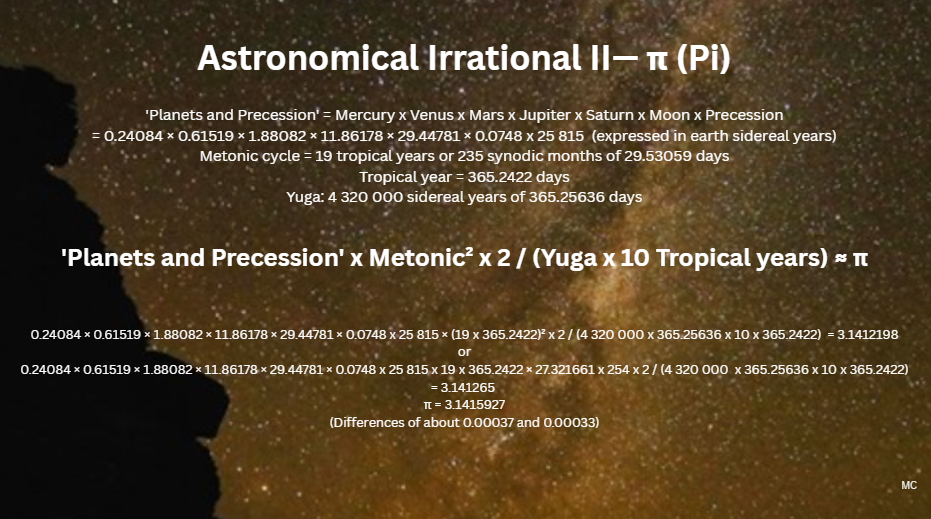
Some approximations arise when planetary cycles are included. In Astronomical Irrationals II and III a composite quantity labelled “Planets and Precession” is constructed by multiplying the sidereal periods of Mercury, Venus, Mars, Jupiter and Saturn together with the Moon and the precessional cycle of the Earth. When this composite quantity is combined with the Metonic cycle and other astronomical periods the result again approaches π with remarkable closeness. These relations suggest that planetary and lunar cycles, when expressed together, can form numerical harmonies that echo fundamental geometric constants.

Some relations extend beyond yearly or monthly periods. Astronomical Irrational VII incorporates the Mars synodic cycle together with the Mahāyuga, the vast cosmological cycle of Indian astronomy. Even at these enormous scales, combinations of cycles can produce values surprisingly close to π.
Astronomical Irrational VIII illustrates another interesting relationship: the difference between the solar year and the lunar year. The lunar year of twelve synodic months is approximately 354.367 days, while the tropical year is about 365.242 days. The difference between them, roughly eleven days, plays an important role in lunisolar calendars.
When the synodic month is compared to this solar–lunar difference and scaled by the harmonic number 864, the resulting value again approaches π.


A further set of approximations arises from relations centred on the Metonic cycle itself. The Metonic cycle represents one of the most important bridges between solar and lunar timekeeping: nineteen tropical years correspond closely to 235 synodic months. Because of this property it has been widely used in lunisolar calendars since antiquity.
When the Metonic cycle is expressed in different astronomical units, be they synodic months, sidereal months, or years, it becomes possible to construct additional numerical relations involving the lunar year, the sidereal month, and related cycles.
Several examples of such relations are shown in Figures XI–XVII.
One particularly striking case (Astronomical Irrational XII) involves the Callippic cycle, which consists of four Metonic cycles, or seventy-six years. When the square of the synodic month is divided by the length of the Callippic cycle, the resulting value approximates π with extremely high accuracy. The numerical difference from π is on the order of one millionth, illustrating how closely solar–lunar periodicities can align with geometric constants.
Other relations arise when the Metonic cycle is expressed simultaneously in its two principal forms: 235 synodic months and 254 sidereal months. Because these two measures represent the same nineteen-year interval expressed in different lunar units, combinations of them can produce further approximations to π. For example, multiplying the Metonic cycle in synodic months by the same cycle expressed in sidereal months and scaling the result by the number of years in the cycle produces a value remarkably close to π.
Similar patterns appear when the sidereal year and sidereal month are included. Since the sidereal year measures the Earth's orbit relative to the fixed stars while the sidereal month measures the Moon’s orbit relative to the same reference frame, their ratio naturally links solar and lunar motions. When combined with the Metonic cycle expressed in synodic months, this ratio again produces an approximation of π.
Taken together, these relations show that the Metonic cycle occupies a particularly rich numerical position within the network of astronomical periods. By linking solar and lunar timekeeping it provides multiple pathways through which combinations of cycles can generate values close to geometric constants.

The Metonic cycle appears repeatedly in these relations. The cycle provides a bridge between solar and lunar timekeeping because nineteen tropical years correspond closely to 235 synodic months. Astronomical Irrational X illustrates another aspect of this relationship. When the Metonic cycle expressed in synodic months is multiplied by the number of years in the cycle and divided by 144, the result closely approximates pi cubed. This again highlights how the Metonic cycle sits at a numerical intersection between solar and lunar periodicities.
What makes the examples presented here interesting is the variety of cycles involved, from solar to lunar, planetary and even cosmological, all capable of producing approximations to the same geometric constant. Of course, these relations can't be interpreted as proofs that the astronomical cycles were designed to encode π. Rather, they illustrate how astronomical periods, when expressed numerically, can generate harmonies that approximate well-known geometric constants. The patterns revealed here may therefore be viewed as numerical curiosities, as reflections of deeper mathematical structures in celestial mechanics, or as echoes of the long historical connection between astronomy and geometry. In the next sections we will see that similar relations appear for other irrational constants, including √5 and φ, suggesting that the numerical structure of astronomical cycles may extend beyond π alone.


The significance of these relations may not lie solely in their numerical proximity, but in what they reveal about the nature of number itself. The constants that appear, π, φ, √3, √5, are not merely quantities to be measured, but expressions of an underlying structure that resists complete articulation in arithmetic terms. They are, by definition, incommensurable: no finite ratio can capture them exactly. In this sense, they mark a limit within number, a point at which calculation gives way to approximation, and certainty to approach. For the Greek mathematicians, this was not simply a technical difficulty, but a profound philosophical problem, exposing a tension between the finite and infinite, or between the applied and pure mathematics. Yet it is precisely here, at the boundary of what can be fully known or expressed, that geometry takes on a particular significance. The circle, the triangle, the pentagon, these are not arbitrary forms, but configurations through which such incommensurable relations become visible. To engage with them is therefore not only to measure, but to contemplate. In a Platonic framework, where the intelligible world is approached through number and form, these irrational constants may be understood not as defects in calculation, but as indications of a deeper order, one that cannot be exhausted by enumeration. They point beyond themselves, inviting the mind toward a reality that is at once structured and inexhaustible.
Approximations of the Golden Ratio (φ)
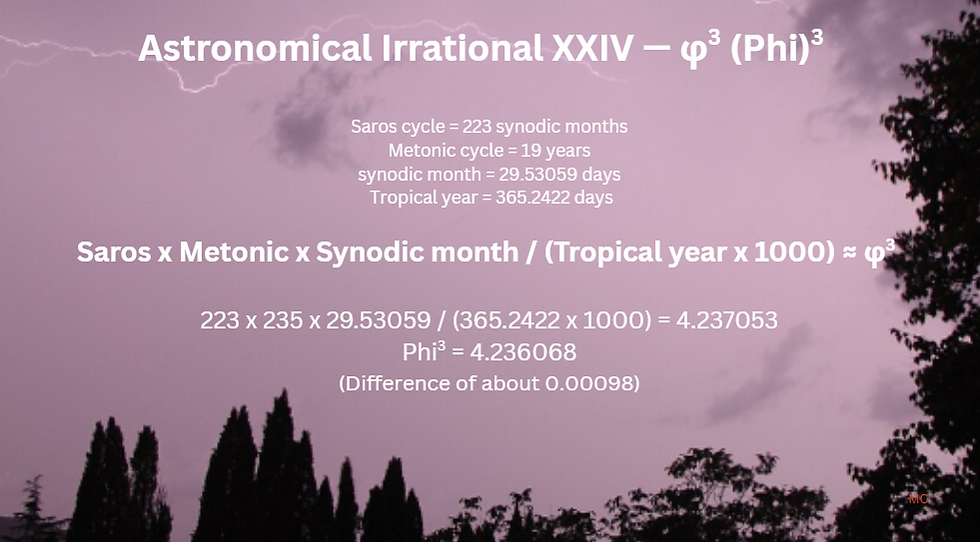
In addition to approximations of π, combinations of astronomical cycles can also produce values close to another fundamental irrational constant: the golden ratio, φ. The golden ratio, defined as ϕ=1+52≈1.618034 appears in many areas of mathematics and geometry, particularly in relations involving growth, proportion, and recursive structures. Its cube, ϕ³, is also notable, since ϕ³ ≈ 4.236068, a value that arises naturally in several geometric constructions. A number of astronomical relations constructed from lunar, solar, and planetary cycles approximate these constants with surprising closeness.
One of the simplest examples arises from the orbital period of Mars. Dividing 10,000 days by nine Mars sidereal periods yields a value close to φ. While this relation involves only a single planetary cycle, it illustrates how orbital periods alone can generate ratios approximating well-known mathematical constants.
A more elaborate example incorporates the composite quantity labelled “Planets and Precession,” formed from the sidereal periods of the classical planets together with the lunar cycle and the precessional period of the Earth. When this composite value is combined with the Saros cycle and the octaeteris, the resulting relation produces an approximation of ϕ³. Although more complex, this relation again demonstrates how planetary and lunar cycles can combine to yield ratios close to the golden ratio.
Other approximations arise from the interaction between solar and lunar cycles. For example, the ratio between the synodic month and the tropical year, scaled appropriately, produces a value close to φ. Since the synodic month measures the cycle of lunar phases while the tropical year measures the Earth's seasonal cycle, this relation again reflects the numerical tension between solar and lunar timekeeping.
The Metonic cycle appears repeatedly in these relations. As discussed earlier, the Metonic cycle provides a bridge between solar and lunar motion by linking nineteen tropical years with 235 synodic months. When this cycle is expressed in different units, days, months, or years, and combined with other astronomical periods such as the Saros cycle, further approximations to φ and ϕ³ emerge.
Some of the relations extend to much larger cycles of time. One example incorporates the Mahāyuga, a vast cosmological cycle from Indian astronomy consisting of 4 320 000 years. When this cycle is combined with the sidereal month, synodic month, Saros cycle, and Metonic cycle, the resulting relation again approaches the golden ratio.
These large-scale relations demonstrate that the appearance of φ is not restricted to short astronomical periods such as months or years, but can also emerge when cycles separated by many orders of magnitude are combined.
Several relations centre specifically on the Saros cycle and the Metonic cycle. The Saros cycle of 223 synodic months is well known as the period over which eclipses repeat with similar geometry. When the Saros cycle is combined with the Metonic cycle and the synodic month, ratios close to ϕ³ appear repeatedly.
The recurrence of these values suggests that the Saros and Metonic cycles together form another important numerical intersection within astronomical timekeeping, much as the Metonic cycle alone provides a bridge between solar and lunar motion.
The appearance of the golden ratio in astronomical relations is particularly intriguing because φ is deeply associated with geometric proportion. In classical geometry it appears in the pentagon, the decagon, and in many constructions involving recursive symmetry.
While the relations presented here should not be interpreted as exact identities, they illustrate how astronomical cycles can generate ratios close to constants that arise naturally in geometry. Just as π emerges from the circular nature of celestial motion, the appearance of φ may reflect the complex network of proportional relations linking solar, lunar, and planetary cycles.
Taken together, these relations suggest that astronomical cycles form a rich numerical structure in which different periods can combine to approximate fundamental mathematical constants. Whether these patterns are viewed as numerical coincidences, echoes of deeper mathematical relationships, or simply curiosities arising from the interplay of incommensurable cycles, they highlight the long-standing connection between astronomy, number, and geometry.




Square Roots
In addition to approximations of π and the golden ratio, certain combinations of astronomical cycles also produce values close to square-root irrationals such as √2, √3 and √5. These numbers occupy a central place in classical geometry: √2 arises from the diagonal of the square, √3 from the geometry of the equilateral triangle, and √5 from the pentagon and the golden ratio. Their appearance within relations involving astronomical periods is therefore especially intriguing.
As in the earlier examples, these relations involve combinations of independently measured cycles—sidereal months, synodic months, planetary periods, and long cosmological cycles such as the yuga of Indian astronomy. When arranged in certain ways, these quantities produce values that approximate well-known geometric constants.
√3 and the Yuga–Lunar Relation
One of the most striking relations involves the sidereal month and the great cosmological cycle known as the yuga, described in the Āryabhaṭīya of the Indian mathematician and astronomer Āryabhaṭa (c. 499 CE). In this work, the number of revolutions of the Moon in a yuga is given as 57,753,336.
A yuga is defined as 4,320,000 sidereal years, and the text explains the hierarchy of time in the following way:
thirty human years make a year of the Fathers
twelve years of the Fathers make a year of the gods
twelve thousand years of the gods make a yuga of all the planets
Thus: 30×12×12 000 = 4 320 000
Using modern estimates for the sidereal year and month, the number of lunar revolutions in a yuga can be estimated as 4 320 000 × 365.25636 / 27.321661 ≈ 57 752 985, which is extremely close to the figure given by Āryabhaṭa. What is particularly remarkable is that this number is itself very close to 10⁸ / √3.
This relationship suggests a natural geometric representation of the lunar cycles within a yuga using the geometry of the equilateral triangle, whose height-to-side ratio is √3 / 2.
This observation became a kind of gateway in the present investigation. Although many astronomical irrationals had already been noted during earlier work on the geometry of Giza, this relation revealed an unexpectedly precise link between a large cosmological cycle and a simple geometric constant.
√3 and the Geometry of the Great Pyramid
The square root of three also appears naturally in the geometry associated with the Great Pyramid. If the pyramid height is taken as approximately 5776 inches, it corresponds closely to one-thousandth of the number of lunar revolutions in a yuga given by Āryabhaṭa:
57 753 336 / 1000 ≈ 5775.3
This suggests that the pyramid’s height may be expressing, in inches, the number of sidereal lunar revolutions in a yuga scaled by a factor of one thousand.
At the same time, √3 appears in other ratios connected with the pyramid. The number 440, traditionally associated with the length of the pyramid base in royal cubits, and the number 254, which appears in several astronomical relations (including the Metonic cycle expressed in sidereal months), combine to give 440 / 254 = 1.732283, which is an excellent approximation of √3.
Another striking appearance of √3 has been observed by Quentin Leplat, who noted that if one side of each of the three main pyramids at Giza is aligned in metres to form a diameter of a circle, the circumference of that circle is close to 1000 × √3 metres.
These recurring appearances suggest that √3 may play a structural role within the geometry of the site.

√2 and the Metonic Framework
The square root of two also emerges from relations involving the Metonic cycle. The Metonic cycle of 235 synodic months linking nineteen solar years forms a numerical bridge between solar and lunar motion. When the number of synodic months in the Metonic cycle is multiplied by sixteen and squared, and the result scaled appropriately, the resulting value approaches √2. Since √2 is the diagonal of the square in classical geometry, this relation echoes the theme encountered earlier: astronomical cycles that reconcile incommensurable motions can produce approximations to the fundamental irrational constants of geometry.

√5 and Planetary–Lunar Relations
The square root of five appears in several relations involving the cycles of Mars, the Moon, and the Metonic framework. √5 is particularly significant because it underlies the golden ratio: ϕ = (1+√5) / 2. In these relations the Metonic cycle, the sidereal month, and the orbital period of Mars combine to produce values very close to √5. In some cases the relation can be inverted to reproduce the Metonic cycle itself with remarkable accuracy.
More complex examples incorporate additional planetary periods or even the slow precessional motion of the Earth’s axis, demonstrating that these square-root relations can emerge across a wide range of astronomical scales.
The appearance of square-root constants within astronomical relations recalls one of the great discoveries of Greek mathematics: that certain geometric ratios are incommensurable, meaning they cannot be expressed exactly as ratios of whole numbers. The diagonal and side of a square produce √2, while the geometry of the equilateral triangle produces √3.
Astronomical cycles display a similar property. Solar years, lunar months, and planetary periods cannot be perfectly reconciled with one another. Any attempt to relate them using integers necessarily produces approximations rather than exact identities.
It may therefore not be entirely surprising that combinations of these cycles sometimes generate numerical values close to the irrational constants of geometry. Both phenomena arise from the same underlying principle: the reconciliation of quantities that are fundamentally incommensurable.
Āryabhaṭa lived more than two thousand years after the pyramids were built. Nevertheless, the possibility remains that he was working within a long mathematical and astronomical tradition that preserved earlier insights about celestial cycles and number.
If so, it is conceivable that the pyramid builders and later astronomers such as Āryabhaṭa were drawing from a shared body of observational knowledge about the motions of the Sun, Moon, and planets. Whether these relations represent deliberate design or numerical coincidence remains open to interpretation, but the recurrence of the same numbers across such widely separated contexts is striking.


Mixed Astronomical Irrationals: The Interaction of π, φ and the Square Roots
After examining relations that approximate the fundamental constants π, φ, √2, √3 and √5 individually, a further set of relations emerges in which these constants appear in combination. These “mixed” irrationals include expressions such as π/√3, √3/φ, φ√3, and π√5.
At first glance these combinations may seem arbitrary. Yet they arise naturally when astronomical cycles that were already seen to approximate different constants are combined together. Once solar, lunar and planetary cycles are expressed in compatible units and linked through cycles such as the Metonic and Saros periods, ratios begin to appear that connect one irrational constant to another.
In this sense the mixed constants can be viewed as the intersections of the earlier structures. If π relations arise primarily from circular motion and φ relations from proportional structures, then the mixed relations represent the point where these geometries overlap.
π / √3 — Circular and Triangular Geometry
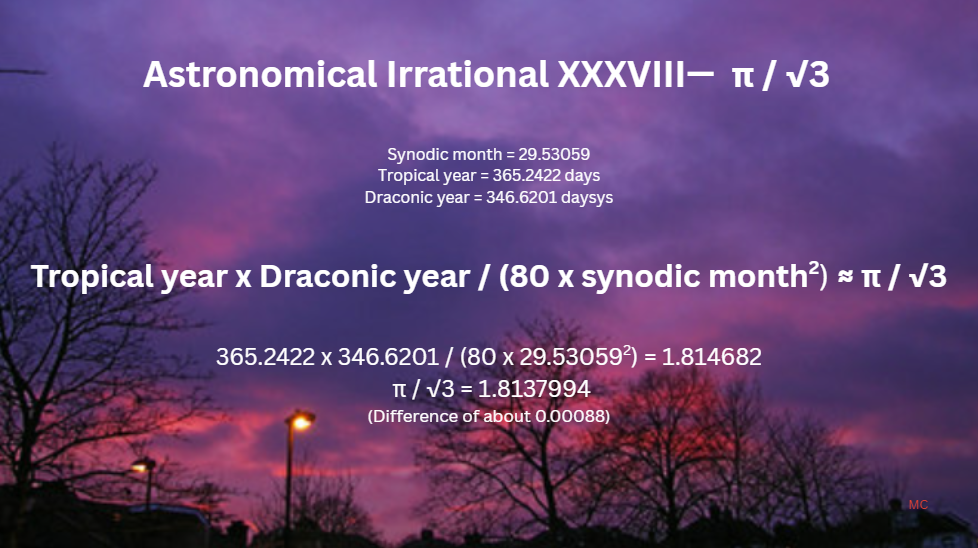
Several relations produce values close to π/√3. This constant is itself geometrically meaningful: it represents the interaction between circular geometry (π) and the geometry of the equilateral triangle (√3).
Astronomically, these relations emerge from combinations of:
the tropical year
the draconic year
the synodic month
the Metonic cycle
large planetary cycles including precession
In particular, relations involving the draconic year, which is the cycle governing the return of the Moon to its orbital nodes, naturally connect with eclipse cycles and the Saros framework. When these are combined with solar and lunar periods, the resulting ratios approach π/√3 with surprising closeness. This constant is also geometrically significant in hexagonal and triangular lattice structures, where √3 appears as the fundamental spacing relation.



√3 / φ and φ√3 — The Triangular and Pentagonal Systems
Other relations combine √3 with the golden ratio φ. These constants correspond to two distinct geometric families:
√3 arises from triangular symmetry
φ arises from pentagonal symmetry
Their combination therefore represents a meeting of two classical geometric systems.
In the astronomical relations presented here, these combinations often arise from the interaction between the Metonic cycle, the Saros cycle, and the synodic month. The recurrence of these cycles across many of the relations suggests that they form an important numerical framework within which these constants can emerge.
When expressed numerically, these relations produce approximations close to values such as √3/φ or φ√3, again illustrating how astronomical cycles can combine to produce geometric constants.


π√5 — Circular and Golden Geometry
Another mixed constant appearing in the relations is π√5. Since √5 underlies the golden ratio, this constant connects circular geometry (π) with the pentagonal system associated with φ. Relations of this type typically involve the sidereal month, sidereal year, and the Metonic cycle expressed in sidereal months. When combined with planetary periods such as the orbit of Mars, the resulting ratios approximate π√5 with notable accuracy.
Taken together, these mixed relations reveal something deeper than isolated numerical coincidences. The constants involved—π, φ, √2, √3 and √5—form the foundation of classical geometry. They describe the proportions of circles, squares, triangles and pentagons, the basic shapes from which much of mathematical geometry is constructed. The astronomical cycles that generate these approximations arise from entirely different phenomena: the motions of the Sun, Moon and planets across the sky. Yet when these cycles are combined in certain ways, they begin to reproduce the same constants that define geometric structure.
In this sense the relations presented here resemble a kind of algorithmic structure, in which one constant leads naturally to another. Circular geometry flows into triangular geometry, triangular relations into pentagonal ones, and the resulting constants combine again into new proportions.
From this perspective, the geometry associated with Giza may be understood not simply as static architecture but as a three-dimensional embodiment of mathematical relationships.
The constants π, φ and √3 appear repeatedly in the geometry traditionally associated with the Great Pyramid. If the astronomical relations discussed here were known or explored within ancient astronomical traditions, they would have provided a natural bridge between celestial cycles and geometric form. In that sense the architecture could be interpreted as a kind of celebration of numerical harmony, translating relationships discovered in the motions of the heavens into permanent geometric form on Earth. Whether these relations were intentionally encoded or are simply reflections of deeper mathematical structures remains an open question. Yet the recurrence of the same constants across astronomy, geometry and architecture suggests that the ancient fascination with number and proportion may have been rooted in the observation that the cosmos itself appears to follow these patterns.


It is perhaps fitting that such relations emerge from astronomical cycles, since for Plato the motions of the heavens were the clearest visible expression of mathematical order in the cosmos. In the Timaeus, he describes the universe as structured according to harmonic and geometrical principles, and the study of the heavens was therefore seen as a path toward understanding these deeper mathematical realities.
The recurrence of geometric constants in astronomical cycles can thus be seen not merely as numerical curiosities, but as reminders of the intimate relationship between astronomy and geometry that has fascinated thinkers since antiquity.
One reason that values close to π arise repeatedly in relations involving the Metonic cycle may lie in the nature of the cycle itself. The Metonic cycle links the two most important celestial bodies of the ancient world, the Sun and the Moon, often described symbolically as the two “eyes” of heaven, or the eyes of Horus in Egyptian thought. Nineteen solar years correspond closely to 235 lunar months, providing a remarkable reconciliation between solar and lunar time. Yet the two cycles are not perfectly commensurable: no exact integer relation exists between the solar year and the lunar month. In this sense the relation between these cycles resembles the famous incommensurabilities of geometry, such as the relation between the side and diagonal of a square, or between the diameter and circumference of a circle, where irrational numbers such as √2 and π arise. The Metonic cycle therefore represents a bridge between two motions that can only ever be approximately reconciled, and it is perhaps within this tension between commensurable numbers and incommensurable cycles that these approximations to geometric constants emerge.
B. From Astronomical Cycles to Monument Geometry
The astronomical relations explored in the preceding sections are not presented here as isolated numerical curiosities. The numbers involved are all derived from a study of the dimensions of the Pyramids of Giza, expressed in inches. the inch is perhaps the only unit of measure necessary to connect the dimensions to the proportions at Giza. Taken together, these relations suggest that the numerical system appearing in the pyramid’s dimensions may belong to a broader framework linking geometry, astronomy and number. The three pyramids of Giza could be understood not merely as a monument but as a geometric expression of astronomical knowledge, an attempt to embody numerical relationships discovered in the motions of the heavens within the proportions of architecture.
All the numbers in this study are based on the dimensions of the Giza plateau as given by W. M. F. Petrie, in The Pyramids and Temples of Gizeh (1883). The table below gives these measurements.
Structure / Feature | Measurement | Dimension (inches) |
Great Giza Rectangle | Width (east–west) | 29,227.2 |
Length (north–south) | 35,713.2 | |
Great Pyramid (Pyramid I) | Mean base side | 9,068.8 |
Base perimeter | 36,275.2 | |
Casing base side | 9,126 | |
Height | 5,776 | |
King’s Chamber | Mean length (north) | 412.40 |
Mean length (south) | 412.11 | |
Mean width (east) | 206.29 | |
Mean width (west) | 205.97 | |
Second Pyramid (Pyramid II) | Mean base side | 8,474.9 |
Height | 5,664 | |
Third Pyramid (Pyramid III) | Mean base side | 4,153.6 |
Height (core estimate) | 2,564 | |
Height (casing estimate) | 2,580.8 | |
Inter-pyramid distances | Great Pyramid → Second Pyramid (centre to centre) | 19,168.4 |
Great Pyramid → Third Pyramid (centre to centre) | 36,857.7 | |
Second Pyramid → Third Pyramid (centre to centre) | 17,873.2 |
These measurements form the numerical dataset from which the geometric relations explored in this study are derived. When treated purely as numbers expressed in inches, they generate a network of ratios linking astronomical cycles with the geometric constants π, φ, √2, √3 and √5.
Conclusion: An Algorithm Written in Stone
The relations explored in this study reveal a surprising pattern: when astronomical cycles are combined in certain ways, the resulting ratios repeatedly approach the fundamental irrational constants of geometry, such asπ, φ, √2, √3 and √5. These constants arise naturally in the geometry of circles, triangles, squares and pentagons, the shapes that form the foundation of classical mathematical thought. Astronomy and geometry might at first seem to belong to different domains: one to the motions of the heavens, the other to abstract mathematical form. Yet both are governed by the same underlying principle: the reconciliation of quantities that are fundamentally incommensurable. Solar years, lunar months and planetary cycles cannot be expressed as simple ratios of integers. Likewise, the diagonal of a square cannot be expressed exactly as a ratio of its side, nor can the circumference of a circle be expressed exactly in terms of its diameter.
When such incommensurable quantities are combined, irrational constants naturally emerge. It may therefore not be surprising that the motions of the heavens can produce numerical relations that approximate the same constants that appear in geometry.
What is remarkable, however, is the richness of the structure that emerges. Solar, lunar and planetary cycles combine to produce values close to π, the constant of the circle. Other combinations approach the golden ratio φ, long associated with proportion and harmony. Still others generate √2, √3 and √5, the geometric constants of the square, triangle and pentagon. When these constants are combined, further relations appear linking them together: π/√3, √3/φ, φ√3 and π√5.
Taken together, these relations form something resembling an algorithm of geometry, in which one constant leads naturally to another and one geometric form transforms into the next. Seen in this light, the architecture of Giza takes on a new and intriguing dimension. The Great Pyramid has long been associated with geometric constants such as π and √3. If astronomical cycles were indeed studied in ways that revealed these numerical relationships, it becomes possible to imagine the monuments not simply as structures of stone but as embodiments of mathematical insight. The pyramid, in this view, becomes a geometric expression of celestial order, a translation of relationships discovered in the heavens into architectural form on Earth. The constants that govern circles, triangles and proportions become not merely abstract mathematical ideas but physical dimensions expressed in stone. The example of Āryabhaṭa illustrates how such ideas could arise within a tradition of astronomical observation and numerical reasoning. Writing in the fifth century, he described the vast cosmological cycle of the yuga and calculated the number of revolutions of the Moon within it with remarkable accuracy. The proximity of this number to 10⁸/√3 reveals an unexpected connection between cosmic cycles and geometric proportion.
Whether the pyramid builders possessed knowledge of similar relationships remains unknown. Yet the possibility that such ideas belonged to a long-standing tradition of astronomical and mathematical reflection cannot easily be dismissed.
At the very least, the patterns explored here remind us of something that fascinated ancient thinkers from Egypt to Greece and India: that the cosmos appears to be governed by number. Geometry, astronomy and proportion are not isolated disciplines but different expressions of the same underlying order. If the monuments at Giza encode anything, it may not be a secret message but something simpler and perhaps more profound: a celebration of the remarkable harmony between number, geometry and the motions of the heavens.
In the Mathematical Preface to Euclid (1570), John Dee distinguishes between “Number Numbryng” and “Number Numbred.” The latter refers to number as applied to objects: three lions, three stones, three stars. But the former refers to number as an ordering principle inherent in creation itself. According to Dee, this divine numbering is the act by which the cosmos is structured. If the universe itself is governed by such numerical relationships, it becomes plausible that astronomical cycles might reveal harmonic patterns underlying cosmic order.
Of my former wordes, easy it is to be gathered, that Number hath a treble state: One, in the Creator: an other in euery Creature (in respect of his complete constitution:) and the third, in Spirituall and Angelicall Myndes, and in the Soule of mã. In the first and third state, Number, is termed Number Numbryng. But in all Creatures, otherwise, Number, is termed Nũber Numbred. And in our Soule, Nũber beareth such a swaye, and hath such an affinitie therwith: that some of the old Philosophers taught, Mans Soule, to be a Number mouyng it selfe. And in dede, in vs, though it be a very Accident: yet such an Accident it is, that before all Creatures it had perfect beyng, in the Creator, Sempiternally. Number Numbryng therfore, is the discretion discerning, and distincting of thinges. But in God the Creator, This discretion, in the beginnyng, produced orderly and distinctly all thinges. For his Numbryng, then, was his Creatyng of all thinges. And his Continuall Numbryng, of all thinges, is the Conseruation of them in being: And, where and when he will lacke an Vnit: there and then, that particular thyng shalbe Discreated. Here I stay. But our Seuerallyng, distinctyng, and Numbryng, createth nothyng: but of Multitude considered, maketh certaine and distinct determination. And albeit these thynges be waighty and truthes of great importance, yet (by the infinite goodnes of the Almighty Ternarie,) Artificiall Methods and easy wayes are made, by which the zelous Philosopher, may wyn nere this Riuerish Ida, this Mountayne of Contemplation: and more then Contemplation. And also, though Number, be a thyng so Immateriall, so diuine, and æternall: yet by degrees, by litle and litle, stretchyng forth, and applying some likenes of it, as first, to thinges Spirituall: and then, bryngyng it lower, to thynges sensibly perceiued: as of a momentanye sounde iterated: then to the least thynges that may be seen, numerable: And at length, (most grossely,) to a multitude of any corporall thynges seen, or felt: and so, of these grosse and sensible thynges, we are trayned to learne a certaine Image or likenes of numbers: and to vse Arte in them to our pleasure and proffit. So grosse is our conuersation, and dull is our apprehension: while mortall Sense, in vs, ruleth the common wealth of our litle world. Hereby we say, Three Lyons, are three: or a Ternarie. Three Egles, are three, or a Ternarie. Which* Ternaries, are eche, the Vnion, knot, and Vniformitie, of three discrete and distinct Vnits. That is, we may in eche Ternarie, thrise, seuerally pointe, and shew a part, One, One, and One. Where, in Numbryng, we say One, two, *.ijThree. But how farre, these visible Ones, do differre from our Indiuisible Vnits (in pure Arithmetike, principally considered) no man is ignorant. Yet from these grosse and materiall thynges, may we be led vpward, by degrees, so, informyng our rude Imagination, toward the cõceiuyng of Numbers, absolutely (:Not supposing, nor admixtyng any thyng created, Corporall or Spirituall, to support, conteyne, or represent those Numbers imagined:) that at length, we may be hable, to finde the number of our owne name, gloriously exemplified and registred in the booke of the Trinitie most blessed and æternall.
In mathematics an irrational number represents a ratio that cannot be fully captured by any finite sequence of digits or any exact fraction of whole numbers. And yet these quantities emerge naturally from simple geometric figures. The diagonal of a square yields √2. The proportions of the pentagon reveal φ. The circle gives rise to π. Geometry therefore contains within it relationships that are both precise and inexhaustible, relationships that exist independently of any particular measurement system.
For the philosophers of antiquity this fact was profoundly meaningful. Thinkers such as Pythagoras and Plato regarded mathematics not merely as a practical tool but as a pathway toward understanding the underlying order of reality. In Plato’s cosmology the universe itself is structured through geometric forms. Matter emerges from triangles, which combine to produce the regular solids, and the harmony of the cosmos reflects mathematical proportion. Geometry was therefore understood as a bridge between the visible world and the intelligible structure that underlies it.
Seen in this light, the appearance of geometric constants within astronomical cycles becomes philosophically suggestive. The heavens move according to measurable rhythms: the revolutions of planets, the phases of the Moon, the slow turning of the equinoxes. Yet when these rhythms are examined through the lens of number, they sometimes reveal relationships that echo the irrational constants of geometry. The cosmos, in other words, can be read simultaneously as a system of cycles and as a field of proportions. The cycles of the sun and the moon can be described as incommensurable, just like the circumference and diameter of a circle: you can never quite fully capture the measure of one, by the other.
It is within this broader context that monumental structures such as the pyramids of Giza pyramid complex take on renewed significance. Their immense triangular faces, precise orientation, and geometric simplicity give the impression of architecture conceived as a physical expression of mathematical order. Whether or not these monuments were ever used for philosophical instruction or ritual initiation cannot be known with certainty. Yet their form alone reflects an understanding that geometry possesses a symbolic and cosmological dimension.
If the ancient world indeed regarded mathematics as a pathway toward contemplation of the cosmos, then the study of number was never intended to remain purely abstract. It was meant to lead the mind upward, from measurement to proportion, from proportion to geometry, and from geometry to an understanding of the structure of reality itself. Plato expressed this beautifully when he wrote that geometry has the power to turn the soul toward being.
In this sense the relationships explored here may be viewed not simply as numerical curiosities but as invitations to contemplation. The heavens move in cycles; geometry expresses relationships that transcend finite measurement; and between them there occasionally appear resonances that hint at a deeper harmony. Whether you interpret these patterns as coincidences, as traces of ancient astronomical insight, or as reflections of a profound mathematical structure underlying nature, the result is the same: the study of number becomes an act of wonder. And perhaps this was always the deeper purpose of mathematics. Not merely to calculate, but to reveal that the universe itself is written, in some mysterious way, in the language of geometry.
It is sometimes suggested in later philosophical and esoteric traditions that Greek thinkers such as Pythagoras and Plato travelled to Egypt and studied with the priests there. Ancient writers do indeed describe Greek philosophers learning mathematics, astronomy and theology from Egyptian temple scholars, although the precise details remain uncertain. Whether or not these journeys occurred exactly as later accounts describe them, the idea of a transmission of cosmological knowledge between Egypt and Greece has long fascinated historians and philosophers alike.
The great monuments of Giza pyramid complex invite a different kind of interpretation from the strictly funerary one usually proposed. Egyptian royal tombs elsewhere in the Nile valley are typically cut into rock and richly decorated with texts and images describing the journey of the soul. The pyramids at Giza, by contrast, are strikingly austere structures: vast geometric forms of stone, largely devoid of internal decoration and dominating the plateau with an almost abstract simplicity. Their design seems to emphasise proportion, orientation and geometry rather than narrative imagery. Seen from this perspective, you can imagine these structures functioning not merely as monuments to the dead but as places of ritual encounter with cosmic order. Their precise alignment to the cardinal directions, their massive scale and their mathematical proportions suggest a symbolic architecture in which geometry itself becomes the language of the sacred. Within such a framework, the pyramid could be understood as a kind of stone diagram of the cosmos, a place where astronomical observation, mathematical reflection and religious ritual converged.
In such a setting it is tempting to imagine rites of instruction or initiation taking place. Later traditions, including certain strands of Renaissance Hermeticism and modern fraternal orders, describe initiatory ceremonies in which symbolic journeys through darkness and light represent the awakening of knowledge. Whether or not anything similar occurred in ancient Egypt cannot be demonstrated, yet the architectural drama of the pyramids, descending passages, ascending galleries and chambers aligned with the stars, naturally invites such imaginative interpretations. It's not difficult picture students or priests undergoing symbolic experiences designed to impress upon them the harmony of the heavens and the mathematical order of the universe. If the pyramids were indeed conceived as monumental expressions of similar principles, the idea that they once served as places of philosophical or religious instruction becomes at least an intriguing possibility. These reflections remain speculative. Yet they point toward a deeper intuition shared by many ancient traditions: that geometry, astronomy and spiritual insight are intimately connected, and that the contemplation of cosmic order can itself be a form of initiation.
Plato repeatedly emphasised the philosophical importance of mathematical study. In the Republic he famously remarked that geometry has the power to turn the soul toward truth, writing that geometry compels the soul to contemplate being. Mathematical contemplation was therefore not simply a technical discipline but a pathway toward understanding the structure of reality itself. Seen in this light, the possibility that ancient monuments might encode astronomical and geometric relationships becomes less surprising. Whether or not such intentions can be demonstrated in every case, the intellectual environment of antiquity clearly linked cosmology, mathematics, and spiritual reflection in a profound way.
Interestingly, similar ideas appear in other ancient traditions. A passage from the Sanskrit astrological text the Brihat Parāśara Horā Śāstra describes the cosmos as structured in four divisions corresponding to parts of the divine body. The universe itself is described as “chaturvidha,” or four-fold, created in accordance with the attributes of the divine. The notion of a four-sided or four-part cosmic order resonates strongly with geometric symbolism, recalling the four directions, the square as a symbol of the world, and the pyramidal forms that arise when triangular faces meet at a single apex. Such parallels do not imply direct historical connection, but they do illustrate a broader pattern in ancient thought: the conviction that the structure of the cosmos can be understood through number, proportion, and geometry. Across cultures, mathematical relationships were seen not merely as abstractions but as reflections of the deeper order of the universe.
At first the immersion in numbers may seem unappealing, like the thought of a sea swim in winter perhaps. Yet as the patterns begin to emerge, the experience becomes something quite different. Numerical relationships linking planetary cycles, lunar months and geometric constants begin to reveal a kind of hidden harmony. What initially appears dry gradually unfolds into something unexpectedly beautiful.
Unlike the richly decorated rock-cut tombs of the Nile Valley, the pyramids present an austere architectural language dominated by pure geometric form: triangular faces, cardinal orientation, and immense proportional precision. Such characteristics suggest monuments conceived not merely as sepulchral structures but as embodiments of cosmological order. If ancient philosophers such as Pythagoras or Plato encountered Egyptian traditions linking astronomy, number, and sacred architecture, as several classical sources suggest, it is tempting to imagine the pyramids as part of a broader intellectual landscape in which geometry, astronomical observation, and spiritual contemplation were deeply intertwined. Whether or not these monuments ever served as settings for formal rites of instruction or initiation cannot be known. Yet as monumental expressions of geometric and celestial order, they stand as powerful reminders that for many ancient cultures the contemplation of number and form was inseparable from the search for deeper truths about the cosmos.
Thank you to Andrew Christie for sharing the Brihat Parāśara Horā Śāstra text. And thank you to feedback and many ideas in the Discord chat, especially from Ryan Seven.
Very special thanks to Jim Wakefield, for showing how the sun, moon and planets worked at Giza, and to the imcomparable and magical Dennis Payne and David Kenworthy!


Congratulations on 100 papers and what a great paper this is!! Far beyond the curve.