
105. Where the Nectar Fell: Sacred Place and Solar Rhythm in the Kumbh Mela

Updated: Aug 22
Earlier this year, 2026, in January, an event that comes only once in many generations unfolded at Prayagraj, in India: the Maha Kumbh Mela. This momentous festival periodically brings about a convergence of people so vast that it is often described as the largest gathering of humanity on Earth. For forty-five days, millions of faithful pilgrims entered the waters at an astronomically significant time, to participate in a cosmic rhythm that has been observed for centuries. To an outside observer, the spectacle might look like an immense pilgrimage which returns at a regular interval. It is sometimes said that the Kumbh Mela takes place every three years at one of four cities, returning to each city every twelve years. That is a useful first approximation, but only an approximation. Unlike the Olympics, this is not a simple four-year cycle transferred in turn from one host city to another.
This cosmic rhythm follows the movements of Jupiter, the Sun and the Moon. As the orbital period of Jupiter is approximately 12 years long, each one of the four sites hosts the Maha Kumbh Mela once every twelve years. Jupiter travels along the ecliptic, through the twelve zodiac signs, and so spends approximately one year in each sign. The planet also appears to move slowly across the background stars over the course of a single night. Over a period of weeks, Jupiter’s eastward drift among the stars becomes noticeable, shifting its position slightly within the zodiac.
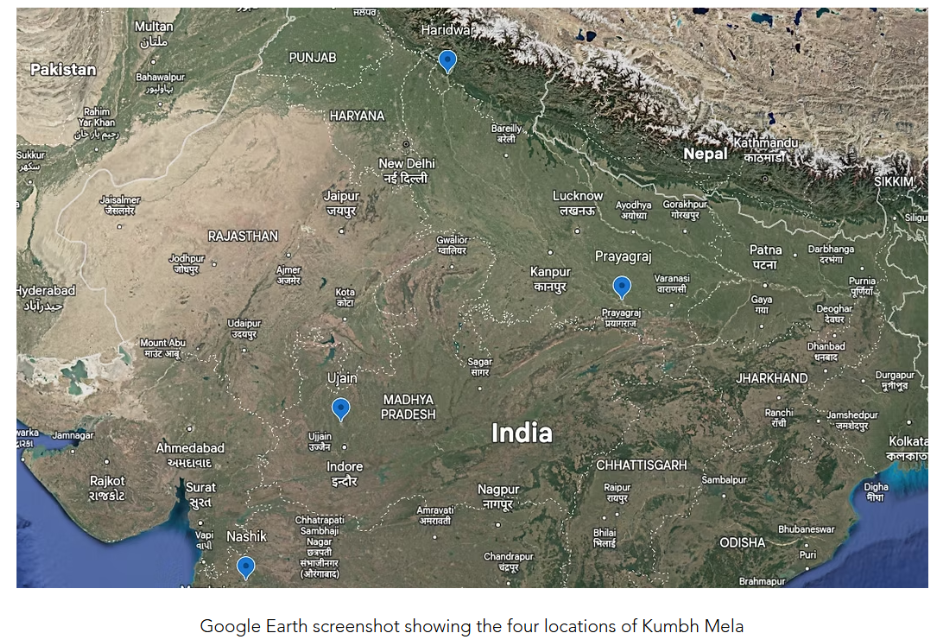
The four recognised sites are Prayagraj, Haridwar, Nashik–Trimbakeshwar and Ujjain. Each is associated with a sacred river, and each festival requires a particular relationship between Jupiter, the Sun and, on the principal bathing days, the Moon. Jupiter, known in Hindu tradition as Bṛhaspati, the teacher of the gods, provides the slow rhythm. The Sun supplies the season, while the Moon identifies particular sacred days within it. The result is not a mechanical timetable but a set of interlocking celestial conditions.
Why should a bathing festival be governed by planets? Why these four places among the countless sacred river sites of India? The traditional answer begins in a cosmic ocean.
The Myth

Myth offers an answer: these are the places where drops of amrita, the nectar of immortality, fell to Earth during the cosmic churning of the ocean. The Kumbh Mela derives its origins from the Samudra Manthan myth, according to which gods and demons churned the cosmic ocean to extract the nectar of immortality.
Depictions of the myth often show a strange scene: a central pillar of rock is at the centre. A huge snake is wrapped once around its base, its head (or heads) and tail are stretched out, and held up by parties of strange beings, who seem to be taking it in turn to tug on the snake's body. The base of the rock is quite thin and is submerged in water, resting on the back of a turtle. Sitting cross-legged on top of the rock is a god. The land above the water is populated by strange creatures. What does this mean, and how does it relate to this bathing festival?
The story is told in several forms in the Mahabharata and the Purāṇas. At its beginning, the devas, the gods, have lost their strength. In one well-known version, the irascible sage Durvāsas gives Indra a divine garland. Indra places it carelessly on his elephant, which throws it to the ground. Durvāsas curses the gods, and their vitality begins to ebb away. Their enemies, the asuras, gain the advantage.
The devas appeal to Vishnu. His solution is surprising: they must make a temporary alliance with their rivals. Hidden in the Ocean of Milk is amṛta, the nectar which overcomes death, but it can be obtained only if the ocean itself is churned. Gods and asuras must perform the impossible task together. They uproot Mount Mandara to use as a churning rod and persuade the enormous serpent Vāsuki to serve as the rope. The serpent is wound around the mountain. The devas take one end and the asuras the other; by pulling alternately, they cause the mountain to turn backwards and forwards.
But the mountain has no footing. It begins to sink into the depths. Vishnu then assumes the form of Kūrma, the great tortoise, descends beneath the waters and supports the mountain upon his shell. An axis has been established: tortoise below, mountain at the centre and serpent encircling it, while two opposing powers set the whole apparatus in motion.
The Churning
The churning does not immediately produce the treasure the gods seek. First it disturbs everything hidden in the deep. The earliest substance to emerge is hālāhala, a poison powerful enough to destroy creation. Shiva takes it into his throat to save the world; Pārvatī prevents it from passing farther into his body, and his throat turns blue. This is why Shiva is called Nīlakaṇṭha, the blue-throated one. Before immortality can appear, the poison concealed within the ocean must be brought to the surface and contained.
The ocean then yields a succession of marvellous beings and objects. Lists differ between texts, but they include Lakṣmī, goddess of fortune; the Moon; the white horse Uccaiḥśravas; the elephant Airāvata; the wish-granting cow; celestial nymphs; jewels and divine medicines. At last Dhanvantari, physician of the gods, rises from the waters carrying the coveted vessel, the kumbha, filled with this magical substance, amṛta.
The alliance immediately collapses. Gods and asuras struggle for the vessel. In later tellings, Jayanta, the son of Indra, carries it away while the asuras pursue him. Vishnu also appears as Mohinī, an enchantress of irresistible beauty, and persuades the asuras to allow her to distribute the nectar. She gives it instead to the devas. One asura, Rāhu, disguises himself and manages to taste it, but the Sun and Moon expose him. Vishnu severs his head; because the nectar has touched his lips, the head remains immortal and periodically pursues the Sun and Moon, causing eclipses. The nectar is saved, but not every drop remains in the vessel.
Where the nectar touched the Earth
During the pursuit, according to the tradition now inseparable from the Kumbh Mela, drops of amṛta fall at four earthly places. One falls at Prayagraj, at the confluence of the Ganga, Yamuna and Saraswati. Another falls at Haridwar, where the Ganga leaves the Himalayas and enters the plains. A third sanctifies Nashik–Trimbakeshwar on the Godavari, the “Ganga of the South”. The fourth falls at Ujjain on the Shipra, the city of Mahākāla, Shiva as lord of time.
At the correct celestial moment, the rivers at these places are believed to recover the potency of the primordial nectar. Bathing is therefore much more than physical immersion. The pilgrim enters a conjunction of mythic time, celestial time and earthly place.
Yet this elegant story contains a historical puzzle. The four places are all ancient centres of pilgrimage, but it is difficult to find an early text which groups these four, and only these four, as the sites at which the nectar fell. Prayāga is praised in the Mahabharata as an exceptionally sacred bathing place. Tryambaka and the Godavari, Ujjain and Mahākāla, and Haridwar and the Ganga each belong to old, but partly independent, sacred geographies. They recur in traditions of tīrthas, jyotirliṅgas and, in some cases, Śakti Pīṭhas, but not as one stable set.
The rivers at these sites are believed to carry the essence of the spilled Amrita, granting purification and liberation to those who bathe in them during the Kumbh Mela. Yet, one might think that the rivers that run through these cities would be equally sacred all along their courses. Why do they become especially potent at these specific places? Perhaps, in the case of Prayagraj, it’s because of the Triveni Sangam, that is, it is the meeting point of the Ganga, Yamuna, and Saraswati rivers. This confluence symbolises unity and the merging of divine energies. But what about the other three cities? What is it about Haridwar, situated on the banks of the Ganga, which qualifies it as a gateway to the heavens? And what does Ujjain, with its feet washed by the Shipra River, and protected by the deity Mahakaleshwar, a form of Shiva, have to do with the cyclical nature of time and cosmic order? Nashik, on the Godavari River, is often referred to as the "Ganges of the South", but why does it hold immense spiritual significance?

The Turtle
These wonderful stories are based on solid astronomy and mathematics. One clue is the turtle: this creature is the foundation upon which the churning can take place.
In Hindu mythology, the role of the cosmic turtle appears in the churning of the ocean (Samudra Manthana), where Vishnu takes the form of Kurma, the tortoise, to support Mount Mandara as it is used to churn the primordial waters. Here the turtle does not depict the cosmos directly, but serves as its foundation, bearing the axis of transformation as the forces of creation are set in motion.
The tortoise deserves attention because it is not a decorative participant. Without Kūrma, the mountain disappears into the unformed ocean and no churning is possible. The animal represents stability beneath movement: a foundation firm enough to support transformation.
Tortoises and turtles lend themselves naturally to cosmological thought. Their upper shell resembles a dome, their lower shell a plane, and their patterned scutes suggest an ordered division of space or time. Numerical claims about a universal thirteen-fold turtle shell should be treated cautiously, since shell patterns differ by species and individual, but the wider symbolism is clear. The living animal seems to carry a structured world on its back.
Comparable images occur far beyond India. In several Mesoamerican traditions, a cosmic turtle is associated with the Earth and the place of creation, and the Maize God emerges from a cracked carapace. These traditions should not be collapsed into one another, but they share a striking intuition: before the ordered world can emerge, it requires a living foundation.
In the churning myth, the tortoise supports not simply the world but an operation. Above its back, opposing powers create motion; within that motion, danger and treasure appear together; from it come the Moon, medicine and the nectar that escapes death. Kūrma is the still point beneath time.
In the churning of the ocean, Vishnu assumes multiple forms, supporting the process as the tortoise Kurma and later guiding its outcome as the enchantress Mohini, so that the devas ultimately prevail. The narrative presents these transformations as expressions of Vāsudeva, the underlying divine principle through which the entire cosmic drama unfolds. In Hindu cosmology, Vishnu is closely associated with the structure of time itself. “Vasudeva is the origin of the universe. He is the supreme cause of all the worlds. It was due to Vispu’s grace that everything took place favouring the realization of Devas* objectives.” In the Bhagavad Gita, he declares, “Time am I, destroyer of worlds,” identifying himself not merely with the passage of time but with its underlying force. In the Vishnu Purana, he is described as the source of creation, preservation, and dissolution, the principle through which the great cycles of the universe unfold. Time, in this sense, is not abstract, but embodied, structured, sustained, and ultimately governed by the divine.
Most turtles have 13 divisions on their shells. These divisions may symbolise the 13 months in a year of 364 days, which is one among several ancient ways of thinking of the year (others being the tropical, the sidereal, etc.) Indeed 13 periods of 28 days make up such a year. In Mesoamerica, the structuring of time around the number thirteen is particularly clear in the 260-day ritual calendar (Tzolk’in), which combines a cycle of thirteen numbers with twenty named days, producing a repeating sequence fundamental to divination and cosmology. In Maya iconography, the so-called Cosmic Turtle, a being linked to the earth and the place of creation, is sometimes depicted with thirteen divisions or markings on its shell, from which the Maize God emerges at the beginning of the current world age. The turtle thus functions as a cosmological support, a living foundation upon which the ordered world is established. While the pairing of 13 with 20 is more explicit in Mesoamerican calendrics than any direct 13–28 scheme, the recurrence of thirteen as a structuring number, and its association with both time and the architecture of the cosmos, offers a suggestive parallel to other traditions in which numerical patterns are embedded in both myth and the natural world. Furthermore, if the sidereal periods of the seven classical planets are multiplied together, expressed in earth sidereal years, and multiplied by 50, the result is 364 also. Precessional time, the slow turning of the heavens, so often seems to rest on a framework built from these same numbers.

Turtle shells, Dublin Zoo, my photo
The Timing
The timing presents a second puzzle. even though the cycle of four sacred sites corresponds to a twelve year period, the Mela does not simply move to a new city every three years, so that each city receives it every twelve.
The reason begins with Jupiter. The planet takes approximately 11.86 years, not exactly twelve calendar years, to complete its orbit and return to the same region of the zodiac. It spends roughly, but not uniformly, a year in each sign. The Kumbh at a particular site therefore recurs approximately every twelve years, although an eleven-year interval occasionally becomes necessary as the astronomical and calendrical cycles slip against one another.
The location of each festival depends on just where Jupiter will be in the sky, always one of four places in India. For instance, when Jupiter is in the constellation Taurus (Vṛṣabha), and the Sun is in Capricorn, then the Kumbh Mela will take place in Prayagraj. When Jupiter is in Aquarius (Kumbha), and the Sun in Aries, then the festival will take place in Haridwar. For the festival to take place in Nashik, Jupiter must be in Leo (Siṃha) and the Sun in Cancer. And for Ujjain, Jupiter will be in Leo and the Sun in Aries. Different authorities sometimes give variant formulations, especially for the Moon and alternative configurations. That variation is itself instructive. The festival is not generated by one modern astronomical equation. It belongs to a luni-solar calendar informed by traditional astrology, local practice and decisions made by religious authorities.
But why must Jupiter be in Leo for two of the festivals, Nashik and Ujjain? It seems somehow asymmetrical. In fact it seems there are historical reasons for this, from the 18th century. whatever the reason, the four-site sequence is uneven. Nashik and Ujjain both depend upon Jupiter’s passage through Leo and may occur in the same year or in adjacent years. Prayagraj and Haridwar also hold intervening six-year festivals, traditionally called Ardh Kumbh or “half Kumbh”, although official naming has changed in recent years. Prayagraj, moreover, has an annual Māgh Mela, of which the twelve-year gathering is a magnified form. Sometimes several years separate major events; sometimes two crowd together. “Every four years” conceals exactly what is most interesting about the system.
The Kumbh calendar keeps several cycles in conversation: Jupiter’s almost-twelve-year circuit, the Sun’s year, the Moon’s phases and months, and the inherited ritual identity of each place. It is regular without being mechanically periodic.
What is Being Churned?
We can now return to the strange machine at the centre of the myth. A mountain stands upright in a cosmic sea. A serpent is wound around it. Opposing powers pull in turn. A tortoise provides the stable foundation. The operation releases the Moon, poison, treasures and the drink of immortality. Is this only a story about divine conflict, or does it also preserve a way of imagining the sky? Like all myths, it can be read on more than one level, spiritual, social, psychological or cosmic. Is this the churning of the mind, from which both poison and wisdom emerge? Or perhaps a representation social and cosmic cooperation between opposites? The imagery also invites an astronomical reading.
To see why, we must first imagine the sky as ancient observers experienced it. The stars do not look like objects scattered through infinite emptiness. They appear to form a vast sphere surrounding the Earth. During the night that sphere seems to turn around a fixed point near the celestial pole. An upright cosmic mountain is therefore a natural image of an axis; a serpent wound around it evokes circular or spiral motion; and the forces pulling from opposite sides reproduce the alternating action by which rotation is generated. The tortoise below gives the moving axis a stable base. So the stuff being churned must be the Milky Way, but why is it being stirred in this way?
One theory is precession. The celestial pole is not perfectly fixed. The Earth rotates on a tilted axis, and that axis slowly changes its direction like the stem of a spinning top. This movement is called axial precession. Over approximately 25 772 years, the north celestial pole traces a circle among the stars. Polaris is our pole star only for the present era. Thousands of years ago the pole lay nearer Thuban in Draco; thousands of years from now it will point elsewhere. Precession also moves the equinoctial points westward against the background constellations. The Sun still reaches an equinox every spring and autumn, but the stellar backdrop at those moments changes very slowly. A shift invisible within a single life becomes unmistakable across centuries of careful observation. The entire framework by which heavenly and seasonal time are related appears to turn.
The myth gives us an axis which is not merely standing but being turned; a great serpent associated cross-culturally with the winding northern sky; an ocean out of which the Moon and measures of time emerge; and a divine tortoise that stabilises the operation. Vishnu, who becomes the tortoise and later Mohinī, is repeatedly associated in Hindu thought with the maintenance of cosmic order across immense cycles of creation and dissolution. The churning may therefore be read as an image of cosmic time generated by rotation around an axis. If the tugging by two opposing parties suggests alternate directions in the rotation of this pillar, then this could mean two things: either it is a reference to the fact that the stars seem to rotate in the opposite direction to the planets, as seen from earth, so that there are two alternating opposite motions at play at once. Moreover, occasionally Mercury and Venus also seem to move in the opposite direction, when they are retrograde. The other possibility is that this alternate tugging is the source of energy, and opposing forces, as we see in the Chinese concept of yin and yang. In this way, the energy that sets in motion the circular movement of our galaxy, and the planets within, are presented as containing opposing forces. These opposing forces form the basis of a view of the world in which dualisms are important, such as masculine and feminine, heaven and earth, light and darkness, etc. this would tie in with the symbolism present in some figures derived from Ophiuchus, when they are asociated with a conflict. For example, Thor, Saint Michael or Saint George and the dragon (Scorpio). The conflict between the two opposing forces is never quite resolved.

The Milky Way as a River
What is this milky ocean? There is another clue overhead. Every unaided star visible from Earth belongs to our galaxy, but the luminous band we call the Milky Way is produced by looking through the denser plane of that galaxy. Here on Earth, we’re on an outer arm of the spiral that is our galaxy. Across many cultures it has been imagined as milk, a road or a celestial river.
In Sanskrit it is Ākāśa Gaṅgā, the Ganga of the sky. The heavenly and earthly rivers mirror one another. The Purāṇic Ganga descends from heaven, and Shiva receives her in his hair so that the force of her fall does not shatter the Earth. At Mamallapuram, the vast rock relief known as the Descent of the Ganges turns this descent into stone; water may once have flowed through its central cleft.
This celestial-river idea is not confined to India. The Chinese “River of Heaven”, the Japanese Amanogawa, and numerous river and path traditions elsewhere locate a flowing waterway among the stars. An Irish poem in the Metrical Dindshenchas links the Boyne with other great rivers of the known world. Such comparisons do not prove a common origin, but they show how readily human observers understand the Milky Way as a current crossing the night.
The Ocean of Milk can thus be imagined as the luminous substance of the heavens, while its churning describes the revelation of celestial order from that brightness. The resemblance is especially arresting near the Galactic Centre in Sagittarius and Ophiuchus. Ophiuchus-derived figures are usually shown as tall figures, perhaps grasping a serpent, perhaps holding an item in each hand, standing above Scorpio. Sometimes they are part serpentine. Sometimes even they are a conical rock, or figure imprisoned in rock. The configuration of the churning of the Milky Ocean scene recalls a central bearer, a great snake and an animal below. This is not an exact one-to-one identification of Mandara, Vāsuki and Kūrma, but it may be another reason the myth feels written into the stars.
In the Bay of Bengal, there is a giant rock relief that tells the story of the descent of the sacred river from the sky down on to Earth. It tells the story of the river goddess Ganga who was led by a king named Bhagiratha, with the help of Shiva to break her fall. Bhagiratha's ancestors had suffered a curse, which he hoped to break, and it was in order to achieve this that he looked to Ganga for help. When the sacred waters arrived on Earth they caused havoc and filled up the sea. A sage called Rishi Jahnu was angered by the destruction so he drank up all the water, but then let it out again through his ear so that the souls of the ancestors of Bhagiratha could be released. The rock relief once had water flowing down the central panel.

Panoramic view of the Descent of the Ganges relief, photo Ssriram mt,Wikimedia Commons
Five Rivers: The Ganges, Yamuna, Saraswati, Godavari, and Shipra
Of course, there are many sacred rivers in India. The rivers associated specifically with the Kumbh Mela are the Ganges, Yamuna, Saraswati, Godavari, and Shipra, are all seen as earthly manifestations of cosmic pathways. This association reinforces the festival’s theme of aligning earthly actions with cosmic principles. These sites have since become the focal points of the Kumbh Mela, where pilgrims gather to bathe in sacred rivers, seeking purification and spiritual renewal. The drops of Amrita fell at these locations at specific cosmic moments when the alignment of Jupiter, the Sun, and the Moon occurred. This celestial alignment repeats every 12 years, and during the Kumbh Mela, it is believed that the rivers are re-energised with the same spiritual potency.
The five rivers of the Kumbh landscape can be seen as more than separate waterways. Each forms a local threshold, a tīrtha, a word which means a ford or crossing-place. At the correct moment, the crossing is not only from one riverbank to another but between ordinary and sacred time.
Prayagraj makes the principle visible through confluence: two rivers can be seen and a third is apprehended through tradition. Haridwar marks a transition in the Ganga’s geography, where the mountain river reaches the plains. Nashik and Trimbakeshwar connect the Godavari with the source, with Shiva, and with episodes from the Ramayana. Ujjain joins the Shipra to Mahākāla and to a city that became a major centre of Indian astronomy and a reference meridian for geographical calculation.
In a passage of the Skanda Purana, the ocean is described as “the mouth of all the rivers,” while the earth, Mahī, is invoked as their mother and as the embodiment of all sacred places. The image is both simple and profound: rivers flow outward across the land, only to return to a single source, while the earth itself is conceived as a living, generative whole. . Across many ancient traditions, rivers are not merely geographical features, but expressions of a deeper order, cycles of flow, return, and renewal that bind the landscape to the cosmos.

Looking for the Sacred Sites of the Kumbh Mela in Historical Texts
A passage in the Skanda Purana offers a revealing glimpse into an earlier layer of sacred geography. In listing the manifestations of the liṅga across the three worlds, the text includes a wide range of sites:
“...Lord Visveśvara in Kāśī, Laliteśvara in Prayāga, Triyambaka in Brahmagiri (Nasik District)… Kedāra… Someśvara in Saurāṣṭra… Śikhareśvara on Śrīśaila… and many other liṅgas… installed in all the three worlds for the welfare of the universe.”
Within this extended catalogue, three of the four later Kumbh Mela sites can be identified, though not always under their modern names. Prayāga appears explicitly; Tryambaka, associated with Brahmagiri, corresponds to the Nashik region; and Ujjain is represented through the shrine of Mahākāla, one of its principal forms of Śiva. These sites are not singled out, however, but appear alongside many others, including Kāśī (Varanasi), Kedarnath, Somanath in Saurashtra, and Śrīśaila in the south, forming part of a broad and distributed sacred landscape.
Notably absent from this list is Haridwar, the fourth of the Kumbh Mela locations. Its omission is striking, though not entirely surprising: Haridwar is primarily associated with the Ganges rather than with a major liṅga shrine, and tends to appear in other textual traditions, particularly those centred on the sanctity of the river itself.
The passage as a whole suggests that the now-familiar grouping of four Kumbh sites did not originate as a fixed set within early Purāṇic literature, but rather emerged later from a much wider network of sacred places, only subsequently brought together under a single mythic framework. Searching for an ancient origin for these four sites as a group associated with the Kumbh Mela is difficult.
But Why Those Four Sites?
The four sites associated today with the Kumbh Mela each have deep and independent textual roots, but they do not appear together as a unified group in the earliest sources. Prayāga (Prayagraj) is already praised in the Mahabharata as one of the most sacred places for ritual bathing; the Nashik region, associated with Tryambaka and the Godāvarī, appears in Purāṇic literature such as the Vishnu Purana; Ujjain, under names such as Avantī and through the shrine of Mahākāla, is well attested across the Purāṇas; and Haridwar, as a gateway to the Ganges, emerges in river-centred traditions of similar date. Yet there appears to be no early textual source that clearly unites these four, and only these four, with the story of the amṛta. That association seems to crystallise much later, in medieval tradition, suggesting that the familiar grouping may owe as much to the development of pilgrimage networks and oral transmission as to any single original narrative. Somewhat surprisingly, the historical linking of these four places is therefore less straightforward than one might expect. While the association of the four Kumbh Mela sites with the falling of amṛta is widely repeated today, it is difficult to locate in early textual sources. By the Mughal period, works such as the Ain-i-Akbari of Abu al-Fazl clearly attest to large-scale bathing festivals at Prayāga, indicating that the ritual system was already well established. However, the explicit narrative linking four specific locations, Haridwar, Prayāga, Nashik, and Ujjain, to drops of the nectar emerges more clearly in later pilgrimage literature and becomes fully articulated in early colonial descriptions by scholars such as H. H. Wilson and Monier-Williams. These accounts suggest that the familiar story represents a relatively late consolidation of earlier ritual practices and regional traditions.
A suggestive parallel emerges in the tradition of the Śakti Pīṭhas, in which the dismembered body of the goddess is said to have fallen across the landscape, each location becoming a site of enduring sacred power. Lists of these places, preserved in later texts and recorded in sources such as the Ain-i-Akbari, include several locations that overlap with the later Kumbh Mela geography. Prayāga appears explicitly, associated with the falling of the fingers, while Ujjayinī is also named, and the Godāvarī region, linked to Nashik, is likewise included. Yet the correspondence is incomplete: Haridwar, one of the four Kumbh sites, does not appear in this list. A similar partial overlap can be observed in the tradition of the twelve jyotirliṅgas, the “columns of light” in which Śiva is said to have manifested, where Ujjain (Mahākāla) and Tryambakeśvara (Nashik) are again present, but without forming an identical grouping. What emerges from these comparisons is not a single fixed system, but a series of intersecting sacred geographies, networks of places that are variously linked through myth, ritual, and theology. The recurrence of certain sites across these different traditions suggests enduring centres of significance, while the shifting combinations in which they appear point to a gradual process of selection, reinterpretation, and unification over time.
Myths often preserve, in symbolic form, deeper patterns. If the timing of the festival reflects celestial cycles, might the locations themselves also reflect a relationship with the cosmos, one not of the planets, but of light? Could there be cosmological patterns underpinning not only the timing of the Kumbh Mela but also the locations? The association of the four Kumbh Mela sites with drops of amṛta does not appear in the earliest accounts of the churning of the ocean, but emerges in later, medieval tradition. Rather than originating the sanctity of these places, the story seems to provide a unifying explanation for a network of already important pilgrimage centres, linking them through a shared cosmic event and embedding them within a single sacred narrative.
The Timing of the Festivals
The planetary alignments that govern the Kumbh Mela unfold across the entire sky, visible from every place on Earth. The Sun, however, behaves differently. Its path across the sky, the length of the day, and the angle of sunrise all change with latitude. In this sense, the Sun binds the heavens to the Earth in a more local way, imprinting each place with its own distinct rhythm of light.
This year, the festival was said to be an extra special one, which occurs only every 144 years, known as the Mahakumbh Mela. This event occurs after 12 cycles of 12 years, representing the alignment of multiple celestial and symbolic cycles in Hindu cosmology. The full cycle does not correspond exactly to Jupiter’s sidereal period, but it is a convenient approximation. In Hindu cosmology, Jupiter is known as Brihaspati, the teacher of the gods and a symbol of wisdom, spirituality, and cosmic order. The Moon’s phase is crucial in fine-tuning the festival’s timing. Typically, the most auspicious day for bathing falls on a full Moon (Purnima) that coincides with the celestial alignments. The sun too is key: Each zodiac sign corresponds to one-twelfth of the ecliptic, the Sun’s apparent path through the sky, as we see it from earth. Jupiter traces a slow and majestic path through the twelve signs of the zodiac, completing a full circuit in approximately twelve years. The Sun follows the same path on a different scale, passing through each sign over the course of a single year. Together, these cycles form a layered structure of time: the annual rhythm of the Sun nested within the longer cycle of Jupiter. Over far longer periods, the slow drift of precession subtly shifts the relationship between these signs and the background stars, adding yet another dimension to this cosmic framework. Time, in this sense, is written in the sky.
Prayagraj (Allahabad)
The first site is Prayagraj (Allahabad): Known as the Triveni Sangam, it is the meeting point of the Ganga, Yamuna, and Saraswati rivers. This confluence symbolises unity and the merging of divine energies.
The Mahabharata (400 BCE–300 CE) mentions a bathing pilgrimage at Prayagraj as a means of prāyaścitta (atonement, penance) for past mistakes and guilt. The location of this city at the confluence of Ganges and Yamuna rivers is key, and it has been known in ancient times as Prayāga, which means "place of a sacrifice" in Sanskrit (pra-, "fore-" + yāj-, "to sacrifice"). It was believed that the god Brahma performed the very first sacrifice in this place.
Previous research on sun geometry at particular latitudes led me to ask whether the locations and seasonal light at the four places contributed to their selection. Prayagraj, Haridwar, Nashik and Ujjain occupy different relationships to solstitial day length, sunrise position and geometric proportion. Some of these correspondences are intriguing, particularly Ujjain’s historical identity as a centre for reckoning time. At Prayagraj, at the summer solstice produces a distinctive balance of light and darkness, with the ratio of day to night approaching 7:4. At Prayagraj itself, the rising sun at midsummer appears at an azimuth of approximately 63.4 degrees, a position that can be visualised geometrically as one corner of a great double square, with the setting sun marking its counterpart. The double square was very important in ancient sacred geometry. Indeed, many temples contain one, even beyond India, such as the Temple of Solomon, and the King’s Chamber in the Great Pyramid of Giza. The double square is also important in altar construction. The ratio of daylight to darkness at the summer solstice is 7 to 4 (to within less than a minute).

A number of other sacred centres lie on a remarkably similar latitude to Prayagraj, suggesting that this is not an isolated case, but part of a broader geographical pattern. Just to the west, along the Ganges, lies Varanasi, one of the oldest continuously inhabited cities in the world, where the riverfront ghats form a vast ritual landscape of cremation, purification, and daily worship. At its heart stands the Kashi Vishwanath Temple, dedicated to Shiva, a focal point of devotion for centuries. Nearby is Sarnath, where the Buddha is said to have delivered his first sermon, setting in motion the wheel of Dharma. Together, these sites form an extraordinary concentration of sacred activity along the same latitude.
Further west, this band reaches ancient Egypt, where it passes through Karnak, one of the largest religious complexes ever built, dedicated primarily to Amun, and aligned with striking solar phenomena. Close by lies the Valley of the Kings, a royal necropolis hidden in the desert hills, where the tombs of pharaohs were carved into the rock in a landscape deeply bound to ideas of death, rebirth, and the journey of the sun.
To the east, the same latitude extends into China, where it intersects major early Buddhist centres. The Longmen Grottoes contain tens of thousands of carved figures set into limestone cliffs, created over centuries as an expression of devotion and imperial patronage. Not far away stands the White Horse Temple, traditionally regarded as the first Buddhist temple in China, marking the transmission of Buddhist thought along the Silk Roads. Here again, sacred architecture, landscape, and cosmological ideas converge.
These ancient sites seem to suggest a shared sensitivity to the movement of the sun, and to the possibility that certain latitudes offered particularly resonant conditions for the alignment of sacred place with celestial order.

Haridwar
Situated on the banks of the Ganga, Haridwar is considered a gateway to the heavens. But why that particular part of such a long sacred river? Perhaps the sun can shed some light on this question. The day to night ratios at Haridwar on the 1st May an important cross quarter day in many ancient calendars, has very close to 800 minutes of daylight (to within about 30 seconds). The number eight is very important symbolically.
A line of latitude is a line which runs parallel to the equator, and all the points along a particular latitude have the same length of day and night at any given time of year. It is curious that many other sacred sites also happen to share the same latitude as Haridwar, and thus, this same 800 minutes of daylight on 1st May. Also, interestingly, also on May1st, the place on the horizon where the sun appears from at sunrise, and where it disappears at sunset, correspond to two points of a pentagon with another point pointing north.
These include the Pyramids of Giza and Saqqara, in Egypt, the city of Petra in Jordan, Persepolis, Kerman, Harappa, a number of mountain temples in Nepal and China, the famous giant Buddha in Leshan, and three of the four sacred Buddhist mountains, Mount Emei, Mount Putuo and Mount Jiuhua. These coincidences might easily go unnoticed, yet once seen, they are difficult to ignore. Surely there must be something important about this latitude?

Nashik

Nashik lies on the Godavari River, a waterway of immense spiritual significance, often referred to as the "Ganges of the South" and holds. This wonderful city was for a time the home of Rama, Sita, and Lakshmana, during their 14 year exile. However, it was not yet a city, nor even called Nashik then. In the Araṇya Kāṇḍa of the Ramayana, the scene unfolds in the forest of Pañcavaṭī, when the demoness Shurpanakha, enraged after being rejected and threatening Sita, lunged forward. Then Lakshmana drew his sword, and cuts off her nose and ears, sending her fleeing back into the wilderness.
At the summer solstice, Nashik experiences precisely 800 minutes of daylight. This may seem to be a modern conception, but in fact this corresponds to daylight and darkness being ten parts to eight, or 4:5, an important musical ratio, known as a major third. In India, there are several other important sites which have the same length of day at the summer solstice, including Konark Sun Temple, the Ellora Caves, Grisheshwar Temple, the world-famous Kailasa Temple, carved into the cliff face, and the Aurangabad caves, twelve rock-cut Buddhist shrines. Other sacred sites across the world also have this feature, on the same latitude, including the pyramids of Teotihucan, and Tula, an important archaeological site, once an important regional centre as it was the capital of the Toltec empire, both in Mexico. In China, two interesting temples share this feature: Lingyang Temple in Mashan, carved in a rockface, and Wugong Temple. In Myanmar, the ancient walled-city of Beikthano also has the same properties.
Ujain
The Shipra River is associated with the deity Mahakaleshwar, a form of Shiva, emphasizing the cyclical nature of time and cosmic order. Ujain's winter solstice day to night ratio is close to √5. An almost perfect match would be 10 hours 43 minutes and 59 seconds, which is over a minute longer than the present day length of daylight which is 10 hours 42 minutes and 42 seconds. The first of May has almost exactly 13 hours of daylight, but it's not clear what the significance of that might be, if any.
Although Ujjain today's summer solstice shows no strong astro-geometric resonance, with an azimuth of 63.94°, around 3500–4000 BC, this angle may have matched the diagonal of a 2:1 rectangle, a form loaded with geometric symbolism and cosmic harmony. Ujjain’s historical role as the prime meridian of Indian astronomy, suggests that its sanctity may stem not from visible solar geometry today, but from a once-profound alignment between geometry, sun, and sacred space.
Individually, such correspondences might be dismissed as coincidence. Taken together, they suggest something more subtle: that sacred places may have been recognised, at least in part, through their relationship to cycles of light.

Conclusion
The story of the Kumbh Mela tells us that the nectar of immortality fell at four places on Earth. The reasons for the location and timing of these sites is quite mysterious. Why does Jupiter have to be in Leo twice? Does the sun's behavious make the various latitudes of the sites sacred? In what way are these rivers activated on the right dates?
The pilgrim who enters the river participates not only in an ancient story, but in a living alignment between heaven and Earth, time and place, light and devotion. Perhaps this is why the Kumbh Mela remains so compelling. Its geography is unified by myth but was assembled through history. Its central story can be read spiritually, cosmologically and astronomically without being exhausted by any one interpretation.
When pilgrims enter the river, they remember drops of nectar scattered during a divine pursuit. They respond to Jupiter, the Sun and the Moon. They bathe in an earthly counterpart of the river in the sky. And, beneath the whole turning structure, the cosmic tortoise still bears the axis on its back. Immortality, pertaining to a realm beyond time, enters the world on these precise dates and at these precise locations.
The symbolism of water is key, yet the story explains only enough to deepen the mystery. What, exactly, is being churned? Is the Ocean of Milk the Milky Way, its slow turning an image of precession and the immense cycles of the heavens? Do the opposing pulls of the devas and asuras represent complementary forces, comparable to yin and yang, through whose alternation energy is generated and transformation becomes possible? The serpent is pulled first in one direction and then the other, in a movement that might remind a modern reader of alternating current, although it need not refer literally to electricity. It may instead evoke the contrary motions visible in the sky: the daily westward turning of the celestial sphere; the slower eastward journeys of the planets against the stars; their periodic retrograde loops; and the still slower westward movement of the equinoctial points produced by precession. Perhaps the myth does not ask us to choose between these meanings. Its power may lie precisely in their convergence. Through the tension of opposites, the heavens turn; through churning, what was hidden becomes manifest; and from the waters of time emerges the possibility of passing beyond it.
P.S.
After some really insightful comments from Andras, see below, I am adding a new section to the article. Many thanks to Andras! I really appreciate that.
A Universe Made Through Alternation

The Churning of the Ocean is usually described as a rotation, but the action is more particular than that. The gods pull the serpent Vasuki from one side, and the asuras pull him back from the other. Mount Mandara does not simply turn continuously in one direction. It rotates one way and then the other, like a traditional butter churn operated by pulling a cord alternately between the hands. The distinction may be important. The myth does not merely present a turning universe; it presents a universe transformed through reciprocation.
This alternating movement belongs to a pattern found throughout the natural world. We breathe in and out. The heart contracts and relaxes. Waves rise above and fall below an equilibrium. Sound moves through compression and rarefaction. Alternating current repeatedly reverses direction while continuing to transmit energy and perform work. Day gives way to night, fullness to emptiness, activity to rest. Yin becomes yang and yang returns to yin. These processes are not physically identical, but they share a common grammar: movement in one direction is answered by movement in the other.
Even the binary language of zero and one offers a modern analogy. Digital systems generate enormous complexity from distinctions between two states. This does not mean that the universe is literally a computer, nor that zero and one correspond straightforwardly to non-being and being. A binary state is not necessarily an oscillation, and a negative wave is not an absence of existence. Nevertheless, the analogy is suggestive. Difference makes information possible, while alternation between distinguishable states permits processes to unfold. The commenter’s image of a primordial light flashing between “to be” and “not to be” may therefore be understood philosophically as the emergence of distinction from an undifferentiated condition.
Modern physics gives this intuition a qualified resonance. Matter is no longer conceived simply as inert substance composed of miniature solid objects. Atoms and molecules possess characteristic frequencies and vibrational modes, while particles are described as excitations of underlying quantum fields. Stable forms can emerge from dynamic processes. A standing wave, for example, may appear fixed while being sustained by the interaction of waves moving in opposed directions. Atomic orbitals are not literally classical standing waves, and it would be misleading to claim that the Indian myth anticipates quantum physics. Yet the broader intuition remains striking: apparent stability may be produced by organised movement.
The opposed forces in the churning do not merely cancel one another. They are coupled by Vasuki and organised around Mount Mandara. Unstructured opposition might produce only disorder, but opposition coordinated around a common axis produces rhythm, energy and transformation. Neither gods nor asuras can churn the ocean alone. The forces are adversarial, but also complementary. The world is generated by both.
This does not imply that all natural processes are reversible or cyclical. Entropy gives time an arrow, living beings age, stars exhaust their fuel and some transformations cannot simply be undone. Yet order and entropy are both present in the churning. Treasures and life-giving substances emerge, but so does poison. The process differentiates what was formerly mixed together in the ocean, bringing both creative order and concealed danger into manifestation. Creation is neither wholly harmonious nor wholly destructive. It produces the conditions of life together with the possibility of death.
Poison, Nectar and the Meaning of Immortality
The first great substance to emerge from the churning is not the nectar of immortality but the terrible poison halāhala. Its appearance is one of the most important features of the story. The search for immortality begins by releasing death.
This suggests that the ocean does not contain only goodness waiting to be recovered. It contains the latent possibilities of existence, destructive as well as creative. Once the primordial depths are disturbed, everything hidden within them begins to surface. Transformation cannot be carefully restricted to the desired result. Before the nectar can be obtained, the poison must be confronted.
Neither gods nor asuras can master it. Shiva drinks the poison and holds it in his throat, which turns blue. He does not destroy the poison, digest it or allow it to spread through his body. He contains it at the threshold. The image may express an essential principle of transformation: what is destructive cannot always be eliminated, but it may be consciously held so that it does not poison the whole. Immortality is therefore not reached by denying death, danger or disorder. The poison must first be acknowledged and contained.
What, then, does immortality mean? At the most immediate narrative level, the gods seek amrita because they are vulnerable to defeat and death. But the word points beyond indefinite physical survival. Amrita means the deathless, that which is not subject to mortality. Immortality may therefore signify not endless continuation within time, but participation in a reality beyond temporal generation and decay.
This distinction is crucial. An existence that continued for ever while remaining governed by appetite, fear and accumulation might be less a liberation than an endless imprisonment. Rahu illustrates the danger. He drinks the nectar, but Vishnu’s discus severs his head before it passes through his body. The immortal head can swallow the Sun and Moon but cannot retain or digest them. Nothing fulfils him because he has no body through which consumption can become satisfaction. He becomes an image of appetite perpetually renewed.
Astronomically, Rahu and Ketu are the lunar nodes, the two points at which the path of the Moon crosses the ecliptic and where eclipses become possible. They are not physical celestial bodies but relational points, a head and tail without an intervening body. Symbolically, Rahu may represent desire without fulfilment, while Ketu represents the corresponding movement of dissolution and release. The story therefore asks not only whether immortality can be obtained, but what kind of being is seeking it. If the temporal self became immortal without being transformed, would its fear and desire also become endless?
The spiritual meaning of immortality may instead involve recognising an identity that is not exhausted by the temporal personality. “Re-membering” becomes the inverse of dismemberment: the recovery of a unity fragmented by appetite, fear and identification with transient forms. The Kumbh Mela marks a particular conjunction of celestial cycles, but what it offers symbolically may be an opening beyond ordinary cyclical time.
This may also explain the importance of water and the vessel. The river flows, while the kumbha contains. Breath moves in and out, while kumbhaka suspends it. The planets continue their revolutions, yet the festival identifies a precise moment at which those cycles form a meaningful configuration. The eternal does not simply replace time; it becomes accessible through a particular arrangement within time. Immortality enters the temporal world at a conjunction of the heavens, the river, the vessel and the human body.
The suggestion that Vishnu represents unmanifest consciousness or life should be expressed cautiously. It is not the only Hindu understanding of Vishnu, and the Churning story itself presents him as an active divine agent rather than merely an impersonal field of consciousness. Nevertheless, within a Vedantic or Vaishnava reading, the interpretation has considerable force. As Narayana, Vishnu rests upon the primordial waters between cycles of manifestation. He pervades and sustains the cosmos while also entering it through his avatars.
During the churning, Vishnu participates at several different levels. As Kurma, he becomes the physical foundation supporting the mountain. As Mohini, he enters the realm of appearance, attraction and discernment in order to distribute the nectar. As Vishnu, he directs the operation and restores cosmic order. The same divine principle is therefore transcendent, structural and active within the manifested world. It is beneath the mechanism, beyond it and present inside it.
Kurma may consequently be understood as the structure of time rather than its flowing essence. The tortoise supplies the stable support upon which cyclical movement becomes possible. Vasuki transmits motion, Mandara establishes the axis, and gods and asuras generate alternation. Vishnu, through his different manifestations, makes the machine possible.
Plato and the Lost Cosmological Story
The structure of the Churning of the Ocean invites comparison with three remarkable passages in Plato. Of course, there is no evidence that Plato or Socrates knew the Indian narrative, at least in the form in which it has reached us, but there are interesting parallels. The surviving Indian texts were compiled over long periods, and although their stories may preserve much older oral material, their precise antiquity is difficult to establish.
Plato repeatedly returns to a strikingly similar family of images. In the Timaeus, the Demiurge constructs the World Soul from the Same, the Different and Being. He divides the resulting structure into bands, crosses them and bends them into circles. The outer circle of the Same moves to the right, while the inner circle of the Different moves to the left and is divided into the seven planetary revolutions. Time appears through the ordered movements of these celestial bodies. Unlike the Indian churn, the two circles do not pull alternately. They revolve simultaneously in contrary directions. Nevertheless, both cosmologies generate temporal order through opposed movements organised into a single structure.
In the Statesman, the similarity becomes even more suggestive. Plato describes a universe whose entire rotation periodically reverses. During one cosmic age, the divine pilot guides its movement. At the completion of the cycle, he releases it, and the cosmos begins to revolve in the contrary direction. The result is a profound reversal of the processes of life, generation and history. Here Plato does imagine alternation: the universe turns one way and then the other, although the reversals occur across immense cosmic ages rather than in the rapid reciprocation of a churn.
In the Myth of Er at the end of the Republic, Plato presents the cosmos as the Spindle of Necessity. Concentric whorls rotate at different speeds and in different directions, while the Fates regulate the revolutions and the destinies associated with them. Once again, cosmic order is represented through a mechanical image combining an axis, nested rotations, contrary movements and the ordering of time and life.
The comparison can be summarised as follows:
The Churning of the Ocean | Platonic cosmology |
Mount Mandara as the churning shaft | The Spindle of Necessity |
Kurma as the stable foundation | Necessity supporting the cosmic spindle |
Vasuki transmitting movement | The spindle and its whorls transmitting rotation |
Gods and asuras pulling in opposition | The Same and Different moving in contrary directions |
Alternating rotation | The periodic cosmic reversal in the Statesman |
Treasures, poison and nectar emerge | Order, time, generation and destiny emerge |
Amrita offers escape from mortality | The soul is judged and passes through cycles of embodiment |
Cosmic movement organised around an axis | Celestial revolutions organised by mathematical proportion |
The axis is obviously very important. It establishes orientation. It makes possible the distinction between above and below, north and south, centre and circumference. The Earth’s rotation creates day and night around its axis; the slow movement of that axis produces precession; celestial observations are organised around the poles. An axis may be invisible, but it governs the entire visible movement.
In the Indian story, the axis is not sufficient by itself. Mandara would sink without Kurma, and it would remain motionless without Vasuki and the opposing groups. The complete image therefore unites four principles: a stable foundation, a vertical axis, a means of transmitting energy and complementary forces producing movement. The cosmos is not merely rotating. It is a structured relationship between stillness and motion.
Could Plato’s images and the Indian myth descend from a lost common story? The possibility cannot be excluded, especially because Greek and Indo-Aryan traditions share a much older Indo-European inheritance. Sanskrit amrita and Greek ambrosia preserve related language and ideas concerning deathlessness. That's a pretty amazing correspondence. Primordial waters, divine drinks, serpents, cosmic trees or axes and struggles between divine generations occur across many ancient traditions.
But the evidence does not allow us to reconstruct a lost Proto-Indo-European Churning of the Ocean containing all the features of the Indian narrative. It is safer to speak of a shared complex of cosmological motifs rather than a single recoverable story. These motifs may have been inherited, transmitted between cultures or rediscovered independently through observation of the same heavens and reflection upon the same fundamental problems.
Perhaps India and Greece developed different aspects of an older intuition. The Indian tradition preserved it as a vivid drama of cooperation and conflict: gods and asuras physically pull a serpent backwards and forwards around a cosmic mountain. Plato translated comparable structures into geometry and metaphysics: the Same and the Different, rightward and leftward motion, a spindle regulating the heavens, and a universe that periodically reverses direction.
Behind both traditions may lie an ancient question: can the ordered world arise only when opposing movements are joined around a stable centre?
A Myth with Many Levels
The Churning of the Ocean must be about precession, at one level, especially given the central axis, the celestial setting and the immense cycles associated with the Kumbh Mela. But the alternating action of the churn suggests a wider field of meaning.
The story can be read cosmologically as the production of the manifested world from primordial waters. Astronomically, it evokes an axis and multiple celestial cycles. Temporally, it holds together recurrence, reversal and an opening toward eternity. Physically, it offers an image of stable form emerging through opposed movements. Psychologically, it dramatises the churning of the mind and the surfacing of its concealed contents. Ethically, it asks whether desire seeks to possess immortality or to be transformed by the knowledge of what is deathless. Spiritually, it presents liberation not as the avoidance of poison, but as the capacity to confront and contain it.
No single interpretation exhausts the myth. I like to imagine a person churning butter, or making ghee, and through this everyday technology having a brainwave. An astronomer might see the axis and the contrary movements of the heavens. A yogi might see breath, the central channel and the opposing currents of life. A philosopher might see manifestation arising through difference. A pilgrim entering the river might encounter all these meanings through the immediate experience of water, body, place and time.
When the gods and asuras pull, they do more than rotate a mountain. They establish a pattern in which opposition becomes productive, hidden possibilities rise into visibility and the search for immortality first exposes the reality of death. Beneath everything, the tortoise remains still. Around the axis, the forces alternate. From the depths emerge poison and nectar, disorder and beauty, mortality and the possibility of passing beyond it.
The story is both astronomical and spiritual - and maybe there is knowledge there about the nature of the universe too. It is a model of a world generated through opposed but complementary forces, a world in which movement depends upon stillness, time turns around an invisible axis, and eternity is approached not by escaping the churning, but by understanding what the churning reveals.
Was the Nectar a Kind of Cosmic Butter?
One thing I kept wondering about was butter: if an ocean of milk is churned, should we expect its ultimate product to resemble butter?
Butter is not added to milk from outside. It is already present within it, dispersed and invisible, until repeated agitation causes the fat to separate and gather into a concentrated form. This corresponds remarkably well to the structure of the myth. The amrita is hidden within the primordial ocean and must be brought forth by the alternating action of gods and asuras. Churning does not create the deathless essence from nothing; it separates and reveals something that was present all along.
There is no passage in the familiar accounts of the Churning of the Ocean that simply identifies amrita as butter. Numerous treasures emerge from the waters, followed eventually by the nectar of immortality. Nevertheless, the literal technology underlying the story would inevitably have evoked butter-making for people accustomed to processing milk. The Sanskrit manthana means churning or agitation, and the mountain functions as an enormous churning stick. The everyday transformation of milk into butter has been projected onto a cosmic scale.
Ghee offers a related but slightly different comparison. Butter is the immediate product of churning; ghee is produced only afterwards, when butter is heated and clarified so that its water and milk solids are removed. It is therefore not merely extracted but purified, concentrated and made far more resistant to decay. Its golden colour, luminosity and durability make it an especially appropriate symbol of an incorruptible essence. The distinction may even illuminate the sequence of the myth: the desired substance does not emerge without a further ordeal, for before the nectar appears, the terrible poison rises and must be contained.
A much older Vedic hymn makes the connection between ocean, ghee and immortality unexpectedly compelling. Ṛgveda 4.58.1 reads:
samudrād ūrmir madhumān udāradupāṃśunā sam amṛtatvam ānaṭghṛtasya nāma guhyaṃ yad astijihvā devānām amṛtasya nābhiḥ
A close translation would be:
From the ocean rose a honeyed wave; together with the Soma-stalk, it attained immortality. This is the hidden name of ghṛta: the tongue of the gods, the navel of immortality.
The Sanskrit madhumān can mean “honeyed,” “sweet” or “possessing madhu.” It may therefore refer to literal honey, but its meaning extends to sweetness, delight and an exhilarating divine essence. Honey and ghee belong naturally together: both are golden, nourishing substances in which something transient has been concentrated and preserved. Flowers disappear, but their sweetness endures in honey. Milk rapidly spoils, but its clarified essence can last much longer as ghee.
The descriptions “tongue of the gods” and “navel of immortality” are deliberately enigmatic. Ghee was poured into the sacrificial fire, through which the gods received and “tasted” the human offering. The tongue may consequently refer to the flames of Agni, to divine taste, or even to sacred speech. The Sanskrit nābhi means “navel,” but also a centre, hub or connecting point. As an umbilical image, it is the place through which life is nourished; as the hub of a wheel, it is the still centre around which movement occurs. Ghee becomes both the substance through which the gods receive the sacrifice and the central connection between mortal life and immortality.
The story of the Ocean of Milk may or may not be an allegory of butter-making. But it's interesting that ocean, sweetness, Soma, clarified butter, divine nourishment and immortality already belonged to the same Vedic field of imagery. The later myth may have greatly expanded this ancient association. Amrita could then be understood not simply as a magical drink hidden somewhere in the ocean, but as the concentrated deathless essence brought out of undifferentiated existence by alternating movement, cosmic butter extracted from the milk of creation.


Please consider that immortal, unmanifested Vishnu (genderless pure consciousness - transcendental light - life) is the living / moving (poured) water the ESSENCE of TIME. "His" shadow (or body) in the astral realm (visible by the demons) is the irresistable Mohini. "His" shadow (or incarnation) in the physical realm is the giant turtle (Kurma Avatar) the mechanical (Moon based) STRUCTURE of TIME.
Note too that KUMBH means POT the very symbol of Aquarious Zodiac Sign. In DENDERA he pours out the living water (life essence) from the water-pot. Sumer cylinder seals depicts it as well. KUMBH also means in yogic pranayama holding the breath (Kumbhaka). According to Kriya Yoga there are three knots in human life energy (prana-river) system …
Imagine that everything is made out of transcendental waves of TIME. From a distance the ethernal DIMENSIONLESS POINT-source (see Réné Guenon's teachings), the LOGOS, looks like a flashing-rotating Light House messaging "To be"(ON) and "Not to be"(OFF). Basially It is field structuring protocol in computer science. The first step out of total darkness-chaos (no-space and no-time). The Churning of the Ocean of Milk (aether field) schene is the making of MATTER (standing-wave) or ATOM itself. The final step. The first spinning "particle" (in reality it is a mirrored standing wave) has two charges (proton and electron). The foundation-framework is the Moon-calendar the Turtle Shell with the 28 and 13 parts cycles. (Just like in the Sephiroth Tree Moon i…